Diese Veranstaltung ist beendet!
WHO CARED – SPÄTI
Veranstaltet von: Humboldt Forum
Ort: Schloßplatz, Schloßplatz, Berlin - Mitte
Über die Veranstaltung
[English below] WHO CARED – Generationen-Gespräche über Heimat und Care-Migration
Pflegenotstand und Care-Migration sind kein neues Phänomen. Bereits in den 1960er- und 70er-Jahren wurden systematisch Menschen aus dem Ausland in die Bundesrepublik vermittelt, um die Personallücke im Pflegesektor zu schließen. Die meisten von ihnen kamen aus Südkorea, den Philippinen und Indien. Ihre Erfahrungen prägen die deutsche Geschichte – bleiben jedoch oft unsichtbar.
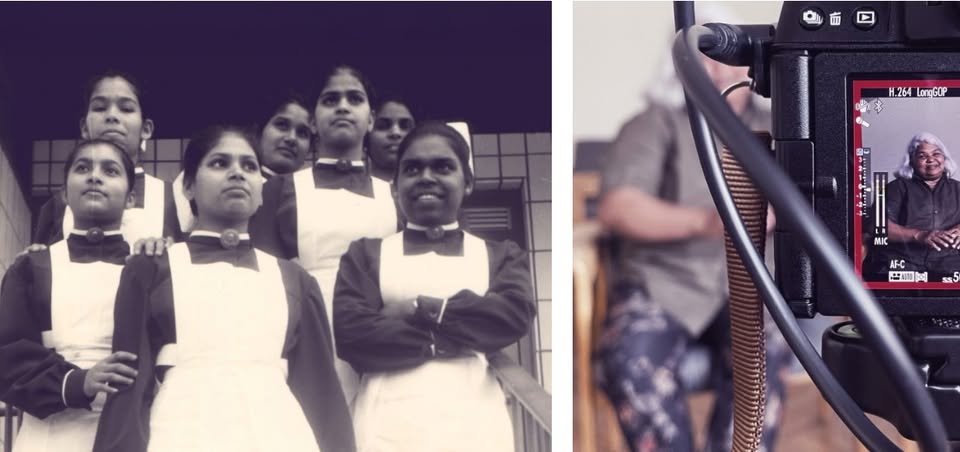
WHO CARED macht diese Geschichten sichtbar: In Videoporträts hält das Online-Archiv die Lebensgeschichten dieser Frauen fest, die vor mehr als 60 Jahren ihre Heimat verließen, um in der Pflege zu arbeiten. Das Besondere: Interviewt werden sie von ihren Kindern, Enkeln oder Nichten und Neffen.
Mit einem Fokus auf Care-Migration aus dem südindischen Kerala, sprechen Urmila Goel und Viola Mattathil-Reuther über die Erforschung dieser Einwanderungsgeschichte – und was wir aus ihr für die Gegenwart lernen können, in der Deutschland wieder vermehrt Menschen aus Indien und anderen Ländern als Pflegekräfte anwirbt. Im Alter von 16 Jahren kam Thressiamma Arackal im Jahr 1975 selbst aus Kerala in die Bundesrepublik, arbeitete 40 Jahre als Krankenpflegerin in Hamm (Westf.) und gründete eine Familie. Bei einem Gespräch mit ihrem Sohn Abhilash berichtet sie von ihren Erfahrungen. Die beiden geben Einblicke in die Archivierungs- und Erinnerungsarbeit von WHO CARED. Dazu gibt es Getränke an der Bar und die passende Musik von Manoj Kurian.
Welche Grenzen zieht Migration zwischen den Erfahrungswelten zweier Generationen? Welche Sehnsüchte prägen sie? Wie schauen die ehemaligen Krankenschwestern auf Pflege, Migration und ihre eigene Geschichte?
Thressiamma Arackals Geschichte und zwei weitere Filme des Projektes sind noch bis Juli in der Ausstellung des Jahresprogramms Beziehungsweise Familie im Humboldt Forum zu sehen.
Mehr Informationen: https://kurzlinks.de/imj5
___
[EN] WHO CARED - Intergenerational Conversations on Belonging and Care Migration
Shortage of care workers and care migration are not new phenomena. As early as the 1960s and 70s, people from abroad were systematically recruited to the Federal Republic of Germany to fill staffing gaps in the care sector. Most of them came from South Korea, the Philippines and India. Their experiences have shaped German history — yet they often remain invisible.
WHO CARED makes these stories visible. In video portraits, the online archive preserves the life stories of the women who left their homes more than 60 years ago to work in care. What makes the project special: they are interviewed by their children, grandchildren, nieces or nephews.
With a focus on care migration from the South Indian state of Kerala, Urmila Goel and Viola Mattathil-Reuther discuss how this migration history can be researched — and what we can learn from it for the present, as Germany once again increasingly recruits people from India and other countries to work in care. At the age of 16, Thressiamma Arackal herself came to the Federal Republic from Kerala in the 1975, worked as a nurse in Hamm (Westphalia) for 40 years and started a family. In a conversation with her son Abhilash, she talks about her experiences. The two provide insights into the archiving and remembrance work of WHO CARED. The talks will be accompanied by music by Manoj Kurian and the bar will be open.
What kinds of boundaries does migration draw between the lived experiences of two generations? What longings shape these lives? How do former nurses look back on care work, migration and their own histories?
Thressiamma Arackal’s story and two additional films from the project can be viewed in the exhibition of the annual programme Family Matters at the Humboldt Forum until July 2026.
Further information: https://kurzlinks.de/whhq
Picture credits: Bild 1: WHO CARED Visual / Späti 09.01.2026 © WHO CARED / Masala Movement e. V.
Bild 2: WHO CARED Interview Behind the Scenes © WHO CARED / Masala Movement e. V.
Ursprüngliche Veranstaltungsquelle
Weitere Veranstaltungen: Humboldt Forum
Veranstaltungen in Berlin heute · Veranstaltungen in Berlin am Wochenende