This event has been ended!
35 rokov hľadania dialógu | diskusia k Nežnej revolúcii
35 years of searching for dialogue | discussion on the Gentle Revolution
Event by: Malý Berlín, Wetzler Institute
Location: Malý Berlín, Štefánikova 94/4, Trnava
About event
Breakthrough events did not take place only in the squares. The abolition of censorship and the creation of a space for social dialogue was decisive for the development of the November events.
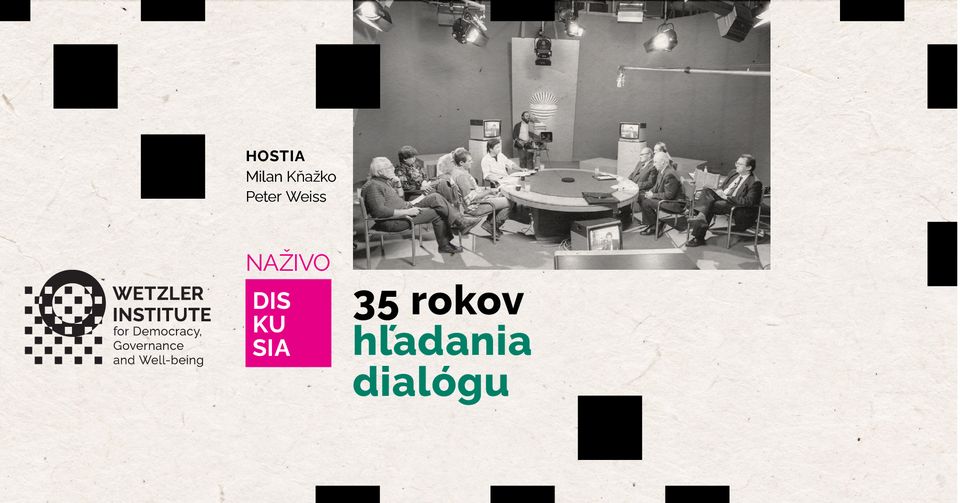
This happened a week after the beginning of November 1989, on November 24, 1989, on Slovak television in the program Studio Dialog. A never-ending effort to cultivate free debate began. After 35 years, the question is: Have we learned to debate? Do we still want to have a dialogue?
:
Jozef Lenč, Wetzler Institute
Jakub Škoda, Wetzler Institute
📅 November 25, 2024 at 7:00 p.m.
📍 Little Berlin, Trnava´
🔑 free entry
▪ ▪ ▪ ▪ ▪ ▪ ▪ ▪ ▪ ▪ ▪ ▪ ▪
🗨️💬 MORE ABOUT THE DISCUSSION TOPIC
The majority of society associates the events of November 1989 with the events at the National Class in Prague, or with public protests in squares across the entire republic. November 1989 was a turning point in the history of Czechoslovakia. After four decades, the rule of one party ended and the Czech-Slovak society got a second chance to create a truly democratic political system built on the protection of civil rights and freedoms.
It is a system in which democracy is a discussion and a mutual dialogue is a way to find solutions to societal problems. The importance of dialogue was shown already at the time of the November events. While in the first week the events had a rather "one-way" trajectory, which took place in the squares, from which appeals to the representatives of the regime resounded, after November 24, 1989, a dialogue between civil society and the political elites of the "departing" regime became part of the "revolutionary" events .
24. November was the day when the ice broke. The first live television broadcast of Studio Dialog was broadcast from the studio of Slovak Television. In its first broadcast, the tribunes of the revolution (Kňažko, Budaj), VPN personalities (Gál, Ondruš) and student representatives (Bombík, Lauko) met on the one hand, and representatives of state enterprises (Šajmír, Chudoba) and institutions linked to the Communist Party (Weiss, Kurucz).
The dictation of the opinions of one party was to be replaced by a dialogue of different perspectives on the future of Czecho-Slovakia. Studio Dialog had a large following. It was a school of democracy. It was the birth of civil society.
Three decades have passed and any dialogue is disappearing from the political discourse. Politicians ignore the debate in the media. The media are becoming the "carriers" of opinions and "truths" and have resigned themselves to the search for them and to moderating the social dialogue, which has turned from discussion to arguments.
Why don't we want to be together, or can't we talk Why have we resigned to what was an essential part of social transformation and is an integral part of democracy? Why, after 35 years, do we no longer want to have a dialogue?
▪ ▪ ▪ ▪ ▪ ▪ ▪ ▪ ▪ ▪ ▪ ▪
🗣️ PETER WEISS
Diplomat and politician, former deputy and vice-chairman of the Slovak National Council.
In the days of the gentle revolution in November 1989, he was present at the STV Dialog Studio, where he represented the communist party and was one of the few communist representatives willing discuss. Opponents of the communists sat opposite him, including Milan Kňažko, Fedor Gál, Ján Budaj and Vladimír Ondruš.
After November 1989, he became an important participant in the political and public discourse on the direction of Slovakia and its integration into international structures. From January 1990 to April 1996, he was the chairman of the Democratic Left Party (SDĽ) and a member of the NR SR. In the years 1992-1994, he was the vice-chairman of the NR SR. In the 1998 parliamentary elections, he was elected as a member of the National People's Congress of the Slovak Republic (SDĽ), but on January 31, 2002, Peter Weiss decided to leave the SDĽ.
After leaving active politics, he worked as a university teacher at the Faculty of International Relations of the University in Bratislava. In the years 2009 – 2013 he was the ambassador of Slovakia to Hungary, since 2013 he was the ambassador to the Czech Republic. Today he works as a political commentator.
🗣️ MILAN KŇAŽKO
Actor, one of the founders of VPN, former minister of culture of the Slovak Republic, former general director of TV JOJ, deputy prime minister, minister of foreign affairs, co-founder of HZDS (1991 ), the Democratic Union and SDKÚ (2000).
Before November 1989, he signed the Petition Several Sentences, drafted by Charter 77 and containing requirements of civil liberty. This limited his acting career. In October 1989, he even returned the title of meritorious artist due to his disagreement with the policies of the communist regime, which was a rare feat at the time.
As a co-founder of VPN, he co-organized and moderated the mass November meetings in Bratislava and also became a member of the VPN Coordinating Committee . After the fall of the communist regime in 1989, Milan Kňažko was an adviser to Czech-Slovak President Václav Havel in Prague and at the same time a member of the Federal Assembly. From June 1990 to August 28, 1990, he was the Minister of International Relations of the Slovak Republic, and in the years 1992-1993, Deputy Prime Minister of the Slovak Republic and Minister of Foreign Affairs of the Slovak Republic. Minister of Culture of the SR. In November 2013, he ran for the presidential elections in 2014. He continues to be active in commenting on political life.
▪ ▪ ▪ ▪ ▪ ▪ ▪ ▪ ▪ ▪ ▪ ▪ ▪
Organizer
Wetzler Institute, Little Berlin
Media partners
trnava-live.sk, trnavskhlas.sk, Trnavské radio, Trnava
photo in graphics: Ivan Rychlo - ČSTK, To the situation in Bratislava - TV dialog. 1989. TASR (from webumenia.sk)