This event has been ended!
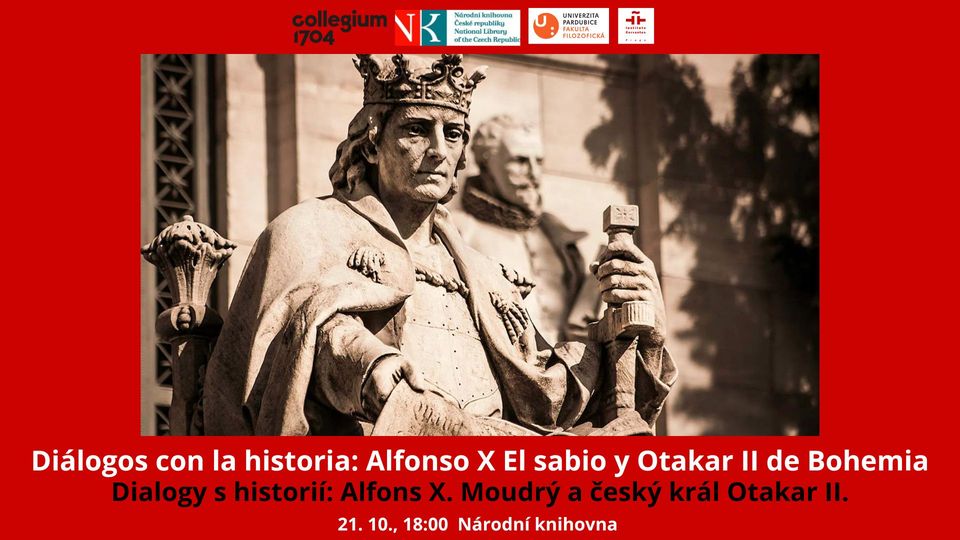
Beseda: Alfons X. Moudrý a český král Otakar II. / Conferencia: Alfonso X y Otakar II
Speech: Alfons X. the Wise and the Czech King Otakar II. / Conference: Alfonso X and Otakar II
Event by: Instituto Cervantes de Praga, Národní knihovna ČR
Location: National Library of the Czech Republic, Mariánské náměstí 5, Praha 1
Discussions and lectures
About event
Alfonso X. the Wise (1221-1284) and Otakar II. Czech (1233-1278) are two essential figures in the history of their countries. Both contemporaries aspired to the crown of the Holy Roman Empire and laid the foundations of civil codes in their countries. Historians Carlos Ayala from the Autonomous University of Madrid and Martin Wihoda from the Masaryk University in Brno will talk about the life and work of both monarchs, as well as the parallels and relationships between their reigns.
Conference in Czech and Spanish with simultaneous translation. Free entry.
This lecture will be followed by the Cantigas de Santa María concert on October 23 in Vzlet. The ensemble Collegium 1704 (Hana Blažíková, Barbora Kabátková, Margit Übellacker and Martin Novák) will perform a selection from the Cantigas de Santa María, the composition of which was overseen by King Alfonso X, known as the Wise, between 1270 and 1290.
Carlos de Ayala Martínez has been a professor of medieval history at the Universidad Autónoma de Madrid since January 2006, and since the same year has held a degree in ecclesiastical studies at the Universidad Pontificia de Comillas. He is the coordinator of the MA in Hispano-American Medieval Studies at the Universidad Autónoma de Madrid (2010-2014) and the coordinator of the PhD in Hispanic Studies: Language, Literature, History and Thought at the UAM (2020-2022). As a researcher, he has participated in six funded projects since 1989 and was the principal investigator of seven projects of the National Research and Development Plan, which related to military orders in the Iberian Peninsula, the genesis and development of the idea of holy war, the religious legitimization of political power and religious violence in the Peninsular Middle Ages . He led a total of 25 introductory research projects and 8 PhD theses, all of which were published, and received six six-year research grants. Coordinator of dozens of international scientific meetings. He is currently co-coordinator of the consolidated research group "Resources, ideologies and power relations in the Peninsular Middle Ages" at the Universidad Autónoma de Madrid (F1-236). He has almost 200 publications to his credit, including books, contributions to books and articles in professional journals.
Martin Wihoda is a Czech historian, a worker at the Institute of History at the Faculty of Philosophy of Masaryk University. He specializes in the medieval history of Central and Western Europe. Martin Wihoda graduated from the gymnasium in Opava and then studied history at the Faculty of Arts of Masaryk University. He continued his doctoral studies at the universities of Brno, Würzburg and Marburg, the Ph.D. in 1999. In 2010, he was appointed professor of general history with a focus on the Middle Ages. Since 2013, he has been a member of the international Society for Stauf History (Gesellschaft für staufische Geschichte) based in Göppingen[clarify]. Since 2017, he has been a member of the scientific board of the Constitutiones et acta publica imperatorum et regum project at the Berlin-Brandenburg Academy of Sciences (Berlin-Brandenburgische Akademie der Wissenschaften). In 2019, he was elected a corresponding member of the management of the Monumenta Germaniae Historica in Munich. Since 2020, he has been a member of the scientific board of the Institute of Saxon History and Ethnography (Institut für Sächsische Geschichte und Volkskunde e.V.) at the Saxon Academy of Sciences in Leipzig. He specializes in the "Europeanization" of the history of Central and Middle Eastern Europe in the Early and High Middle Ages. He collaborates with historians in Germany, Austria, Poland and Hungary.
-----
Diálogos con la historia: Alfonso X «el Sabio» y Otakar II de Bohemia
Alfonso X «el Sabio» (1221-1284) and Otakar II de Bohemia (1233-1278) are two fundamental figures of the history of their respective countries. Being coetáneos, both aspired to the crown of the Sacro Imperio and sat the bases of the civil codes in their countries. The historians Carlos Ayala of the Autonomous University of Madrid and Martín Wihoda of the Masarykova University of Brno will talk about the life and work of the two monarchs, as well as the parallels and relationships between their reigns, in a colloquium moderated by Josef Pazderka.
Por otro lado, el día 23 en Vzlet se podra escuchar, en las voces de Hana Blažíková and Barbora Kabátková, a selection of the Cantigas de Santa María whose composition, between 1270 and 1290, was supervised by el Rey sabio.
Carlos de Ayala Martínez has been Professor of Medieval History at the Autonomous University of Madrid since January 2006, as well as a graduate in Ecclesiastical Studies at the Pontifical University of Comillas since the same year. Coordinator of the Universitario Master in Medieval Hispanic Studies of the Autonomous University of Madrid (2010-2014) and Coordinator of the Doctoral Program in Hispanic Studies: Language, Literature, History and Thought of the UAM (2020-2022). As a researcher, he has participated in six funded projects and has been the IP of the network of the national R+D plan since 1989, todos ellos relativeos a órdenes militaryes en la Península Ibérica, genesis y desarrollo de la idea de guerra santa, legitimación religiosa del poder politico y violencia religiosa en la Edad Media Peninsular. He has directed a total of 25 initiation investigations and 8 doctoral theses, all of which have been published and are in possession of six six-year investigations. Coordinator of a dozen international scientific meetings. Currently, he is co-coordinator of the Consolidated Research Group "Recursos, ideología y relaciones de poder en la Edad Media peninsular" de la Universidad Autónoma de Madrid (F1-236). It has about 200 publications between books, collaborations in books and articles in specialized magazines.
Martin Wihoda is a Czech historian, member of the Historical Institute of the Faculty of Letters of the Masaryk University. He specializes in medieval history of Central and Western Europe. Martin Wihoda graduated at the Opava Institute and studied History at the Faculty of Philosophy and Letters at the Masaryk University. He continued his doctoral studies at the Universities of Brno, Wurzburg and Marburg and became a doctor in 1999. In 2010 he was appointed professor of general history with specialization in the Middle Ages. Since 2013, I am a member of the international Gesellschaft für Staufische Geschichte (Sociedad para la Historia de la Stauff), with headquarters in Göppingen[aclaración necessaria]. Since 2017, I am a member of the scientific council of the Constitutiones et acta publica imperatorum et regum de la Berlin-Brandenburgische Akademie der Wissenschaften (Berlin-Brandenburg Academy of Sciences). In 2019, he was elected a corresponding member of the council of the Monumenta Germaniae Historica de Münich. Since 2020, he is a member of the scientific council of the Instituto de Historia y Etnografía Sajonas (Institut für Saxon Geschichte und Volkskunde e.V.) of the Academia Sajona de Ciencias de Leipzig. His professional interest is the «Europeanization» of the history of central and centro-oriental Europe in the High and High Middle Ages. Collaborate with historians of Germany, Austria, Polonia and Hungary.
Conference in Czech and Spanish with simultaneous translation. Free entry.
This lecture will be followed by the Cantigas de Santa María concert on October 23 in Vzlet. The ensemble Collegium 1704 (Hana Blažíková, Barbora Kabátková, Margit Übellacker and Martin Novák) will perform a selection from the Cantigas de Santa María, the composition of which was overseen by King Alfonso X, known as the Wise, between 1270 and 1290.
Carlos de Ayala Martínez has been a professor of medieval history at the Universidad Autónoma de Madrid since January 2006, and since the same year has held a degree in ecclesiastical studies at the Universidad Pontificia de Comillas. He is the coordinator of the MA in Hispano-American Medieval Studies at the Universidad Autónoma de Madrid (2010-2014) and the coordinator of the PhD in Hispanic Studies: Language, Literature, History and Thought at the UAM (2020-2022). As a researcher, he has participated in six funded projects since 1989 and was the principal investigator of seven projects of the National Research and Development Plan, which related to military orders in the Iberian Peninsula, the genesis and development of the idea of holy war, the religious legitimization of political power and religious violence in the Peninsular Middle Ages . He led a total of 25 introductory research projects and 8 PhD theses, all of which were published, and received six six-year research grants. Coordinator of dozens of international scientific meetings. He is currently co-coordinator of the consolidated research group "Resources, ideologies and power relations in the Peninsular Middle Ages" at the Universidad Autónoma de Madrid (F1-236). He has almost 200 publications to his credit, including books, contributions to books and articles in professional journals.
Martin Wihoda is a Czech historian, a worker at the Institute of History at the Faculty of Philosophy of Masaryk University. He specializes in the medieval history of Central and Western Europe. Martin Wihoda graduated from the gymnasium in Opava and then studied history at the Faculty of Arts of Masaryk University. He continued his doctoral studies at the universities of Brno, Würzburg and Marburg, the Ph.D. in 1999. In 2010, he was appointed professor of general history with a focus on the Middle Ages. Since 2013, he has been a member of the international Society for Stauf History (Gesellschaft für staufische Geschichte) based in Göppingen[clarify]. Since 2017, he has been a member of the scientific board of the Constitutiones et acta publica imperatorum et regum project at the Berlin-Brandenburg Academy of Sciences (Berlin-Brandenburgische Akademie der Wissenschaften). In 2019, he was elected a corresponding member of the management of the Monumenta Germaniae Historica in Munich. Since 2020, he has been a member of the scientific board of the Institute of Saxon History and Ethnography (Institut für Sächsische Geschichte und Volkskunde e.V.) at the Saxon Academy of Sciences in Leipzig. He specializes in the "Europeanization" of the history of Central and Middle Eastern Europe in the Early and High Middle Ages. He collaborates with historians in Germany, Austria, Poland and Hungary.
-----
Diálogos con la historia: Alfonso X «el Sabio» y Otakar II de Bohemia
Alfonso X «el Sabio» (1221-1284) and Otakar II de Bohemia (1233-1278) are two fundamental figures of the history of their respective countries. Being coetáneos, both aspired to the crown of the Sacro Imperio and sat the bases of the civil codes in their countries. The historians Carlos Ayala of the Autonomous University of Madrid and Martín Wihoda of the Masarykova University of Brno will talk about the life and work of the two monarchs, as well as the parallels and relationships between their reigns, in a colloquium moderated by Josef Pazderka.
Por otro lado, el día 23 en Vzlet se podra escuchar, en las voces de Hana Blažíková and Barbora Kabátková, a selection of the Cantigas de Santa María whose composition, between 1270 and 1290, was supervised by el Rey sabio.
Carlos de Ayala Martínez has been Professor of Medieval History at the Autonomous University of Madrid since January 2006, as well as a graduate in Ecclesiastical Studies at the Pontifical University of Comillas since the same year. Coordinator of the Universitario Master in Medieval Hispanic Studies of the Autonomous University of Madrid (2010-2014) and Coordinator of the Doctoral Program in Hispanic Studies: Language, Literature, History and Thought of the UAM (2020-2022). As a researcher, he has participated in six funded projects and has been the IP of the network of the national R+D plan since 1989, todos ellos relativeos a órdenes militaryes en la Península Ibérica, genesis y desarrollo de la idea de guerra santa, legitimación religiosa del poder politico y violencia religiosa en la Edad Media Peninsular. He has directed a total of 25 initiation investigations and 8 doctoral theses, all of which have been published and are in possession of six six-year investigations. Coordinator of a dozen international scientific meetings. Currently, he is co-coordinator of the Consolidated Research Group "Recursos, ideología y relaciones de poder en la Edad Media peninsular" de la Universidad Autónoma de Madrid (F1-236). It has about 200 publications between books, collaborations in books and articles in specialized magazines.
Martin Wihoda is a Czech historian, member of the Historical Institute of the Faculty of Letters of the Masaryk University. He specializes in medieval history of Central and Western Europe. Martin Wihoda graduated at the Opava Institute and studied History at the Faculty of Philosophy and Letters at the Masaryk University. He continued his doctoral studies at the Universities of Brno, Wurzburg and Marburg and became a doctor in 1999. In 2010 he was appointed professor of general history with specialization in the Middle Ages. Since 2013, I am a member of the international Gesellschaft für Staufische Geschichte (Sociedad para la Historia de la Stauff), with headquarters in Göppingen[aclaración necessaria]. Since 2017, I am a member of the scientific council of the Constitutiones et acta publica imperatorum et regum de la Berlin-Brandenburgische Akademie der Wissenschaften (Berlin-Brandenburg Academy of Sciences). In 2019, he was elected a corresponding member of the council of the Monumenta Germaniae Historica de Münich. Since 2020, he is a member of the scientific council of the Instituto de Historia y Etnografía Sajonas (Institut für Saxon Geschichte und Volkskunde e.V.) of the Academia Sajona de Ciencias de Leipzig. His professional interest is the «Europeanization» of the history of central and centro-oriental Europe in the High and High Middle Ages. Collaborate with historians of Germany, Austria, Polonia and Hungary.