This event has been ended!
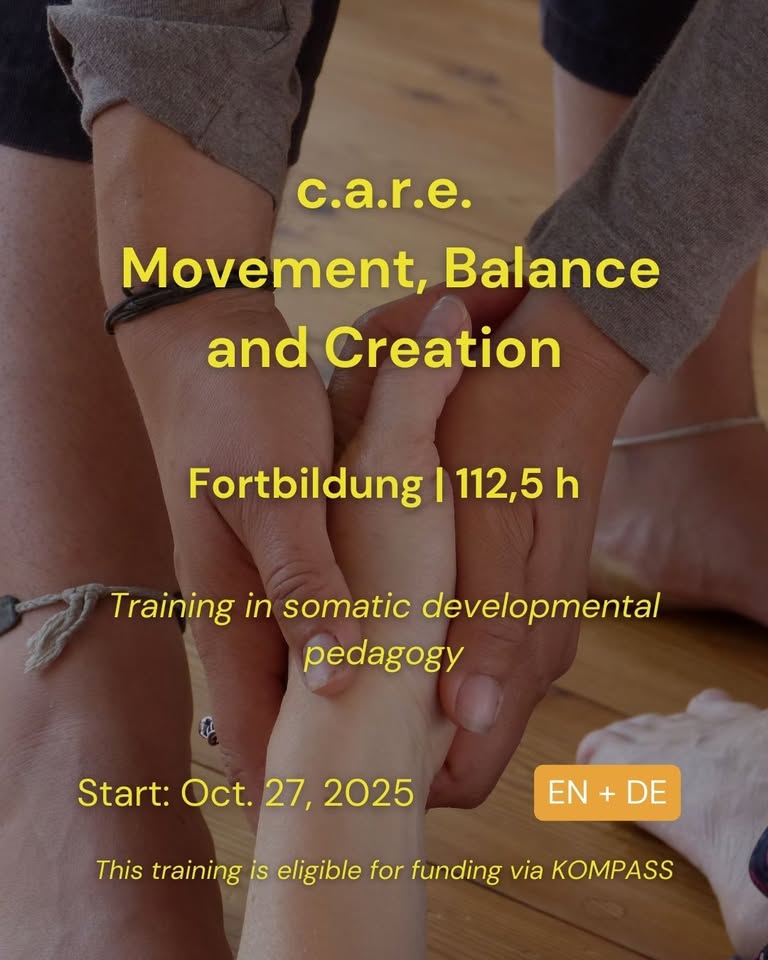
c.a.r.e. Movement, Balance and Creation
Event by: Somatische Akademie Berlin
Location: Paul-Lincke-Ufer 30, Paul-Lincke-Ufer 30, Berlin - Bezirk Friedrichshain-Kreuzberg
Tickets: Get tickets
Talks & discussions, For children
About event
c.a.r.e. Movement, Balance and Creation
Training in somatic developmental pedagogy
📅 October 27 2025 – April 3 2026
🕗10:00 - 17:30 h
💬 EN + DE
👤 Heike Kuhlmann
👤 Adalisa Menghini
👤 Ka Rustler
🎟 This training is eligible for funding via KOMPASS
🔗EN: https://tinyurl.com/care2710en
🔗DE: https://tinyurl.com/care2710de
c.a.r.e. is an advanced training for the orientation of pedagogical work towards basic somatic knowledge in the context of human development (focus: child and adolescent phase).
At the heart of c.a.r.e.- movement, balance and creation is an understanding of the human development process.
By working with early childhood reflexes, embryonic development and the basics of self-regulation, dysfunctional survival strategies can be recognized and participants can be offered movement activities that strengthen functional movement patterns and resilience.
In the three modules, participants gain expertise on the development of the child and adolescent phase and in particular the neuroplasticity of the brain through movement and learning, the neurochemistry (the hormonal aspects) of perception as well as liveliness and embodied creativity.
The modules are based on human development in the infant, child and adolescent phases and delve into specific content.
Benefit of the training
Participants acquire a sound embodied knowledge of the human development process, particularly in the child and adolescent phase.
They gain a fundamental knowledge of age-specific developmental processes based on findings from neuroscience, education, psychology and somatics.
Principles of the following somatic methods are incorporated:
🔸 Feldenkrais Method
🔸 Body-Mind Centering®
🔸 Authentic Movement
🔸 Improvisation
🔸 Contact Improvisation
🔸 INPP (Neurophysiological Psychology)
In the somatic methods, content is experienced practically.
Lessons include anatomical information and theoretical background knowledge that is explored through movement, touch, group and partner work.
The practical instructions serve an embodied understanding of the material. The training also leads to a deeper, subtle experience of one's own body.
The somatic-embodied penetration of the principles of somatic approaches is the prerequisite for their further transmission.
Participants acquire basic developmental knowledge that aligns their pedagogical approach with somatic work.
They learn how to incorporate this into practical teaching in their own teaching experiences.
They improve their teaching skills with the help of various feedback methods.
Using observation and analysis methods, they learn to read the participants' body language and adapt their teaching to this analysis.
To complete the course, they design a teaching sequence, observe 10 lessons and complete a case study.
Participation is certified upon successful completion (teaching a somatic lesson, 10 observations, case study).
Curriculum:
3 modules à 5 days, each from 10:00am - 05:30pm
● Module 1
Oct 27 - Oct 31, 2025 | Embodied transformation - neuroplasticity in movement and learning
🔸 Movement as an integral part of the learning process
🔸 Movement observation and analysis
🔸 Recognizing compensation patterns and adaptations
🔸 Practical tools and contextual applications
🔸 Emotional regulation and nervous system balance
🔸 Embodied development approach
🔸 Case studies from various fields of practice
● Module 2
Jan 31 - Feb 04, 2026 | Motivation, connection & vitality - neurochemistry and perception
🔸Neurotransmitters and their influence on behavior and emotion
🔸Neuroendocrinology of the brain
🔸Endorphins and the biology of liveliness
🔸Functions and effects of dopamine, serotonin and oxytocin
🔸Neurochemistry of motivation and commitment
🔸Emotional regulation and brain chemistry
🔸Touch and sexuality
🔸Attachment and neurobiological dynamics
🔸Perception in the mirror of neurochemical states
🔸Embodied practice to experience neurochemical states
🔸Fields of application in therapy, education and development
● Module 3
Mar 30 - Apr 03, 2026 | Embodied creativity - imagination & expression
🔸Creativity as a transformative process - from impulse to tangible form of expression
🔸Somatic tools for imagination and movement
🔸Creative leadership in therapy, education and group work
🔸Stability and flexibility in dynamic contexts
🔸Connecting perception, movement and expression
🔸Vitality and self-efficacy in creative processes
🔸Holistic support in professional roles
🔸Maintaining and cultivating creativity in complex systems
Who is this training course for?
The training is aimed at people who would like to go into the further teaching and application of somatic movement offers with a specialization in human development processes. In particular, professionals from therapeutic, educational and social occupational fields are addressed.
This training is eligible for funding via KOMPASS, a program of the Federal Ministry of Labour and Social Affairs. It supports self-employed people in becoming crisis-proof and future-proof through further qualifications. Please check first whether you are eligible for KOMPASS funding
Price:
2300€
📍Somatische Akademie Berlin
Paul-Lincke-Ufer 30
10999 Berlin | side building
1st backyard
4th floor
—-------------------
c.a.r.e.- Bewegung, Balance und Gestaltung ist eine Fortbildung zur Ausrichtung pädagogischer Arbeit an somatischen Grundkenntnissen im Kontext der menschlichen Entwicklung (Schwerpunkt: Kinder- und Jugendphase).
Im Zentrum von c.a.r.e.- Bewegung, Balance und Gestaltung steht das Verständnis des menschlichen Entwicklungs-prozesses.
Durch die Arbeit mit frühkindlichen Reflexen, embryonaler Entwicklung und den Grundlagen der Selbstregulation können dysfunktionale Überlebensstrategien erkannt werden und Teilnehmenden Bewegungsangebote gemacht werden, die funktionale Bewegungsmuster und Resilienz stärken.
In den drei Modulen erlangen die Teilnehmenden eine Expertise über die Entwicklung der Kinder- und Jugendphase und dabei speziell der Neuroplastizität des Gehirns durch Bewegung und Lernen, die Neurochemie (die hormonalen Aspekte) von Wahrnehmung sowie Lebendigkeit und verkörperter Kreativität.
Die Module orientieren sich an der menschlichen Entwicklung der Säuglings-, Kinder- und Jugendphase und vertiefen spezifische Inhalte.
Benefit der Fortbildung c.a.r.e.- Bewegung, Balance und Gestaltung
Die Teilnehmenden erlangen ein fundiertes verkörpertes Wissen über den menschlichen Entwicklungsprozess, insbesondere in der Kinder- und Jugendphase.
Sie gewinnen ein grundlegendes Wissen altersspezifischer Entwicklungsprozesse basierend auf Erkenntnissen der Neurowissenschaften, Pädagogik, Psychologie und Somatik. Prinzipien der folgenden somatische Methoden fließen ein:
🔸Feldenkrais Methode
🔸 Body-Mind Centering®
🔸Authentic Movement
🔸Improvisation
🔸 Contact Improvisation
🔸INPP (Neurophysiologische Psychologie)
In den somatischen Methoden werden Inhalte praktisch erfahren. Unterricht beinhaltet sowohl anatomische Informationen, theoretisches Hintergrundwissen, das in Bewegung, in Berührung, in der Gruppe und in Partner*innenarbeit erkundet wird.
Die praktischen Anleitungen dienen einem verkörperten Verständnis des Materials.
Die Fortbildung führt auch zu einem tieferen, feinen Erleben des eigenen Körpers. Die somatisch-verkörperte Durchdringung der Prinzipien somatischer Ansätze stellt vielmehr die Voraussetzung für deren Weitervermittlung dar.
Die Teilnehmenden erlangen ein entwicklungsbezogenes Grundwissen, das ihre pädagogische Herangehensweise an somatischer Arbeit ausrichtet.
Sie erlernen diese in die praktische Vermittlung in eigenen Unterrichtserfahrungen einzubauen.
Mit Hilfe von unterschiedlichen Feedbackmethoden verbessern sie ihre unterrichtenden Fähigkeiten.
Durch Beobachtungs- und Analysemethoden lernen sie die Teilnehmenden in ihrer Körpersprache zu lesen und den Unterricht dieser Analyse entsprechend auszurichten.
Für den Abschluss konzipieren sie eine Unterrichtssequenz, hospitieren in 10 Stunden und absolvieren eine Fallstudie.
Die Teilnahme wird nach erfolgreichem Abschluss zertifiziert (Unterricht einer somatischen Stunde, 10 Hospitationen, Fallstudie).
Curriculum der Fortbildung in somatischer entwicklungsbezogener Pädagogik
3 Module à 5 Tage, jeweils von 10:00 Uhr - 17:30 Uhr
● Modul 1
27.-31.10.2025 | Verkörperte Transformation - Neuroplastizität in Bewegung und Lernen
🔸Gehirnentwicklung und Neuroplastizität durch Bewegung
🔸Bewegung als integraler Bestandteil des Lernprozesses
🔸Bewegungsbeobachtung und -analyse
🔸Erkennen von Kompensationsmustern und Anpassungen
🔸Praxisnahe Werkzeuge und kontextuelle Anwendungen
🔸Emotionale Regulation und Nervensystembalance
🔸Verkörperter Entwicklungszugang
🔸Fallbeispiele diverser Praxisfelder
● Modul 2
31.01.-04.02.2026 | Motivation, Verbindung & Lebendigkeit - Neurochemie und Wahrnehmung
🔸Neurotransmitter und ihr Einfluss auf Verhalten und Emotion
🔸Neuroendokrinologie des Gehirns
🔸Endorphine und die Biologie der Lebendigkeit
🔸Funktionen und Wirkungen von Dopamin, Serotonin und 🔸Oxytocin
🔸Neurochemie von Motivation und Engagement
🔸Emotionale Regulation und Hirnchemie
🔸Berührung und Sexualität
🔸Bindung und neurobiologische Dynamiken
🔸Wahrnehmung im Spiegel neurochemischer Zustände
🔸Verkörperte Praxis zur Erfahrung neurochemischer Zustände
🔸Anwendungsfelder in Therapie, Bildung und Entwicklung
● Modul 3
30.03.-03.04.2026 | Verkörperte Kreativität - Imagination & Ausdruck
🔸Kreativität als transformierender Prozess - vom Impuls zur greifbaren Ausdrucksform
🔸Somatische Werkzeuge für Imagination und Bewegung
🔸Kreative Führung in Therapie, Bildung und Gruppenarbeit
🔸Stabilität und Flexibilität in dynamischen Kontexten
🔸Verbindung von Wahrnehmung, Bewegung und Ausdruck
🔸Lebendigkeit und Selbstwirksamkeit in kreativen Prozessen
🔸Ganzheitliche Begleitung in professionellen Rollen
🔸Kreativität erhalten und kultivieren in komplexen Systemen
Für wen ist diese Fortbildung?
Die Fortbildung richtet sich an Personen, die in die Weitervermittlung und Anwendung von somatischen Bewegungsangeboten mit einer Spezialisierung auf menschliche Entwicklungsprozesse gehen möchten. Dabei werden insbesondere Fachkräfte aus therapeutischen, pädagogischen und sozialen Berufsfeldern angesprochen.
Diese Fortbildung ist förderfähig mit KOMPASS (Kompakte Hilfe für Solo-Selbstständige) als Programm des Bundesministeriums für Arbeit und Soziales. Es unterstützt Solo-Selbstständige, sich krisenfest und zukunftssicher durch weitere Qualifizierungen aufzustellen. Prüfe bitte zuerst, ob die KOMPASS-Förderung für dich möglich ist.
#CARETraining #SomaticEducation #EmbodiedDevelopment #HumanDevelopmentProcess #ChildAndAdolescentDevelopment #MovementBalanceCreation #SelfRegulationSkills #BuildingResilience #NeuroplasticityAndLearning #NeurochemistryOfPerception #FeldenkraisMethod #BodyMindCentering #AuthenticMovement #ImprovisationPractice #PedagogicalSomatics