This event has been ended!
Caminito Del Rey
Caminito del Rey
Event by: Caminhando.pt
Location: Estação do Oriente, Av. Dom João II, Lisboa
Tickets: Get tickets
About event
Event: Caminito Del Rey
Realization Date: 1 to 4 May 2025
Registration deadline: March 20 2025
Event Description: "Walking on the El Torcal, Ronda, sevenil de las bodegas, seville and anthellet"
Ticket Del Rey with guided tour
In this activity proposal we will walk and visit some of the most fabulous places in Andalusia, among them the famous Caminito Del Rey. We will also make a panoramic visit to Seville, just as we will visit Ronda, one of the ex-libris of this region. Still time to meet Setenil de Las Bodegas, another mandatory point of the Blancos Pueblos Route and finally a stop in the famous Roman Italic ruins, and his magnificent Roman amphitheater, the scene of "War of Thrones". It will be a wide-end weekend full of strong emotions and landscapes to remember for a long time. Come so with us!
These will be some of the most important places of our script:
- Walk at Caminito Del Rey
- Panoramic Visit in Seville
- Walk at El Torcal de Antequera Natural Park
- In Antique Tour
- Setenil de Las Bodegas
In the Roman city of Italics (the most important of the Iberian Peninsula)
Natural Landscapes
Time: Lisbon at 6:30 am
Return: Arrival to Lisbon at 20:30
Caminito del Rey
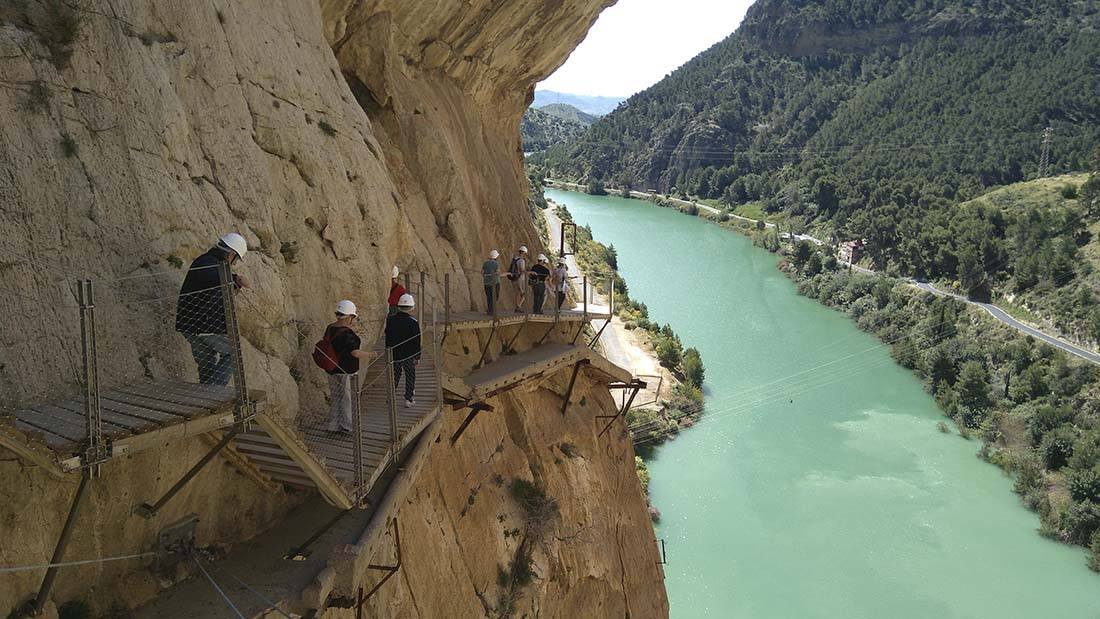
The path is a seven -kilometer passage, almost air and vertiginous, created by man in the paraicles Cry and worker, north of Malaga. It was built in 1905 because the workers of a hydroelectric plant needed a passage, and it was as archaic as its use, made by unraveling - until a king had to cross to inaugurate the dam, and thus earned his name. Over the years, it has been abandoned, collapsing or partially slipping at some points and became a danger, being closed after the death of four tourists between 1999 and 2000.
Its total length is 7.7 kilometers, of which three kilometers are in a walkway and five on track. Going to it in full lasts three to four hours and is considered of average difficulty, with the caveat that by its characteristics still involves some danger and should be done by people with capacity to do so. Also, even before you start, there is a good walk to get there, and it is going up. For example, children under eight are not allowed.
Seville
Seville is one of the most history cities in the world. From there came much of the largest Spanish navigators (and other Portuguese but at the service of the reis of Spain), such as Christopher Colombo or Fernão Magalhães to discover the new world.
Plaza de España, whose half-moon form is traveled by beautiful buggies. Most of the buildings were built for the Ibero-American exhibition of 1929. South of Plaza de España is the green parque de María Luisa, a vast green space full of paths that intersect, birds to swim in the lakes and palaces hidden behind trees. We can also take a walk along the bank of the Guadalquivir River, to observe the river watchman - the Del Oro Tower (Gold Tower), built by the Moors and later used as a prison and warehouse for the treasures brought from the Americas. Its historical complex is made up of more than fifty monuments and buildings that dates back to the Bronze Age, as evidenced by the Cueva de Menga, the Viera and Romeral Dolmen. Crowned by the Castle and the Basilica of Santa Maria, through her old city, there are high school churches, convents, palaces, arches, gates, hermits, manorial houses and a citadel. Among all stands of the Palace of Nájera (18th century), which today is the Municipal Museum; The Catalinas Convent or the Marqueses de La Peña Palace of Mudéjar and Renaissance. In the heart of Andalusia there is a pearl hidden in a sea of limestone landscapes. It's called Ronda. Almost hung in a rocky promontory, the city is separated in two parts, by the “cannon of El Tajo”, a limestone canyon where the Guadalevin river, the old and new part. Malaga is known for its unusual forms of relief and is one of the most impressive charsic landscapes in all of Europe. It has several pedestrian tracks of great beauty, which we will naturally go through.
round
In the heart of Andalusia there is a pearl hidden in a sea of limestone landscapes. It's called Ronda. Almost hanging from a rocky promontory, the city is separated into two parts by the “Cannon of El Tajo”, a limestone canyon where the Guadalevin river, the old and the new part is in place. In the old part it is worth traveling some streets, where we can find the Palace of Mondagón, the Palace of the Marquis of Salvatierra, the house of King Mouro (Casa Del Rey Moro or the Mother Church. In the modern part, stands out the viewer of the National Parador of Ronda, as well as the Alameda del Tajo Park, both with stunning views. Bodegas
Setenil de Las Bodegas is one of the most amazing places of Andalusia. The village was built in the middle and under a huge rock. Originality of the urban layout, which descends from the castle adapting to the river path. People have been settled under the rocks to escape the heat of summer and the strict cold of winter, since it is a place naturally protected by the rock. The houses that have been built over time are painted in shades of white and some streets have a stone in place of the sky. The two busiest streets in the city are Cuevas Del Sol, so called because it is south and receives a lot of light, and La Shadow Cuevas, covered entirely by the presence of the suspended stone between the two lines of white -packed buildings. The castle, located in the upper part of the city, was built between the fourteenth and fifteenth centuries and, since 1985, has been considered Spanish historical heritage. In it were born two great emperors, Trajan and Adriano. With a capacity of 25000 people, the Italic amphitheater was one of the largest in the Roman world, only losing to the Colosseum in Rome and to the Capua amphitheater in Italy. Nowadays, Italics served as a scenario for several series and films, being the most important, the War of Thrones. In the famous series, The Ruins of the Amphitheater are Dragonpit, the Dragon Pit. Alcazar, Cathedral, among others.
- 5:30 pm- Output to Antique
- 7:30 pm- Accommodation and Dinner
May 2nd (Friday)
- 8:30 pm- Hotel's Hotel
- 10:30 am- Caminito Del Rey
- 13:30 pm TORCAL
- 3:30 pm- Visit to the Interpretation and Walking Center at Natural Park
- 7:30 pm- Accommodation and Dinner
May 3rd (Saturday)
- 8h30- Breakfast at the Hotel
- 10h- Walk/Tour for the most important tourist spots: Palace of Monndogón, Marquês de Salvatier, Casa de Salvatier King Moor, the Mother Church, Arab walls and gates of the city, Plaza Duchess of Parcent, Gardens de Cuenca and Viewpoint of Aldehuela and Balcón Del Cono
- 13h - Free Lunch
- 14h - Started to Setenil de Las Bodegas
- 15h - Setenil Tour
May 4 (Sunday)
- 7:30 am - breakfast at the Hotel
- 8:30 am - Exit to the Roman city of Italics (Santiponce - Seville)
- 10:45 am - Visit to Roman italics
- 13h - Lunch Free
- 14h - Exit to Lisbon
- 20h30 - Lisbon
Equipment: Suitable Footwear and Clothing For Walks
Registration Fee:
The value includes:
- bus from Lisbon to each of the places described earlier
- Transportation to the places of each walk and accommodation
- 3 nights of 4-star hotel, with buffet buffet hotel, with buffet hotel Included
- 3 buffet dinners (drinks: water and wine included - 1/2 bottle per person). Coffee Not Included
- The Proposal Accommodation option includes various types of rooms
- Caminito Del Rey entry ticket
- Guide and Monitoring Walks
- Mandatory Insurance
450 € (Price per person in double room)
550 € (Price per person in individual room)
Input value for reservation of place: 100 €
Valid prices until the end of February 2025. From then on the values are € 500 and 600 € respectively
notes:
a) Registration is limited and accommodation options limited to the availability existing at the time of the reserve. Personalized
Registration at www, walking.pt
Realization Date: 1 to 4 May 2025
Registration deadline: March 20 2025
Event Description: "Walking on the El Torcal, Ronda, sevenil de las bodegas, seville and anthellet"
Ticket Del Rey with guided tour
In this activity proposal we will walk and visit some of the most fabulous places in Andalusia, among them the famous Caminito Del Rey. We will also make a panoramic visit to Seville, just as we will visit Ronda, one of the ex-libris of this region. Still time to meet Setenil de Las Bodegas, another mandatory point of the Blancos Pueblos Route and finally a stop in the famous Roman Italic ruins, and his magnificent Roman amphitheater, the scene of "War of Thrones". It will be a wide-end weekend full of strong emotions and landscapes to remember for a long time. Come so with us!
These will be some of the most important places of our script:
- Walk at Caminito Del Rey
- Panoramic Visit in Seville
- Walk at El Torcal de Antequera Natural Park
- In Antique Tour
- Setenil de Las Bodegas
In the Roman city of Italics (the most important of the Iberian Peninsula)
Natural Landscapes
Time: Lisbon at 6:30 am
Return: Arrival to Lisbon at 20:30
Caminito del Rey
The path is a seven -kilometer passage, almost air and vertiginous, created by man in the paraicles Cry and worker, north of Malaga. It was built in 1905 because the workers of a hydroelectric plant needed a passage, and it was as archaic as its use, made by unraveling - until a king had to cross to inaugurate the dam, and thus earned his name. Over the years, it has been abandoned, collapsing or partially slipping at some points and became a danger, being closed after the death of four tourists between 1999 and 2000.
Its total length is 7.7 kilometers, of which three kilometers are in a walkway and five on track. Going to it in full lasts three to four hours and is considered of average difficulty, with the caveat that by its characteristics still involves some danger and should be done by people with capacity to do so. Also, even before you start, there is a good walk to get there, and it is going up. For example, children under eight are not allowed.
Seville
Seville is one of the most history cities in the world. From there came much of the largest Spanish navigators (and other Portuguese but at the service of the reis of Spain), such as Christopher Colombo or Fernão Magalhães to discover the new world.
Plaza de España, whose half-moon form is traveled by beautiful buggies. Most of the buildings were built for the Ibero-American exhibition of 1929. South of Plaza de España is the green parque de María Luisa, a vast green space full of paths that intersect, birds to swim in the lakes and palaces hidden behind trees. We can also take a walk along the bank of the Guadalquivir River, to observe the river watchman - the Del Oro Tower (Gold Tower), built by the Moors and later used as a prison and warehouse for the treasures brought from the Americas. Its historical complex is made up of more than fifty monuments and buildings that dates back to the Bronze Age, as evidenced by the Cueva de Menga, the Viera and Romeral Dolmen. Crowned by the Castle and the Basilica of Santa Maria, through her old city, there are high school churches, convents, palaces, arches, gates, hermits, manorial houses and a citadel. Among all stands of the Palace of Nájera (18th century), which today is the Municipal Museum; The Catalinas Convent or the Marqueses de La Peña Palace of Mudéjar and Renaissance. In the heart of Andalusia there is a pearl hidden in a sea of limestone landscapes. It's called Ronda. Almost hung in a rocky promontory, the city is separated in two parts, by the “cannon of El Tajo”, a limestone canyon where the Guadalevin river, the old and new part. Malaga is known for its unusual forms of relief and is one of the most impressive charsic landscapes in all of Europe. It has several pedestrian tracks of great beauty, which we will naturally go through.
round
In the heart of Andalusia there is a pearl hidden in a sea of limestone landscapes. It's called Ronda. Almost hanging from a rocky promontory, the city is separated into two parts by the “Cannon of El Tajo”, a limestone canyon where the Guadalevin river, the old and the new part is in place. In the old part it is worth traveling some streets, where we can find the Palace of Mondagón, the Palace of the Marquis of Salvatierra, the house of King Mouro (Casa Del Rey Moro or the Mother Church. In the modern part, stands out the viewer of the National Parador of Ronda, as well as the Alameda del Tajo Park, both with stunning views. Bodegas
Setenil de Las Bodegas is one of the most amazing places of Andalusia. The village was built in the middle and under a huge rock. Originality of the urban layout, which descends from the castle adapting to the river path. People have been settled under the rocks to escape the heat of summer and the strict cold of winter, since it is a place naturally protected by the rock. The houses that have been built over time are painted in shades of white and some streets have a stone in place of the sky. The two busiest streets in the city are Cuevas Del Sol, so called because it is south and receives a lot of light, and La Shadow Cuevas, covered entirely by the presence of the suspended stone between the two lines of white -packed buildings. The castle, located in the upper part of the city, was built between the fourteenth and fifteenth centuries and, since 1985, has been considered Spanish historical heritage. In it were born two great emperors, Trajan and Adriano. With a capacity of 25000 people, the Italic amphitheater was one of the largest in the Roman world, only losing to the Colosseum in Rome and to the Capua amphitheater in Italy. Nowadays, Italics served as a scenario for several series and films, being the most important, the War of Thrones. In the famous series, The Ruins of the Amphitheater are Dragonpit, the Dragon Pit. Alcazar, Cathedral, among others.
- 5:30 pm- Output to Antique
- 7:30 pm- Accommodation and Dinner
May 2nd (Friday)
- 8:30 pm- Hotel's Hotel
- 10:30 am- Caminito Del Rey
- 13:30 pm TORCAL
- 3:30 pm- Visit to the Interpretation and Walking Center at Natural Park
- 7:30 pm- Accommodation and Dinner
May 3rd (Saturday)
- 8h30- Breakfast at the Hotel
- 10h- Walk/Tour for the most important tourist spots: Palace of Monndogón, Marquês de Salvatier, Casa de Salvatier King Moor, the Mother Church, Arab walls and gates of the city, Plaza Duchess of Parcent, Gardens de Cuenca and Viewpoint of Aldehuela and Balcón Del Cono
- 13h - Free Lunch
- 14h - Started to Setenil de Las Bodegas
- 15h - Setenil Tour
May 4 (Sunday)
- 7:30 am - breakfast at the Hotel
- 8:30 am - Exit to the Roman city of Italics (Santiponce - Seville)
- 10:45 am - Visit to Roman italics
- 13h - Lunch Free
- 14h - Exit to Lisbon
- 20h30 - Lisbon
Equipment: Suitable Footwear and Clothing For Walks
Registration Fee:
The value includes:
- bus from Lisbon to each of the places described earlier
- Transportation to the places of each walk and accommodation
- 3 nights of 4-star hotel, with buffet buffet hotel, with buffet hotel Included
- 3 buffet dinners (drinks: water and wine included - 1/2 bottle per person). Coffee Not Included
- The Proposal Accommodation option includes various types of rooms
- Caminito Del Rey entry ticket
- Guide and Monitoring Walks
- Mandatory Insurance
450 € (Price per person in double room)
550 € (Price per person in individual room)
Input value for reservation of place: 100 €
Valid prices until the end of February 2025. From then on the values are € 500 and 600 € respectively
notes:
a) Registration is limited and accommodation options limited to the availability existing at the time of the reserve. Personalized
Registration at www, walking.pt