This event has been ended!
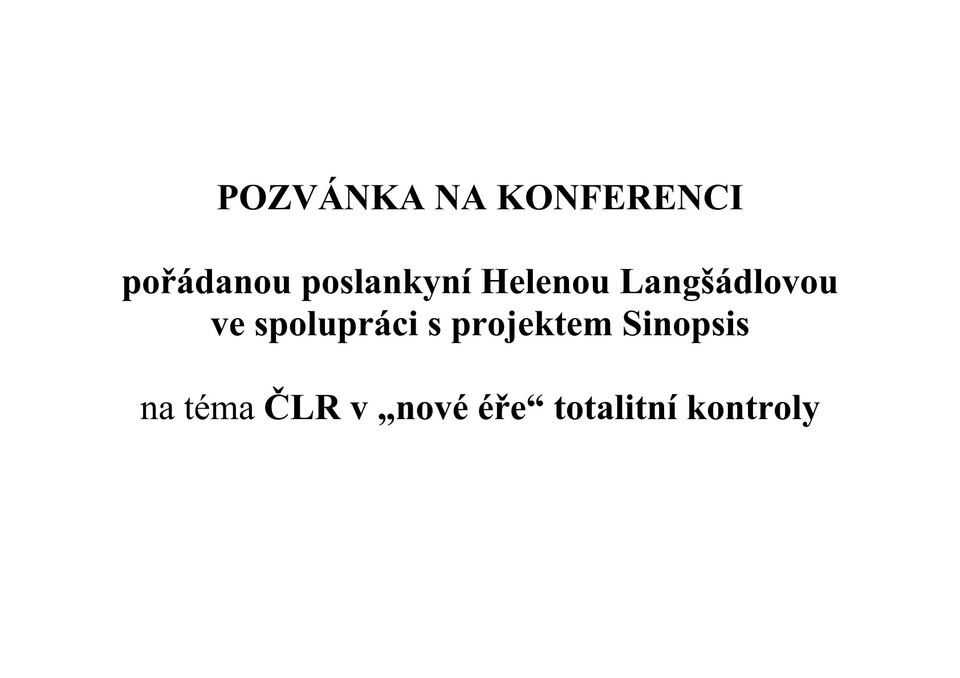
ČLR v „nové éře“ totalitní kontroly
PRC in the "new era" of totalitarian control
Event by: Helena Langšádlová - poslankyně
Location: Malostranské nám. 7/19, Malostranské náměstí 19, Praha 1
Talks & discussions
About event
Program
Introductory block
14:00 - 14:05 - Introductory word - Helena Langšádlová, MEP PSP ČR
14:05 - 2 pm Panel - situation in "autonomous areas"
14:20 - 14:30 - Hong Kong - Martin Hála, project director of Sinopsis
15:00 - 15:10 - The situation of Christians/Church - Simona Fantová, Sinopsis project
15:10 - 15:20 - technology used to control the population - Filip Jirouš, analyst
15:20 - 15:35 Panel - personal experience of PRC Libřický, Ministry of Foreign Affairs
16:10 - 16:20 - Experience from the academic environment - Michaela Schusová, English teacher, CTU
16:20 - 16:50 - Discussion
Summary and conclusion
16:50 - 17:00 It is necessary to confirm participation in e-mail: [email protected] no later than 10. 3. 2025.
Input to the building is only possible with a valid identity card.
Annotation
safety. We know from available information that China does not hesitate to follow its own citizens, use hard repression against opponents of the regime and abuse the work of Chinese companies abroad. (TOP 09) in cooperation with the Sinopsis project.
Since the advent of the Secretary General and President Si Jinjinga, there is an increasingly significant reduction in freedoms in China in 2012. This affects both the majority of the Chan's population and above all ethnic minorities. According to the official definition, the basic feature of the so -called new era is the "complete control of the Communist Party". In many ways, the PRC returns to political conditions before the Teng Siao-Pching reforms and opening with the world. Particular control of all areas of public life, to a large extent and the economy is strengthened. Many states and international organizations have identified events in Sinjiang as genocide or crimes against humanity.
The repressive policy of the Chinese government in Tibet has similar features in some respects and includes hard state control, suppression of cultural and religious identity and extensive supervision systems. In Tibet, however, the indoctrination of the population takes place in a different way, for example through boarding schools or forced relocation of nomads within the "campaign against poverty", which aims to destroy the social links of the population and gain more control over the communities. It is also significant to manage the religious life of the population.
The situation in Hong Kong is also alarming. This special administrative area (SAR) received international high degree of autonomy and freedom for 50 years after the handover of China in 1997. In 2020, however, Beijing adopted the "State Security Act", which in fact ended this autonomy and radically changed the local legal environment. The result was the closure of independent media or the persecution of journalists, activists and politicians, many of whom were released from office, imprisoned or forced to go to exile. What are the conditions in individual parts of China today? How does the development of technology participate in the control of the population? Martin Hála, director of the Sinopsis project, will also talk about this at the conference, especially in the context of the so -called autonomous areas, or Dr. Ondřej Klimeš and Dr. Jarmila Ptáčková from the Oriental Institute of the Academy of Sciences of the Czech Republic. Among other things, journalist Tomáš Etzler will share his direct experience from China. Experience from the academic environment is mediated by Michaela Schusová, head of the Institute of Languages of the Faculty of Mechanical Engineering CTU.
Introductory block
14:00 - 14:05 - Introductory word - Helena Langšádlová, MEP PSP ČR
14:05 - 2 pm Panel - situation in "autonomous areas"
14:20 - 14:30 - Hong Kong - Martin Hála, project director of Sinopsis
15:00 - 15:10 - The situation of Christians/Church - Simona Fantová, Sinopsis project
15:10 - 15:20 - technology used to control the population - Filip Jirouš, analyst
15:20 - 15:35 Panel - personal experience of PRC Libřický, Ministry of Foreign Affairs
16:10 - 16:20 - Experience from the academic environment - Michaela Schusová, English teacher, CTU
16:20 - 16:50 - Discussion
Summary and conclusion
16:50 - 17:00 It is necessary to confirm participation in e-mail: [email protected] no later than 10. 3. 2025.
Input to the building is only possible with a valid identity card.
Annotation
safety. We know from available information that China does not hesitate to follow its own citizens, use hard repression against opponents of the regime and abuse the work of Chinese companies abroad. (TOP 09) in cooperation with the Sinopsis project.
Since the advent of the Secretary General and President Si Jinjinga, there is an increasingly significant reduction in freedoms in China in 2012. This affects both the majority of the Chan's population and above all ethnic minorities. According to the official definition, the basic feature of the so -called new era is the "complete control of the Communist Party". In many ways, the PRC returns to political conditions before the Teng Siao-Pching reforms and opening with the world. Particular control of all areas of public life, to a large extent and the economy is strengthened. Many states and international organizations have identified events in Sinjiang as genocide or crimes against humanity.
The repressive policy of the Chinese government in Tibet has similar features in some respects and includes hard state control, suppression of cultural and religious identity and extensive supervision systems. In Tibet, however, the indoctrination of the population takes place in a different way, for example through boarding schools or forced relocation of nomads within the "campaign against poverty", which aims to destroy the social links of the population and gain more control over the communities. It is also significant to manage the religious life of the population.
The situation in Hong Kong is also alarming. This special administrative area (SAR) received international high degree of autonomy and freedom for 50 years after the handover of China in 1997. In 2020, however, Beijing adopted the "State Security Act", which in fact ended this autonomy and radically changed the local legal environment. The result was the closure of independent media or the persecution of journalists, activists and politicians, many of whom were released from office, imprisoned or forced to go to exile. What are the conditions in individual parts of China today? How does the development of technology participate in the control of the population? Martin Hála, director of the Sinopsis project, will also talk about this at the conference, especially in the context of the so -called autonomous areas, or Dr. Ondřej Klimeš and Dr. Jarmila Ptáčková from the Oriental Institute of the Academy of Sciences of the Czech Republic. Among other things, journalist Tomáš Etzler will share his direct experience from China. Experience from the academic environment is mediated by Michaela Schusová, head of the Institute of Languages of the Faculty of Mechanical Engineering CTU.