This event has been ended!
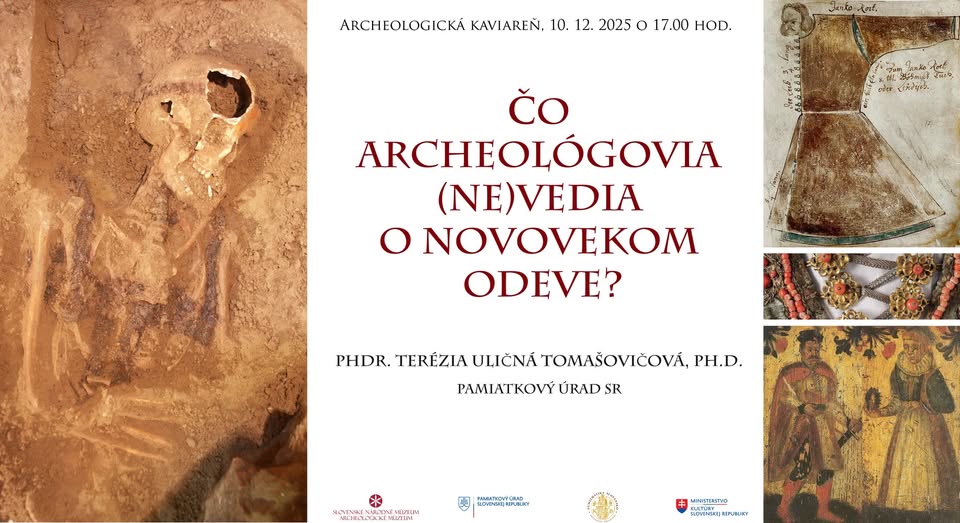
Čo archeológovia (ne)vedia o novovekom odeve?
What do archaeologists (not) know about modern clothing?
Event by: Archeologická kaviareň
Location: Slovenské národné múzeum - Archeologické múzeum, Žižkova 12, Bratislava - Staré Mesto
Topics: History
About event
The last lecture of the Archaeological Café in 2025 (on Wednesday, December 10) will have a festive feel. Its topic will be the clothing of the modern period, i.e. primarily of the Renaissance and Baroque in Hungary, and its multidisciplinary research. Archaeologist PhDr. will talk about this topic. Terézia Uličná Tomašovičová, Ph.D. from the Monuments Office of the Slovak Republic. It specializes in the research of clothing and clothing accessories in the modern era using several scientific fields, but also in their reconstructions - either by hand (beautiful replicas/reconstructions of clothes of the Hungarian nobility) or in cooperation with a jeweler (jewelry and clothing accessories), which also contribute to new findings about old techniques.
About the beautiful and interesting work of dr. You can learn more about Uličná Tomašovičová in a short report on this link (from about 10:30 a.m.): https://www.stvr.sk/televizia/archiv/14130/562627#631
Annotation of lecture:
During the course of history, clothing was a tool of social representation defining the image of a specific individual as a unique individuality and at the same time as a member of a certain social group.
In order to be able to correctly identify and interpret individual textile and non-textile finds related to clothing originating from our territory, it is necessary to understand its symbolic dimension, chronological development, composition and transformations of its individual elements and components in the context of the Central European development of the time fashion. So what did "Hungarian clothing" look like? How did it differ from the fashion worn in neighboring countries?
During the 16th and 17th centuries. several impulses, transformed in their own unique way, enriched with the domestic aesthetic and artistic craft tradition, resulted in the formation of a new way of dressing, which acquired a relatively uniform character throughout the territory of Hungary. For many decades and even centuries, Hungarian clothing became not only a symbol of one's own aesthetic ideas, but also a specific element of national identity and a symbolic representative of various self-identification efforts and pragmatic demands.
The problem of a targeted study of this issue is not only the researched material itself, which in most cases has been preserved in the form of fragments, but also the mutual overlap of individual scientific fields that are affected by this topic. In addition to archaeological findings, what sources can we use to study clothing? How objective are they? Research into the social, cultural and symbolic function of clothing in the modern era is still insufficient, and this source is not used in a way that would fully encompass its informative potential. As part of the lecture, we will focus on the expressive possibilities of modern clothing as a research subject, but also possible mistakes and misinterpretations resulting from the inappropriate use of this unique source. Entrance fee €3 (payable at the SNM - Archaeological Museum cash desk, payment only possible in cash).
For the traditional fantastic Bratislava rolls, we thank our lovely sponsors from OZ Numizmatika Slovensko :)
About the beautiful and interesting work of dr. You can learn more about Uličná Tomašovičová in a short report on this link (from about 10:30 a.m.): https://www.stvr.sk/televizia/archiv/14130/562627#631
Annotation of lecture:
During the course of history, clothing was a tool of social representation defining the image of a specific individual as a unique individuality and at the same time as a member of a certain social group.
In order to be able to correctly identify and interpret individual textile and non-textile finds related to clothing originating from our territory, it is necessary to understand its symbolic dimension, chronological development, composition and transformations of its individual elements and components in the context of the Central European development of the time fashion. So what did "Hungarian clothing" look like? How did it differ from the fashion worn in neighboring countries?
During the 16th and 17th centuries. several impulses, transformed in their own unique way, enriched with the domestic aesthetic and artistic craft tradition, resulted in the formation of a new way of dressing, which acquired a relatively uniform character throughout the territory of Hungary. For many decades and even centuries, Hungarian clothing became not only a symbol of one's own aesthetic ideas, but also a specific element of national identity and a symbolic representative of various self-identification efforts and pragmatic demands.
The problem of a targeted study of this issue is not only the researched material itself, which in most cases has been preserved in the form of fragments, but also the mutual overlap of individual scientific fields that are affected by this topic. In addition to archaeological findings, what sources can we use to study clothing? How objective are they? Research into the social, cultural and symbolic function of clothing in the modern era is still insufficient, and this source is not used in a way that would fully encompass its informative potential. As part of the lecture, we will focus on the expressive possibilities of modern clothing as a research subject, but also possible mistakes and misinterpretations resulting from the inappropriate use of this unique source. Entrance fee €3 (payable at the SNM - Archaeological Museum cash desk, payment only possible in cash).
For the traditional fantastic Bratislava rolls, we thank our lovely sponsors from OZ Numizmatika Slovensko :)
Events in Bratislava today · Events in Bratislava this weekend