This event has been ended!
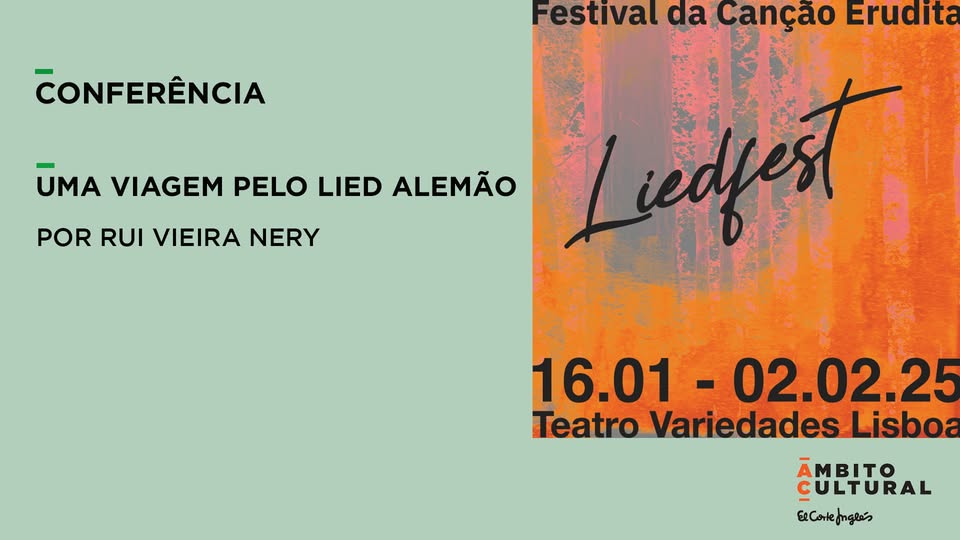
Conferência Uma Viagem Pelo Lied Alemão, por Rui Vieira Nery
Conference A Journey Through German Lied, by Rui Vieira Nery
Event by: Âmbito Cultural El Corte Inglés Lisboa
Location: El Corte Inglés, Avenida António Augusto de Aguiar 31, Lisboa
About event
Link to register: https://ambito-cultural.elcorteingles.pt /agendas/conferencia-uma-viagem-pelo-lied-alemao-por-rui-vieira-nery/
The Scope Cultural Center at El Corte Inglés is pleased to invite you to the Conference Uma Viagem Pelo Lied Alemão, by Rui Vieira Nery, to be held on January 14th at 6:30 pm, in the Cultural Scope Room at El Corte Inglés in Lisbon.
Synopsis
For almost two centuries, between the end of the 18th century and the middle of the 20th century, the Lied for singing and piano constituted one of the most significant genres of German classical music. With Haydn and Mozart, he started from the appreciation of traditional rural song and the legacy of the Lutheran choir. With Beethoven and Schubert, forms and harmonies became more complex, and the Lied asserted itself as a recognized exponent of Germanic cultural identity itself. With Schumann, Mendelssohn and Brahms, the piano increasingly became a determining partner in musical discourse, in a dialogue between peers with the voice. With Mahler, the instrumental component was extended to include the orchestra. With Wolf and Richard Strauss, the romantic tradition would reach its final peak in this genre, before the song took the path of Modernism, through the pen of Berg, Weil or Henze. Along the way, these composers crossed paths with some of the greatest poets of all time in the German language, from Goethe, Heine, Eichendorff, Rückert or Mörike to Dehmel, Rilke, Brecht or Hesse.
The Scope Cultural Center at El Corte Inglés is pleased to invite you to the Conference Uma Viagem Pelo Lied Alemão, by Rui Vieira Nery, to be held on January 14th at 6:30 pm, in the Cultural Scope Room at El Corte Inglés in Lisbon.
Synopsis
For almost two centuries, between the end of the 18th century and the middle of the 20th century, the Lied for singing and piano constituted one of the most significant genres of German classical music. With Haydn and Mozart, he started from the appreciation of traditional rural song and the legacy of the Lutheran choir. With Beethoven and Schubert, forms and harmonies became more complex, and the Lied asserted itself as a recognized exponent of Germanic cultural identity itself. With Schumann, Mendelssohn and Brahms, the piano increasingly became a determining partner in musical discourse, in a dialogue between peers with the voice. With Mahler, the instrumental component was extended to include the orchestra. With Wolf and Richard Strauss, the romantic tradition would reach its final peak in this genre, before the song took the path of Modernism, through the pen of Berg, Weil or Henze. Along the way, these composers crossed paths with some of the greatest poets of all time in the German language, from Goethe, Heine, Eichendorff, Rückert or Mörike to Dehmel, Rilke, Brecht or Hesse.