This event has been ended!
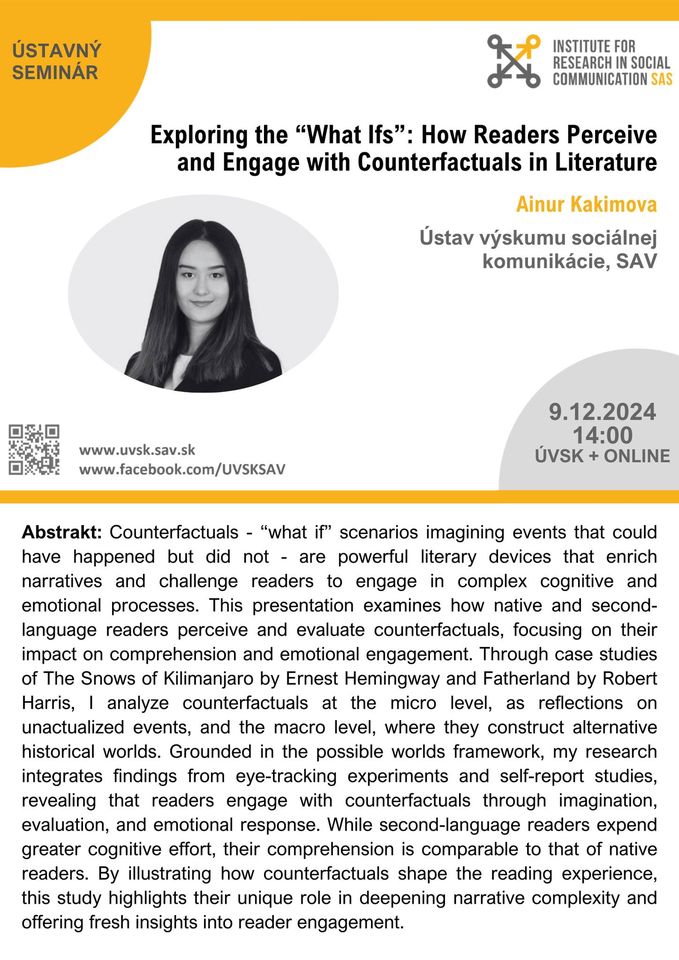
Exploring the “What Ifs”: How Readers Perceive and Engage with Counterfactuals in Literature
Event by: Ústav výskumu sociálnej komunikácie SAV, verejná výskumná inštitúcia
Location: Slovenská akadémia vied, Dúbravská cesta 9, Bratislava - Karlova Ves
Online event
Talks & discussions
About event
Dear colleagues,
We cordially invite you to the institutional seminar entitled "Exploring the “What Ifs": How Readers Perceive and Engage with Counterfactuals in Literature", where our colleague Ainur Kakimova from our institute will present the results of her dissertation work in which she investigated how readers perceive "what if" scenarios in literature, depending on whether they read in their native language or in another language. The seminar will be in English.
Please pass this information on to your colleagues. The seminar will take place on 9/12/2024 at 14:00 in a hybrid form (ÚVSK + online). If you are interested in online participation, please fill out a simple form: https://forms.gle/mcKCWzFN2kTPXTpp8
At the latest on the day of the seminar Access data for the online meeting will be sent to you. The maximum number of participants outside ÚVSK SAS is 50 people.
Dear colleagues,
You are cordially invited to the Institute's seminar entitled "Exploring the "What Ifs": How Readers Perceive and Engage with Counterfactuals in Literature". Our colleague Ainur Kakimova will present the results of her dissertation, in which she investigated how both native and second-language readers perceive and evaluate counterfactuals, with a focus on their impact on comprehension and emotional engagement.
Please feel free to pass this information to your colleagues. The workshop will take place on 9/12/2024 at 14:00 in a hybrid format (UVSK + online). If you are interested in online participation, please fill in the simple form: https://forms.gle/mcKCWzFN2kTPXTpp8
You will receive the access data for the online meeting on the day of the seminar. The maximum number of participants outside the UVSK SAV is 50 people.
Abstract: Counterfactuals - “what if” scenarios imagining events that could have happened but did not - are powerful literary devices that enrich narratives and challenge readers to engage in complex cognitive and emotional processes. This presentation examines how native and second-language readers perceive and evaluate counterfactuals, focusing on their impact on comprehension and emotional engagement. Through case studies of The Snows of Kilimanjaro by Ernest Hemingway and Fatherland by Robert Harris, I analyze counterfactuals at the micro level, as reflections on unactualized events, and the macro level, where they construct alternative historical worlds. Grounded in the possible worlds framework, my research integrates findings from eye-tracking experiments and self-report studies, revealing that readers engage with counterfactuals through imagination, evaluation, and emotional response. While second-language readers expend greater cognitive effort, their comprehension is comparable to that of native readers. By illustrating how counterfactuals shape the reading experience, this study highlights their unique role in deepening narrative complexity and offering fresh insights into reader engagement.
We cordially invite you to the institutional seminar entitled "Exploring the “What Ifs": How Readers Perceive and Engage with Counterfactuals in Literature", where our colleague Ainur Kakimova from our institute will present the results of her dissertation work in which she investigated how readers perceive "what if" scenarios in literature, depending on whether they read in their native language or in another language. The seminar will be in English.
Please pass this information on to your colleagues. The seminar will take place on 9/12/2024 at 14:00 in a hybrid form (ÚVSK + online). If you are interested in online participation, please fill out a simple form: https://forms.gle/mcKCWzFN2kTPXTpp8
At the latest on the day of the seminar Access data for the online meeting will be sent to you. The maximum number of participants outside ÚVSK SAS is 50 people.
Dear colleagues,
You are cordially invited to the Institute's seminar entitled "Exploring the "What Ifs": How Readers Perceive and Engage with Counterfactuals in Literature". Our colleague Ainur Kakimova will present the results of her dissertation, in which she investigated how both native and second-language readers perceive and evaluate counterfactuals, with a focus on their impact on comprehension and emotional engagement.
Please feel free to pass this information to your colleagues. The workshop will take place on 9/12/2024 at 14:00 in a hybrid format (UVSK + online). If you are interested in online participation, please fill in the simple form: https://forms.gle/mcKCWzFN2kTPXTpp8
You will receive the access data for the online meeting on the day of the seminar. The maximum number of participants outside the UVSK SAV is 50 people.
Abstract: Counterfactuals - “what if” scenarios imagining events that could have happened but did not - are powerful literary devices that enrich narratives and challenge readers to engage in complex cognitive and emotional processes. This presentation examines how native and second-language readers perceive and evaluate counterfactuals, focusing on their impact on comprehension and emotional engagement. Through case studies of The Snows of Kilimanjaro by Ernest Hemingway and Fatherland by Robert Harris, I analyze counterfactuals at the micro level, as reflections on unactualized events, and the macro level, where they construct alternative historical worlds. Grounded in the possible worlds framework, my research integrates findings from eye-tracking experiments and self-report studies, revealing that readers engage with counterfactuals through imagination, evaluation, and emotional response. While second-language readers expend greater cognitive effort, their comprehension is comparable to that of native readers. By illustrating how counterfactuals shape the reading experience, this study highlights their unique role in deepening narrative complexity and offering fresh insights into reader engagement.