This event has been ended!
Female Cadence: Ewa Wanat (Polen) mit dem Ola Blachno Quartet
Female Cadence: Ewa Wanat (Poland) with the Ola Blachno Quartet
Event by: Jazz am Helmholtzplatz e.V.
Location: Brotfabrik Berlin, Caligariplatz 1, Berlin - Bezirk Pankow
Tickets: Get tickets
About event
Thursday, December 11, 2025, 8 p.m., Brotfabrik, Caligariplatz 1, 13086 Berlin, entrance fee 18-12 euros. Box office from 7:30 p.m. (cash only), presale via Eventbrite.
Link to Eventbrite:https://www.eventbrite.de/e/1975344794455?
EWA WANAT (NOVI SINGERS), POLAND
presented by
OLA BLACHNO QUARTET
Ola Blachno – vocals
Arseny Rykov – piano
Christian Müller – bass
Johannes Metzger – drums
Ewa Wanat (*1942) was one of the leading voices of the Polish jazz scene of the 1960s and 1970s and a founding member of the renowned vocal group Novi Singers. The group, whose name stands for “New Original Vocal Instruments,” was founded in Warsaw in 1964 by five music students and was known for its innovative use of the human voice as an instrument. In addition to Wanat, Bernard Kawka, Janusz Mych, Waldemar Parzyński and Aleksander Głuch were among the founding members. The Novi Singers combined singing with instrumental virtuosity. Wanat, originally a violinist, contributed significantly to the group's characteristic sound with her soprano and versatility. A central feature of their music was the eschewing of lyrics in favor of scat singing, maximizing improvisation and expressiveness. Wanat emphasized: “Above all, we found the human voice a perfect jazz instrument, and the possibilities in sound, expression and interpretation were unlimited.” In the 1950s and 1960s, vocal ensembles were very popular.
At a time when jazz in Poland was seen as a symbol of Western values and was often viewed as subversive, the music of the Novi Singers was an act of cultural self-assertion, but also managed to evade censorship. The group performed at major events including the Jazz Jamboree in Warsaw, the International Jazz Festival in Zurich and, most notably, the Newport Jazz Festival in the USA, which brought them international recognition. Albums like Bossa Nova (1967) and Rien Ne Va Plus (1973) show their stylistic diversity and innovative strength. The political situation in Poland was characterized by severe restrictions on artistic freedom. Jazz was often perceived as “forbidden fruit”. However, Wanat and the Novi Singers used music as an expression of personal and collective freedom. The conscious avoidance of lyrics and the focus on scat singing were both an artistic decision and a subtle political statement.
After Bernard Kawka's withdrawal in 1973 and the group's subsequent dissolution in 1985, Ewa Wanat remained faithful to the music. She continued to perform and had a lasting impact on the Polish jazz scene. Her commitment and artistic integrity make her a key figure in Polish jazz and a symbol of the power of music as an expression of freedom and resistance.
OLA BLACHNO
Ola Błachno is a Polish jazz singer, composer, lyricist and violinist who now works in Berlin. She began her musical training with the violin and attended music schools in Warsaw (Skrzypce and others) as well as jazz singing studies at the Jazz Institute in Berlin, among others. Her debut album How To Be Me was released in 2019; She leads her own projects such as the Ola Błachno Quartet and the Ola Błachno Octet. She performs regularly at jazz festivals and competitions, has received several awards (e.g. prizes at the Novum Jazz Festival, Jazz nad Odrą, Ladies' Jazz Festival) and is a scholarship holder (including the Elsa-Neumann scholarship). She is currently working on a new octet album called “Warschauer Straße”, which combines jazz with vocals, electronics and string quartet. https://ola.blachno.pl/
MICHAŁ AFTYKA
Michał Aftyka is a Polish double bassist and composer who is one of the young voices of jazz in Poland. He completed his training in jazz double bass in Warsaw and Katowice and is currently also a doctoral student at the Music Academy in Wrocław. His quintet released their debut album Frukstract in 2023, with which he won the Fryderyk Award as “Jazzowy Debiut Roku”; The album was also internationally received and nominated. In addition to his quintet, he is involved in projects such as the Amalia Umeda Quartet, the JAH Trio and collaborations with Ola Błachno. https://www.deutscher-jazzpreis.de/award-category/debuet-album-des-jahr-international/
ARSENY RYKOV
Arseny Rykov is a Russian pianist and composer based in Berlin. His style combines impressionistic timbres with contemporary jazz and a penchant for subtle interaction. He leads his own trio, performs in a duo with Mathilde Vendramin and has a broad network in the Berlin jazz scene. Concert appearances took him to clubs like Donau115 or to festivals. Further information: https://www.instagram.com/arseny_rykov?igsh=MXZvNGZueGdrZGxzdQ==
JOHANNES METZGER
Johannes Metzger is a drummer and composer based in Berlin. He studied jazz drums at the Jazz Institute Berlin and at the Hannover University of Music, Theater and Media with teachers such as John Hollenbeck, Jim Black, Oliver Steidle, etc. Metzger has recorded over 20 albums and is regularly active at national and international festivals, including Elbjazz, Jazzbaltica, Leverkusener Jazztage, etc. As a bandleader, he published FRAMES (2022) and How Far? feat. Benjamin Schaefer (2023) with his quartet; also the album Orange Sky with his septet formation CAPTCHA. He is a multiple winner of various jazz awards (e.g. Munich Jazz Award, Hannover Jazz Award, Future Sounds Contest). www. johannes-metzger.com
Background:
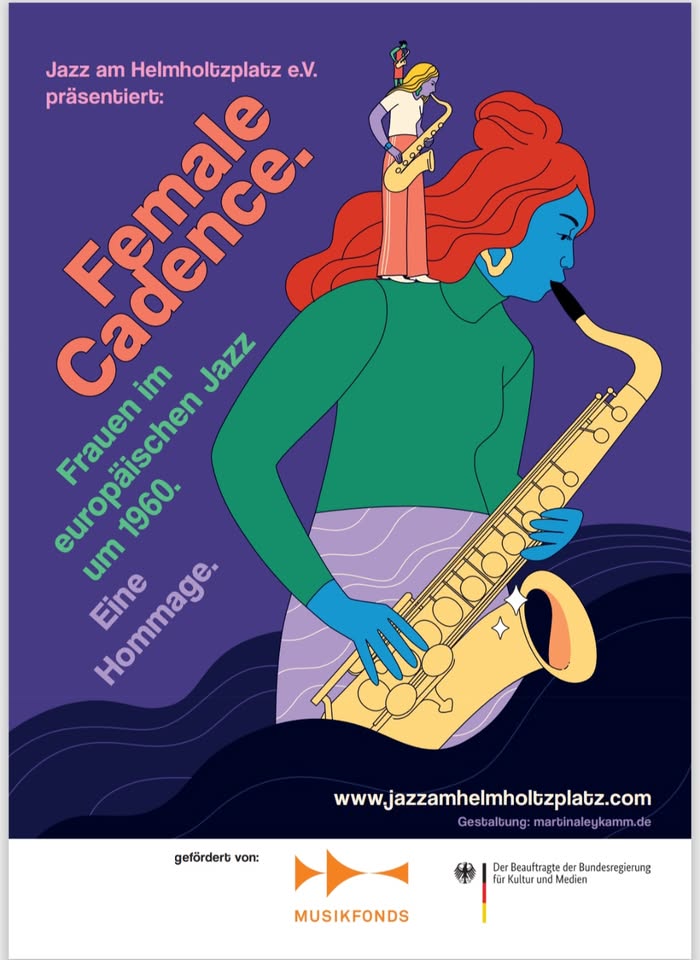
Female Cadence: Women in European Jazz around 1960 (October 2025 - January 2026) is dedicated to forgotten female musicians who had a decisive influence on jazz in Europe. The focus is on artists such as Lolita Garrido (Spain), Pia Beck (Netherlands), Colette Magny (France), German Tülay (Turkey), Kathy Stobart (Great Britain) and Ewa Wanat (Poland).
The project brings these artists back into the public consciousness by introducing Berlin musicians such as Olga Reznichenko, Mathilde Vendramin, Lucia Boffo, Pinar Tatlikazan, Birgitta Flick and Ola Blachno and their ensembles reinterpret, transcribe and combine works by these women with their own artistic positions. This creates a dialogue between the past and the present, between politically motivated music history and today's jazz avant-garde.
In addition to six concerts in venues such as the Brotfabrik and the Kubiz Raoul Wallenberg, the series includes lectures and a program booklet. A podcast will then be created. This makes female jazz history lastingly visible and at the same time opens up a discourse about the social conditions of these musicians - patriarchal structures and authoritarian regimes come into focus. The aim is also to take a look at today's conditions in jazz and to present current artistic positions of female jazz and improvisational music musicians.
The concert series is intended as a contribution to making forgotten female biographies visible and as a reflection on the extent to which artistic expression and social protest are intertwined then and now.
Funded by the Musikfonds e.V. with funds from the Federal Government Commissioner for Culture and Media.
Idea and implementation: Regina Câmara
Link to Eventbrite:https://www.eventbrite.de/e/1975344794455?
EWA WANAT (NOVI SINGERS), POLAND
presented by
OLA BLACHNO QUARTET
Ola Blachno – vocals
Arseny Rykov – piano
Christian Müller – bass
Johannes Metzger – drums
Ewa Wanat (*1942) was one of the leading voices of the Polish jazz scene of the 1960s and 1970s and a founding member of the renowned vocal group Novi Singers. The group, whose name stands for “New Original Vocal Instruments,” was founded in Warsaw in 1964 by five music students and was known for its innovative use of the human voice as an instrument. In addition to Wanat, Bernard Kawka, Janusz Mych, Waldemar Parzyński and Aleksander Głuch were among the founding members. The Novi Singers combined singing with instrumental virtuosity. Wanat, originally a violinist, contributed significantly to the group's characteristic sound with her soprano and versatility. A central feature of their music was the eschewing of lyrics in favor of scat singing, maximizing improvisation and expressiveness. Wanat emphasized: “Above all, we found the human voice a perfect jazz instrument, and the possibilities in sound, expression and interpretation were unlimited.” In the 1950s and 1960s, vocal ensembles were very popular.
At a time when jazz in Poland was seen as a symbol of Western values and was often viewed as subversive, the music of the Novi Singers was an act of cultural self-assertion, but also managed to evade censorship. The group performed at major events including the Jazz Jamboree in Warsaw, the International Jazz Festival in Zurich and, most notably, the Newport Jazz Festival in the USA, which brought them international recognition. Albums like Bossa Nova (1967) and Rien Ne Va Plus (1973) show their stylistic diversity and innovative strength. The political situation in Poland was characterized by severe restrictions on artistic freedom. Jazz was often perceived as “forbidden fruit”. However, Wanat and the Novi Singers used music as an expression of personal and collective freedom. The conscious avoidance of lyrics and the focus on scat singing were both an artistic decision and a subtle political statement.
After Bernard Kawka's withdrawal in 1973 and the group's subsequent dissolution in 1985, Ewa Wanat remained faithful to the music. She continued to perform and had a lasting impact on the Polish jazz scene. Her commitment and artistic integrity make her a key figure in Polish jazz and a symbol of the power of music as an expression of freedom and resistance.
OLA BLACHNO
Ola Błachno is a Polish jazz singer, composer, lyricist and violinist who now works in Berlin. She began her musical training with the violin and attended music schools in Warsaw (Skrzypce and others) as well as jazz singing studies at the Jazz Institute in Berlin, among others. Her debut album How To Be Me was released in 2019; She leads her own projects such as the Ola Błachno Quartet and the Ola Błachno Octet. She performs regularly at jazz festivals and competitions, has received several awards (e.g. prizes at the Novum Jazz Festival, Jazz nad Odrą, Ladies' Jazz Festival) and is a scholarship holder (including the Elsa-Neumann scholarship). She is currently working on a new octet album called “Warschauer Straße”, which combines jazz with vocals, electronics and string quartet. https://ola.blachno.pl/
MICHAŁ AFTYKA
Michał Aftyka is a Polish double bassist and composer who is one of the young voices of jazz in Poland. He completed his training in jazz double bass in Warsaw and Katowice and is currently also a doctoral student at the Music Academy in Wrocław. His quintet released their debut album Frukstract in 2023, with which he won the Fryderyk Award as “Jazzowy Debiut Roku”; The album was also internationally received and nominated. In addition to his quintet, he is involved in projects such as the Amalia Umeda Quartet, the JAH Trio and collaborations with Ola Błachno. https://www.deutscher-jazzpreis.de/award-category/debuet-album-des-jahr-international/
ARSENY RYKOV
Arseny Rykov is a Russian pianist and composer based in Berlin. His style combines impressionistic timbres with contemporary jazz and a penchant for subtle interaction. He leads his own trio, performs in a duo with Mathilde Vendramin and has a broad network in the Berlin jazz scene. Concert appearances took him to clubs like Donau115 or to festivals. Further information: https://www.instagram.com/arseny_rykov?igsh=MXZvNGZueGdrZGxzdQ==
JOHANNES METZGER
Johannes Metzger is a drummer and composer based in Berlin. He studied jazz drums at the Jazz Institute Berlin and at the Hannover University of Music, Theater and Media with teachers such as John Hollenbeck, Jim Black, Oliver Steidle, etc. Metzger has recorded over 20 albums and is regularly active at national and international festivals, including Elbjazz, Jazzbaltica, Leverkusener Jazztage, etc. As a bandleader, he published FRAMES (2022) and How Far? feat. Benjamin Schaefer (2023) with his quartet; also the album Orange Sky with his septet formation CAPTCHA. He is a multiple winner of various jazz awards (e.g. Munich Jazz Award, Hannover Jazz Award, Future Sounds Contest). www. johannes-metzger.com
Background:
Female Cadence: Women in European Jazz around 1960 (October 2025 - January 2026) is dedicated to forgotten female musicians who had a decisive influence on jazz in Europe. The focus is on artists such as Lolita Garrido (Spain), Pia Beck (Netherlands), Colette Magny (France), German Tülay (Turkey), Kathy Stobart (Great Britain) and Ewa Wanat (Poland).
The project brings these artists back into the public consciousness by introducing Berlin musicians such as Olga Reznichenko, Mathilde Vendramin, Lucia Boffo, Pinar Tatlikazan, Birgitta Flick and Ola Blachno and their ensembles reinterpret, transcribe and combine works by these women with their own artistic positions. This creates a dialogue between the past and the present, between politically motivated music history and today's jazz avant-garde.
In addition to six concerts in venues such as the Brotfabrik and the Kubiz Raoul Wallenberg, the series includes lectures and a program booklet. A podcast will then be created. This makes female jazz history lastingly visible and at the same time opens up a discourse about the social conditions of these musicians - patriarchal structures and authoritarian regimes come into focus. The aim is also to take a look at today's conditions in jazz and to present current artistic positions of female jazz and improvisational music musicians.
The concert series is intended as a contribution to making forgotten female biographies visible and as a reflection on the extent to which artistic expression and social protest are intertwined then and now.
Funded by the Musikfonds e.V. with funds from the Federal Government Commissioner for Culture and Media.
Idea and implementation: Regina Câmara