This event has been ended!
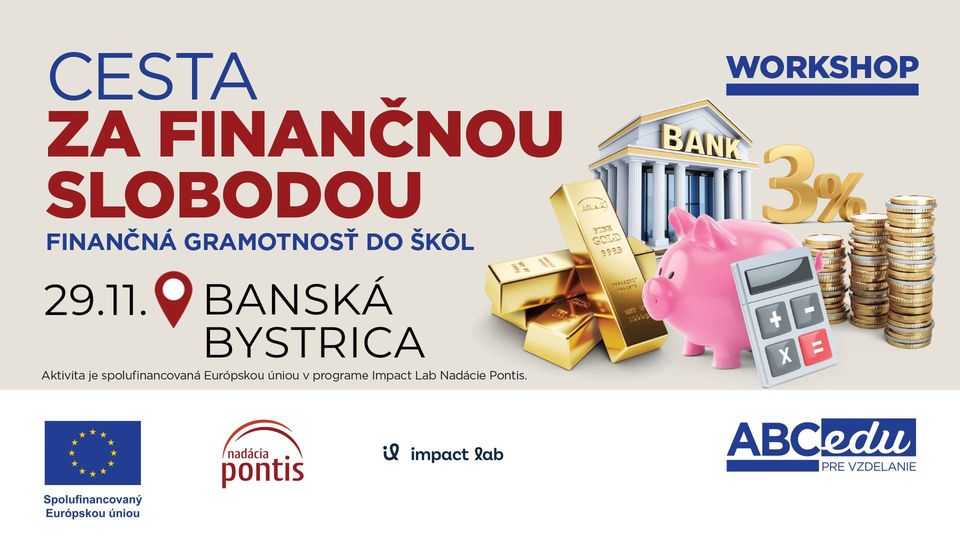
Finančná gramotnosť do škôl
Financial literacy for schools
Event by: ABCedu
Location: The Blend, Rudohorská 6736/35, Banská Bystrica
Talks & discussions
About event
For primary and secondary school teachers.
Registration:
http s://docs.google.com/forms/d/e/1FAIpQLSdae5ecZzZ5CoyIe8YLe8teW9YkumnXf4-2gVFnp_eZivxSXw/viewform
How affects the FINANCIAL LITERACY of pupils and students?
How to best use knowledge and experience in real life?
Which skills are important for effective financial management?
Pupils' financial responsibility and increasing knowledge in the areas of financial literacy of teachers are the main topics of the seminar in terms of the National Standard of Financial Literacy. We emphasize the practical use of knowledge and its connection with situations from real life, in a didactically appropriate form and with regard to the age of the student. Let's help students navigate the world of finance, information, banks and financial institutions together. Let's put them on their own feet. We have to start slowly from the basics, but consistently with the vision of a financially literate young person in the future. ,
- financial responsibility and consumer protection,
- planning, work, income and mandatory contributions,
- introduction to the tax system,
- basic banking products and methods payments,
- when to open a bank account and under what conditions,
- how to start saving and where we can save,
- inflation, reasons for the increase in inflation,
- positive and negative saving and investing pages,
- quiz questions, stimuli and assignments for work in lessons,
- how to practically teach financial literacy at school.
ABCedu for education
ABCedu
The activity is co-financed by the European Union in the Impact Lab program of the Pontis Foundation.
Co-financed by the European Union within the project no. 101091634 – Impact Acceleration of Slovak CSOs. The views and opinions expressed are those of the author(s) and do not necessarily reflect the views of the European Union or the European Education and Culture Executive Agency (EACEA). Neither the European Union nor the European Executive Agency for Education and Culture is responsible for them.
Registration:
http s://docs.google.com/forms/d/e/1FAIpQLSdae5ecZzZ5CoyIe8YLe8teW9YkumnXf4-2gVFnp_eZivxSXw/viewform
How affects the FINANCIAL LITERACY of pupils and students?
How to best use knowledge and experience in real life?
Which skills are important for effective financial management?
Pupils' financial responsibility and increasing knowledge in the areas of financial literacy of teachers are the main topics of the seminar in terms of the National Standard of Financial Literacy. We emphasize the practical use of knowledge and its connection with situations from real life, in a didactically appropriate form and with regard to the age of the student. Let's help students navigate the world of finance, information, banks and financial institutions together. Let's put them on their own feet. We have to start slowly from the basics, but consistently with the vision of a financially literate young person in the future. ,
- financial responsibility and consumer protection,
- planning, work, income and mandatory contributions,
- introduction to the tax system,
- basic banking products and methods payments,
- when to open a bank account and under what conditions,
- how to start saving and where we can save,
- inflation, reasons for the increase in inflation,
- positive and negative saving and investing pages,
- quiz questions, stimuli and assignments for work in lessons,
- how to practically teach financial literacy at school.
ABCedu for education
ABCedu
The activity is co-financed by the European Union in the Impact Lab program of the Pontis Foundation.
Co-financed by the European Union within the project no. 101091634 – Impact Acceleration of Slovak CSOs. The views and opinions expressed are those of the author(s) and do not necessarily reflect the views of the European Union or the European Education and Culture Executive Agency (EACEA). Neither the European Union nor the European Executive Agency for Education and Culture is responsible for them.