This event has been ended!
Frühe Meister der Filmkunst: Unter den Brücken
Early Masters of Film Art: Under the Bridges
Event by: Filmkunst66
Location: Bleibtreustraße 12, Bleibtreustraße 12, Berlin - Bezirk Charlottenburg-Wilmersdorf
Tickets: Get tickets
About event
D 1946
Director: Helmut Käutner
Screenplay: Helmut Käutner, Walter Ulbrich based on the script of Leo de Laforgue's “Under the Bridges of Paris”
Production: Kurt-Fritz Quassowski
Music: Bernhard Eichhorn
Camera: Igor Oberberg
Editor: Wolfgang Wehrum
Cast: Hannelore Schroth, Carl Raddatz, Gustav Knuth, Ursula Grabley, Margarete Haagen, Hildegard Knef and others
95 minutes, b/w, FSK 12
A film from the collection of the Friedrich-Wilhelm-Murnau-Stiftung (www.murnau-stiftung.de) in Wiesbaden.
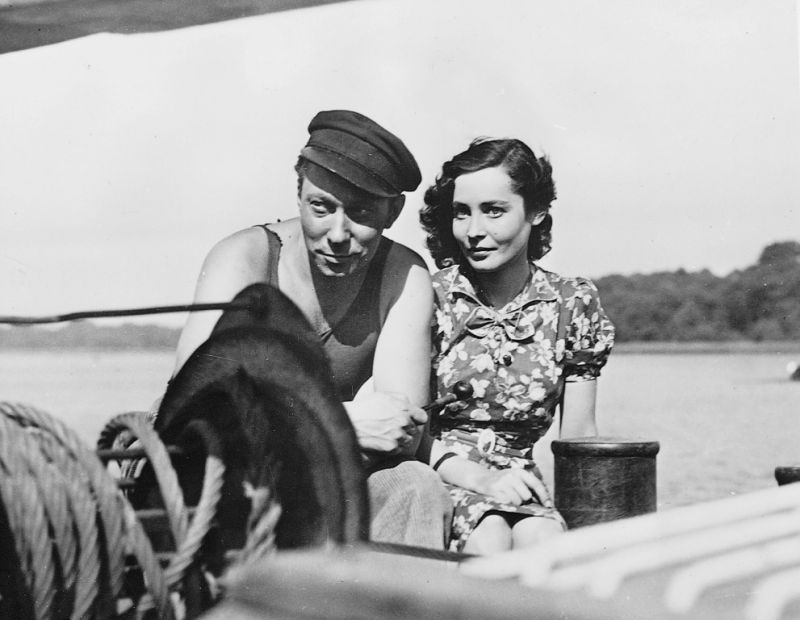
Two young inland boatmen take a young woman who is disappointed in love and life on board their tug and persuade her to go on a long journey. Both fall in love with their sexy passenger, but their friendship withstands the test, and after the choice has been made, the three unanimously continue their journey. (filmdienst.de)
Made in the last days of the "Third Reich" under primitive conditions, the sensitive camera makes a virtue out of necessity and allows the barren landscape to play a major role. (filmdienst.de)
Filming took place, among other things, at the Glienicke Bridge, in Werder (Havel), Havelberg, Rathenow and Potsdam as well as at Berlin locations such as its inland ports, the Tiergarten, in the Berlin Jannowitzbrücke train station and on the bridge of the same name, a Spree bridge that was destroyed and rebuilt shortly after filming, and on the Schlütersteg, also shortly afterwards The destroyed bridge between Schiffbauerdamm and Berlin Friedrichstrasse train station, which was not rebuilt.
Premiere in 1946 in Locarno. German premiere in 1950 in Göttingen.
“A small, everyday story with poetry, realism, lots of atmosphere and a dash of humor, unpretentious and precisely staged.” (Lexicon of International Film)
"The camera work is flawless, turning the film into a single etude in light and shadow, from the images of the opening credits, which show the journey under bridges in daring angles skyward, to the scene of a big debate in the rowing boat. Only parts of Anna's face are visible at the beginning, shrouded in the shadows of the night, from which the lights appear in an almost natural-looking artificiality Stitch games. You can also call this 'poetic realism'. And Helmut Käutner with that – can I say it? – definitely stand next to Jean Renoir or Marcel Carné.” (film headquarters)
Director: Helmut Käutner
Screenplay: Helmut Käutner, Walter Ulbrich based on the script of Leo de Laforgue's “Under the Bridges of Paris”
Production: Kurt-Fritz Quassowski
Music: Bernhard Eichhorn
Camera: Igor Oberberg
Editor: Wolfgang Wehrum
Cast: Hannelore Schroth, Carl Raddatz, Gustav Knuth, Ursula Grabley, Margarete Haagen, Hildegard Knef and others
95 minutes, b/w, FSK 12
A film from the collection of the Friedrich-Wilhelm-Murnau-Stiftung (www.murnau-stiftung.de) in Wiesbaden.
Two young inland boatmen take a young woman who is disappointed in love and life on board their tug and persuade her to go on a long journey. Both fall in love with their sexy passenger, but their friendship withstands the test, and after the choice has been made, the three unanimously continue their journey. (filmdienst.de)
Made in the last days of the "Third Reich" under primitive conditions, the sensitive camera makes a virtue out of necessity and allows the barren landscape to play a major role. (filmdienst.de)
Filming took place, among other things, at the Glienicke Bridge, in Werder (Havel), Havelberg, Rathenow and Potsdam as well as at Berlin locations such as its inland ports, the Tiergarten, in the Berlin Jannowitzbrücke train station and on the bridge of the same name, a Spree bridge that was destroyed and rebuilt shortly after filming, and on the Schlütersteg, also shortly afterwards The destroyed bridge between Schiffbauerdamm and Berlin Friedrichstrasse train station, which was not rebuilt.
Premiere in 1946 in Locarno. German premiere in 1950 in Göttingen.
“A small, everyday story with poetry, realism, lots of atmosphere and a dash of humor, unpretentious and precisely staged.” (Lexicon of International Film)
"The camera work is flawless, turning the film into a single etude in light and shadow, from the images of the opening credits, which show the journey under bridges in daring angles skyward, to the scene of a big debate in the rowing boat. Only parts of Anna's face are visible at the beginning, shrouded in the shadows of the night, from which the lights appear in an almost natural-looking artificiality Stitch games. You can also call this 'poetic realism'. And Helmut Käutner with that – can I say it? – definitely stand next to Jean Renoir or Marcel Carné.” (film headquarters)