This event has been ended!
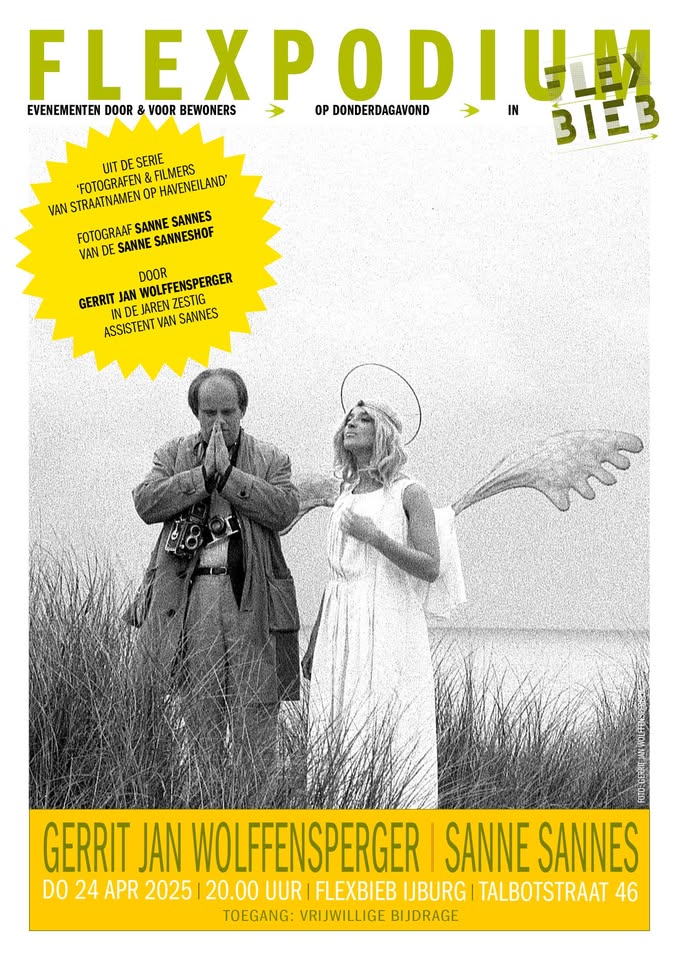
Gerrit Jan Wolffensperger over fotograaf Sanne Sannes
Gerrit Jan Wolffensperger about photographer Sanne Sannes
Event by: FlexBieb
Location: Talbotstraat 46, Talbotstraat 46, Amsterdam - Amsterdam-Oost
Tickets: Get tickets
About event
A new episode of our series about the photographers and filmers after whom many streets, squares and courtyards on the port island on IJburg are named.
This time: Sanne Sannes (1937-1967), by Gerrit Jan Wolffensperger, who was his assistant from 1964 to Sannes' Death! During the evening, Sannes Production Dirty Girl will be shown: a photo film in which a married woman dreams of an existence in which she is nude model, prostitute and ultimately murderous of her silly husband. Sannes died just before he was about to break through internationally with Dirty Girl.
Reserve: Via the chipta-link on this page
Access: Voluntary contribution
***
Wolffenperger wrote an introduction to the last book <> in the Sanne Sannnes in the Sanne Sannnes in the Sanne Sanne in the Sanne Sannes in the Sanne Sannes in the Sanne Sannes in the Sanne Sannes in the Sanne Sanne in Sanne Duinen near Bergen makes Sanne Sannes a report on Zomermode on behalf of Libelle. The sun is shining, but it's blood cold. We have had three cars of the type Porsche printed, and the models are chattered in their summer dresses. At the end of the day we will recover in a cafe in Bergen. Warmed and cheerful we drive in the car from Sanne to Bergen aan Zee, where our cars are. That comes the blow.
I wake up the next morning in a hospital bed, and put the radio shell on my ear. The first thing I hear is the news item: "Yesterday, the famous Dutch photographer Sanne Sannes died in a car accident in Bergen."
Then I scream for the sister.
My collaboration with Sanne started in 1964, when making a film for the VPRO. Sanne as a photographer, I as an assistant and regulator. The film, working title Santa Lucia, would take the form of a "cine novel": after making the images, a film camera movement was suggested. The theme of that film would also come back in the later work of Sanne: the woman in a number of archetypal roles: as an angel, as a whore, as a vampire. In all those roles the woman is the boss; The man is secondary or even victim. The film was never broadcast: the broadcaster found some images too violent. After that film I continued to work with Sanne. Partly out of friendship, but mainly because I was fascinated by his work and the way he made that.
What makes Sanne Sannes such a special and unique photographer?
Certainly not the kind of assignments as on that fatal day in March, which were made for the Brode. His strength and passion were in free work, in which women played the leading role. The core is that photos were not a goal for Sanne, but a means. He did not interest beautiful pictures, his images were a means to capture and convey emotions, with the most intense emotion of eroticism. The sessions in which those images were created were often intense. Sanne did not work with professional models, but with friends and acquaintances. His tactic was one of the disruption: through short assignments, flattery, cynical jokes and sometimes long walks of woods, he built a tension that women eventually brought in the poses he had in mind. Intimacy played no role in this; The models became more focused on the camera than on the photographer who was behind it.
After those recordings came the second phase: trained as a graphic artist, he edited the images in his dark room. There he cut out, double -press, and sometimes scratched the negatives to emphasize the emotion he wanted to show even more violently. The images that came about in this way are unique and recognizable to this day.
That entire working method is not clear from the person of Sanne Sannes. A stiff Groninger, who made difficult contact with people, and who hid his embarrassment behind a mask of cynical jokes. Who led a roaming existence, with the house of his parents as a fixed point, and who had little contact with other photographers and artists. A man for whom contact with women through the camera was easier than, if not replaced, an intimate personal relationship.
The photographic work of Sanne Sannes only spans for a period of eight years. If he had remained alive, he would undoubtedly also take other directions in addition to photography: he worked on film scripts, and television also fascinated him.
It should not have been that way. After his death, his fame was less for a while, until the transfer of his archive to the Nederlands Fotomuseum led to new exhibitions, purchases by museums, and a documentary. But the awareness and appreciation have remained on the academies and internationally. Sanne Sannes was een unieke kunstenaar, die beelden maakte die ver uitstijgen boven de reminiscentie van de jaren zestig, die niets aan actualiteit hebben ingeboet omdat ze ook nu nog fascineren door hun kracht en hun schoonheid.
***
Over Gerrit Jan Wolffensperger:
Gerrit Jan Wolffensperger (Amsterdam, 9 augustus 1944) is een voormalig Nederlands politicus. He is a former party leader in the Lower House of the D66 political party and was chairman of the Board of Directors of the Public Omroep from 1998 to 2003.
Wolffensperger is a son of resistanceman and visual artist Gerrit van der Veen (1902-1944, name giver of an Amsterdam high school).
Wolffensperger studied law and economy and was also a photographer, until 1967 as an assistant to the photographer Sanne Sannes, with whom he was involved in a traffic accident in that year in which Sannes died. He also worked as a load officer at the KNSM, before he became a teacher at the law faculty of the University of Amsterdam in 1969 and legal assistant of Dagblad de Volkskrant.
In 1978 he became a member of the Amsterdam City Council. The same year he also became alderman for municipal companies, relocation and broadcaster. In 1982 he again became an alderman, then of education, relocation and broadcaster. From 1986 to 1997 he was in the Lower House on behalf of D66, with the main portfolios of justice, traffic and water management and media policy. From 1994 to 1997 he was the party leader of D66.
from 1998 to 2003 he worked as chairman of the NOS. He was also chairman of the Nederlands Fotomuseum in Rotterdam (1990-2003), of World Press Photo (1998-2007) and of the Pictoright Foundation, the copyright organization of visual makers (2007-2018).
This time: Sanne Sannes (1937-1967), by Gerrit Jan Wolffensperger, who was his assistant from 1964 to Sannes' Death! During the evening, Sannes Production Dirty Girl will be shown: a photo film in which a married woman dreams of an existence in which she is nude model, prostitute and ultimately murderous of her silly husband. Sannes died just before he was about to break through internationally with Dirty Girl.
Reserve: Via the chipta-link on this page
Access: Voluntary contribution
***
Wolffenperger wrote an introduction to the last book <> in the Sanne Sannnes in the Sanne Sannnes in the Sanne Sanne in the Sanne Sannes in the Sanne Sannes in the Sanne Sannes in the Sanne Sannes in the Sanne Sanne in Sanne Duinen near Bergen makes Sanne Sannes a report on Zomermode on behalf of Libelle. The sun is shining, but it's blood cold. We have had three cars of the type Porsche printed, and the models are chattered in their summer dresses. At the end of the day we will recover in a cafe in Bergen. Warmed and cheerful we drive in the car from Sanne to Bergen aan Zee, where our cars are. That comes the blow.
I wake up the next morning in a hospital bed, and put the radio shell on my ear. The first thing I hear is the news item: "Yesterday, the famous Dutch photographer Sanne Sannes died in a car accident in Bergen."
Then I scream for the sister.
My collaboration with Sanne started in 1964, when making a film for the VPRO. Sanne as a photographer, I as an assistant and regulator. The film, working title Santa Lucia, would take the form of a "cine novel": after making the images, a film camera movement was suggested. The theme of that film would also come back in the later work of Sanne: the woman in a number of archetypal roles: as an angel, as a whore, as a vampire. In all those roles the woman is the boss; The man is secondary or even victim. The film was never broadcast: the broadcaster found some images too violent. After that film I continued to work with Sanne. Partly out of friendship, but mainly because I was fascinated by his work and the way he made that.
What makes Sanne Sannes such a special and unique photographer?
Certainly not the kind of assignments as on that fatal day in March, which were made for the Brode. His strength and passion were in free work, in which women played the leading role. The core is that photos were not a goal for Sanne, but a means. He did not interest beautiful pictures, his images were a means to capture and convey emotions, with the most intense emotion of eroticism. The sessions in which those images were created were often intense. Sanne did not work with professional models, but with friends and acquaintances. His tactic was one of the disruption: through short assignments, flattery, cynical jokes and sometimes long walks of woods, he built a tension that women eventually brought in the poses he had in mind. Intimacy played no role in this; The models became more focused on the camera than on the photographer who was behind it.
After those recordings came the second phase: trained as a graphic artist, he edited the images in his dark room. There he cut out, double -press, and sometimes scratched the negatives to emphasize the emotion he wanted to show even more violently. The images that came about in this way are unique and recognizable to this day.
That entire working method is not clear from the person of Sanne Sannes. A stiff Groninger, who made difficult contact with people, and who hid his embarrassment behind a mask of cynical jokes. Who led a roaming existence, with the house of his parents as a fixed point, and who had little contact with other photographers and artists. A man for whom contact with women through the camera was easier than, if not replaced, an intimate personal relationship.
The photographic work of Sanne Sannes only spans for a period of eight years. If he had remained alive, he would undoubtedly also take other directions in addition to photography: he worked on film scripts, and television also fascinated him.
It should not have been that way. After his death, his fame was less for a while, until the transfer of his archive to the Nederlands Fotomuseum led to new exhibitions, purchases by museums, and a documentary. But the awareness and appreciation have remained on the academies and internationally. Sanne Sannes was een unieke kunstenaar, die beelden maakte die ver uitstijgen boven de reminiscentie van de jaren zestig, die niets aan actualiteit hebben ingeboet omdat ze ook nu nog fascineren door hun kracht en hun schoonheid.
***
Over Gerrit Jan Wolffensperger:
Gerrit Jan Wolffensperger (Amsterdam, 9 augustus 1944) is een voormalig Nederlands politicus. He is a former party leader in the Lower House of the D66 political party and was chairman of the Board of Directors of the Public Omroep from 1998 to 2003.
Wolffensperger is a son of resistanceman and visual artist Gerrit van der Veen (1902-1944, name giver of an Amsterdam high school).
Wolffensperger studied law and economy and was also a photographer, until 1967 as an assistant to the photographer Sanne Sannes, with whom he was involved in a traffic accident in that year in which Sannes died. He also worked as a load officer at the KNSM, before he became a teacher at the law faculty of the University of Amsterdam in 1969 and legal assistant of Dagblad de Volkskrant.
In 1978 he became a member of the Amsterdam City Council. The same year he also became alderman for municipal companies, relocation and broadcaster. In 1982 he again became an alderman, then of education, relocation and broadcaster. From 1986 to 1997 he was in the Lower House on behalf of D66, with the main portfolios of justice, traffic and water management and media policy. From 1994 to 1997 he was the party leader of D66.
from 1998 to 2003 he worked as chairman of the NOS. He was also chairman of the Nederlands Fotomuseum in Rotterdam (1990-2003), of World Press Photo (1998-2007) and of the Pictoright Foundation, the copyright organization of visual makers (2007-2018).
Events in Amsterdam today · Events in Amsterdam this weekend