This event has been ended!
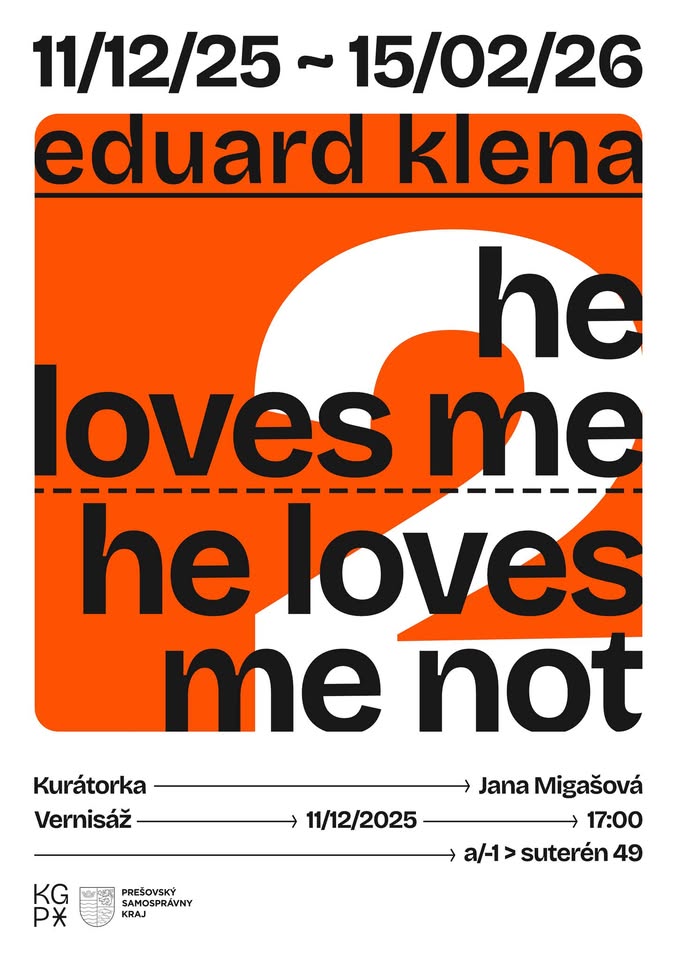
He loves me - he loves me not 2
Event by: Krajská galéria v Prešove
Location: Park of Culture and Recreation, Hlavná 50, Prešov
Talks & discussions, Exhibitions
About event
He Loves Me, He Loves Me Not 2
Regional Gallery in Prešov
Author: Eduard Klena (1988)
Curator: Jana Migašová
Contemporary intermedial artist Eduard Klena (1988) brings a suggestive spatial concept inspired by Japanese mythology to the premises of the Regional Gallery in Prešov. Klena works with Jōkai (妖怪) beings, which can be understood as ghosts situated between reality and dream. They can be scary and dangerous, but also playful and fun. They have different forms and characteristics that represent certain phenomena and moments of human life. The leitmotif of the installation is a creature named Rokurokubi (轆轤首), which has a unique ability – during the night, its neck grows insanely long, while the head can separate from the body and move independently. In this form, she usually comes out to scare or watch people. The author and "his ghosts" in their metaphorical form are the core of the exhibition concept.
Distant culture resonated with Klen again – this time during the Arts Itoya spring residency in Fukuoka, Japan. Jōkai ghosts help him understand and communicate his own fragility in human society. The multimedia installation conveys a well-known, shared experience of being in the world: our bodies are constantly observed by the eyes of the "big other", we often feel that we stand out and do not belong. We are frantically looking for support in a solid point, in love. Subsequently, we painfully discover that love can be anything but a fixed point. At least temporarily. "Temporary fixed point" is, however, a paradoxical expression, an oxymoron.
For his narration, the author uses various media and forms, this time he works with a soft textile figure, architectural elements, projection and sound. It breaks through and delimits the space, edits the installation in situ. The composition of the premiere autumn exhibition in the Bratislava Kunsthalle is adapted to the space of the Prešov "gallery underground". The installation invites the visitor to move. Klena puts visual and physical obstacles in the way, offers to stop, climb into the "observable room" and guard the space. It provides a condensed experience of the present, which can be described by the contradiction between "being under surveillance" and "seeing to penetrate the privacy of others". The wanderer has the chance to stop in the "safety of home" framed by duvets, pillows and a window, but even this sense of security is only temporary: insomniac "ghosts" force the wanderer to move further - until the final realization that the pain of individual experience can be alleviated by sharing personal experience. The ghosts that drink our blood (and with which we learn to live) also connect us.
An integral part of the installation is the sound component of Bernhard Hollinger, a Berlin experimental composer whom Klena met during his Japanese residency. The characteristic that the musician states about himself also connects him with Klena's approach: "His desire to transcend genres through intuition and subtlety as a compass for his musical research is manifested in contrast and playfulness, minimalist schemes as well as organic movement."
Eduard Klena is in his current exhibition project He Loves Me, He Loves Me Not 2 2025) – radically personal. It can be said that he takes the visitor by the hand and lets him somaesthetically experience his reality. The frustrating impossibility to remain peacefully in one place is somewhere in the core of the installation - architecture, which is conceptually divided into four parts: I. Elementary school grounds; II. Obake (a spectre); III. Portrait of an ex; IV. Pile of 2025. The four segments represent personal ghosts that accompany the author on his travels (and there is no escape from them): the ghost of childhood bullying; alienation; trauma from the loss of love and an increasingly intense feeling that he does not belong to his own country.
All four "chapters" of Klen's story are connected by the neck of the being Rokurokubi, which is also a meta-motif representing the experiences of mystery and uncertainty as the basic feelings of current being in the world. With this exhibition as well, Klena confirms his "manuscript": thoughtful work with the semiotics of space, rough, raw and consciously de-aestheticized forms, disturbing sound and an emphasis on movement. He composes the exhibition as a complex experience, but this time he emphasizes the awareness of the fragile boundary between reality and ghosts, between what is seen and imagined, between the present and the past.
Eduard Klena (1988) is an intermediate / multimedia artist originally from Prešov. He graduated from the Faculty of Graphics at the Academy of Fine Arts in Bratislava, and completed his studies and residencies in the Czech Republic, South Korea, Ukraine, Spain and Japan. Klena consciously situates herself in the interstices of categorizations. He oscillates between curator and artist, between architect and graphic artist, between aesthetics and concept.
Regional Gallery in Prešov
Author: Eduard Klena (1988)
Curator: Jana Migašová
Contemporary intermedial artist Eduard Klena (1988) brings a suggestive spatial concept inspired by Japanese mythology to the premises of the Regional Gallery in Prešov. Klena works with Jōkai (妖怪) beings, which can be understood as ghosts situated between reality and dream. They can be scary and dangerous, but also playful and fun. They have different forms and characteristics that represent certain phenomena and moments of human life. The leitmotif of the installation is a creature named Rokurokubi (轆轤首), which has a unique ability – during the night, its neck grows insanely long, while the head can separate from the body and move independently. In this form, she usually comes out to scare or watch people. The author and "his ghosts" in their metaphorical form are the core of the exhibition concept.
Distant culture resonated with Klen again – this time during the Arts Itoya spring residency in Fukuoka, Japan. Jōkai ghosts help him understand and communicate his own fragility in human society. The multimedia installation conveys a well-known, shared experience of being in the world: our bodies are constantly observed by the eyes of the "big other", we often feel that we stand out and do not belong. We are frantically looking for support in a solid point, in love. Subsequently, we painfully discover that love can be anything but a fixed point. At least temporarily. "Temporary fixed point" is, however, a paradoxical expression, an oxymoron.
For his narration, the author uses various media and forms, this time he works with a soft textile figure, architectural elements, projection and sound. It breaks through and delimits the space, edits the installation in situ. The composition of the premiere autumn exhibition in the Bratislava Kunsthalle is adapted to the space of the Prešov "gallery underground". The installation invites the visitor to move. Klena puts visual and physical obstacles in the way, offers to stop, climb into the "observable room" and guard the space. It provides a condensed experience of the present, which can be described by the contradiction between "being under surveillance" and "seeing to penetrate the privacy of others". The wanderer has the chance to stop in the "safety of home" framed by duvets, pillows and a window, but even this sense of security is only temporary: insomniac "ghosts" force the wanderer to move further - until the final realization that the pain of individual experience can be alleviated by sharing personal experience. The ghosts that drink our blood (and with which we learn to live) also connect us.
An integral part of the installation is the sound component of Bernhard Hollinger, a Berlin experimental composer whom Klena met during his Japanese residency. The characteristic that the musician states about himself also connects him with Klena's approach: "His desire to transcend genres through intuition and subtlety as a compass for his musical research is manifested in contrast and playfulness, minimalist schemes as well as organic movement."
Eduard Klena is in his current exhibition project He Loves Me, He Loves Me Not 2 2025) – radically personal. It can be said that he takes the visitor by the hand and lets him somaesthetically experience his reality. The frustrating impossibility to remain peacefully in one place is somewhere in the core of the installation - architecture, which is conceptually divided into four parts: I. Elementary school grounds; II. Obake (a spectre); III. Portrait of an ex; IV. Pile of 2025. The four segments represent personal ghosts that accompany the author on his travels (and there is no escape from them): the ghost of childhood bullying; alienation; trauma from the loss of love and an increasingly intense feeling that he does not belong to his own country.
All four "chapters" of Klen's story are connected by the neck of the being Rokurokubi, which is also a meta-motif representing the experiences of mystery and uncertainty as the basic feelings of current being in the world. With this exhibition as well, Klena confirms his "manuscript": thoughtful work with the semiotics of space, rough, raw and consciously de-aestheticized forms, disturbing sound and an emphasis on movement. He composes the exhibition as a complex experience, but this time he emphasizes the awareness of the fragile boundary between reality and ghosts, between what is seen and imagined, between the present and the past.
Eduard Klena (1988) is an intermediate / multimedia artist originally from Prešov. He graduated from the Faculty of Graphics at the Academy of Fine Arts in Bratislava, and completed his studies and residencies in the Czech Republic, South Korea, Ukraine, Spain and Japan. Klena consciously situates herself in the interstices of categorizations. He oscillates between curator and artist, between architect and graphic artist, between aesthetics and concept.