This event has been ended!
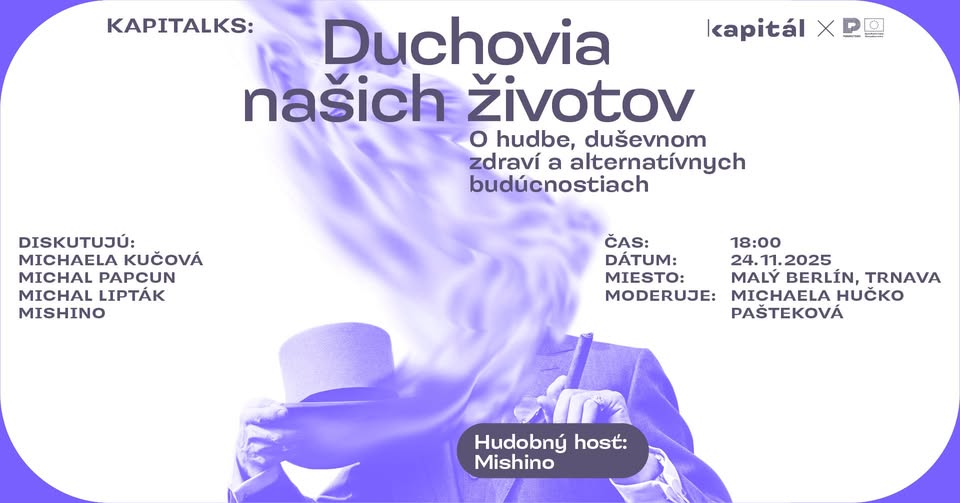
KAPITALKS: Duchovia našich životov. O hudbe, duševnom zdraví a alternatívnych budúcnostiach
KAPITALKS: Spirits of our lives. About music, mental health and alternative futures
Event by: Malý Berlín, Kapitál
Location: Malý Berlín, Štefánikova 94/4, Trnava
Concerts, Discussions and lectures
About event
According to the British cultural theorist and philosopher Mark Fisher, music is a space in which we can recognize the main symptoms of a cultural crisis. 🎹 What kind of society is the current music production talking about? Can it reflect the present or are we still living trapped in the 20th century, as Fisher claimed ten years ago in his lyrics?
🎸 They say that we no longer expect such ruptures as the Beatles or disco. Neoliberal capitalism has resulted in a culture of retrospection and pastiche, depriving artists of the means to create something new. Life sped up, but culture slowed down. Is it due to the precariousness of the work culture, which throws people into a state in which they are exhausted and flooded with sensations?
📢 Mark Fisher often wrote about the relationship between capitalism and mental health, these motifs are part of many of his now cult musical analyses. What was unique about Fisher's writing about music and how is it inspirational for contemporary music journalism? Do female and male musicians deal more with the topic of psychological problems today thanks to Fisher? And is music today more of a therapy or can it once again be able to foresee alternative futures and ignite the flame of political imagination? 🎶
---
The event is part of the Perspectives project – a new brand for independent, constructive and multi-perspective journalism. More about the project here: goethe.de/perspectives_eu.
The Perspectives project is financed by the European Union. The views and positions expressed are those of the author(s) and do not necessarily reflect the views and positions of the European Union or the European Education and Culture Executive Agency (EACEA). Neither the European Union nor the EACEA assumes any responsibility for them.
🎸 They say that we no longer expect such ruptures as the Beatles or disco. Neoliberal capitalism has resulted in a culture of retrospection and pastiche, depriving artists of the means to create something new. Life sped up, but culture slowed down. Is it due to the precariousness of the work culture, which throws people into a state in which they are exhausted and flooded with sensations?
📢 Mark Fisher often wrote about the relationship between capitalism and mental health, these motifs are part of many of his now cult musical analyses. What was unique about Fisher's writing about music and how is it inspirational for contemporary music journalism? Do female and male musicians deal more with the topic of psychological problems today thanks to Fisher? And is music today more of a therapy or can it once again be able to foresee alternative futures and ignite the flame of political imagination? 🎶
---
The event is part of the Perspectives project – a new brand for independent, constructive and multi-perspective journalism. More about the project here: goethe.de/perspectives_eu.
The Perspectives project is financed by the European Union. The views and positions expressed are those of the author(s) and do not necessarily reflect the views and positions of the European Union or the European Education and Culture Executive Agency (EACEA). Neither the European Union nor the EACEA assumes any responsibility for them.