This event has been ended!
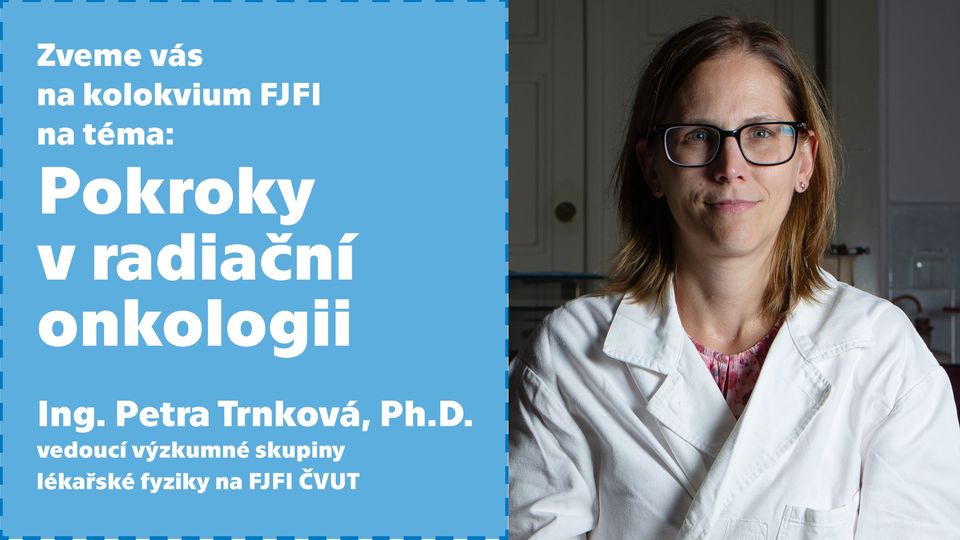
Kolokvium FJFI: Petra Trnková – Pokroky v radiační onkologii
FJFI colloquium: Petra Trnková - Advances in radiation oncology
Event by: Jaderka
Location: Czech Technical University in Prague, Faculty of Nuclear Sciences and Physical Engineering, Břehová 7, Praha 1
Talks & discussions
About event
Abstract:
Applied research and technology development for radiation oncology is very interdisciplinary. Using the example of research in the field of proton radiotherapy guided by magnetic resonance, I would like to show what opportunities different disciplines have to participate in the progress in radiation, which will lead to far more precise and targeted treatment of tumors.
Integration of advanced imaging methods into radiation of the devices is very important for visualizing the exact position of the organs and the tumor just before or even during the irradiation, and adapting the irradiation plan to the current anatomy. Especially during irradiation in parts of the body where the position of the organs is affected by breathing or different internal contents on individual irradiation days. The combination of magnetic resonance, which makes it possible to visualize low-contrast tumors, such as liver and pancreatic tumors, and proton radiotherapy, which due to its physical properties targets the dose more precisely, opens up possibilities to significantly reduce the toxicity of the treatment and possibly treat new tumors that have not been irradiated before due to high toxicity . But this integration is not trivial and faces many technical problems. In cooperation with the Technical University of Dresden and the Medical University of Vienna, we are working on a technological solution that will contribute to the introduction of this method into clinical practice.
Medallion:
Petra Trnková deals with interdisciplinary applied research in medicine physics. In 2007, she obtained an engineering degree at FJFI in the field of Radiological Physics and in 2010 a doctorate at the Medical University of Vienna. During her career so far, she has worked in leading research institutions (Paul Scherrer Institute, Harvard Medical School, HollandPTC and the Medical University of Vienna), where in addition to research, she also engaged in clinical practice. Her focus is primarily on the development of methods for the refinement and efficiency of irradiation in classical and proton radiotherapy.
Applied research and technology development for radiation oncology is very interdisciplinary. Using the example of research in the field of proton radiotherapy guided by magnetic resonance, I would like to show what opportunities different disciplines have to participate in the progress in radiation, which will lead to far more precise and targeted treatment of tumors.
Integration of advanced imaging methods into radiation of the devices is very important for visualizing the exact position of the organs and the tumor just before or even during the irradiation, and adapting the irradiation plan to the current anatomy. Especially during irradiation in parts of the body where the position of the organs is affected by breathing or different internal contents on individual irradiation days. The combination of magnetic resonance, which makes it possible to visualize low-contrast tumors, such as liver and pancreatic tumors, and proton radiotherapy, which due to its physical properties targets the dose more precisely, opens up possibilities to significantly reduce the toxicity of the treatment and possibly treat new tumors that have not been irradiated before due to high toxicity . But this integration is not trivial and faces many technical problems. In cooperation with the Technical University of Dresden and the Medical University of Vienna, we are working on a technological solution that will contribute to the introduction of this method into clinical practice.
Medallion:
Petra Trnková deals with interdisciplinary applied research in medicine physics. In 2007, she obtained an engineering degree at FJFI in the field of Radiological Physics and in 2010 a doctorate at the Medical University of Vienna. During her career so far, she has worked in leading research institutions (Paul Scherrer Institute, Harvard Medical School, HollandPTC and the Medical University of Vienna), where in addition to research, she also engaged in clinical practice. Her focus is primarily on the development of methods for the refinement and efficiency of irradiation in classical and proton radiotherapy.