This event has been ended!
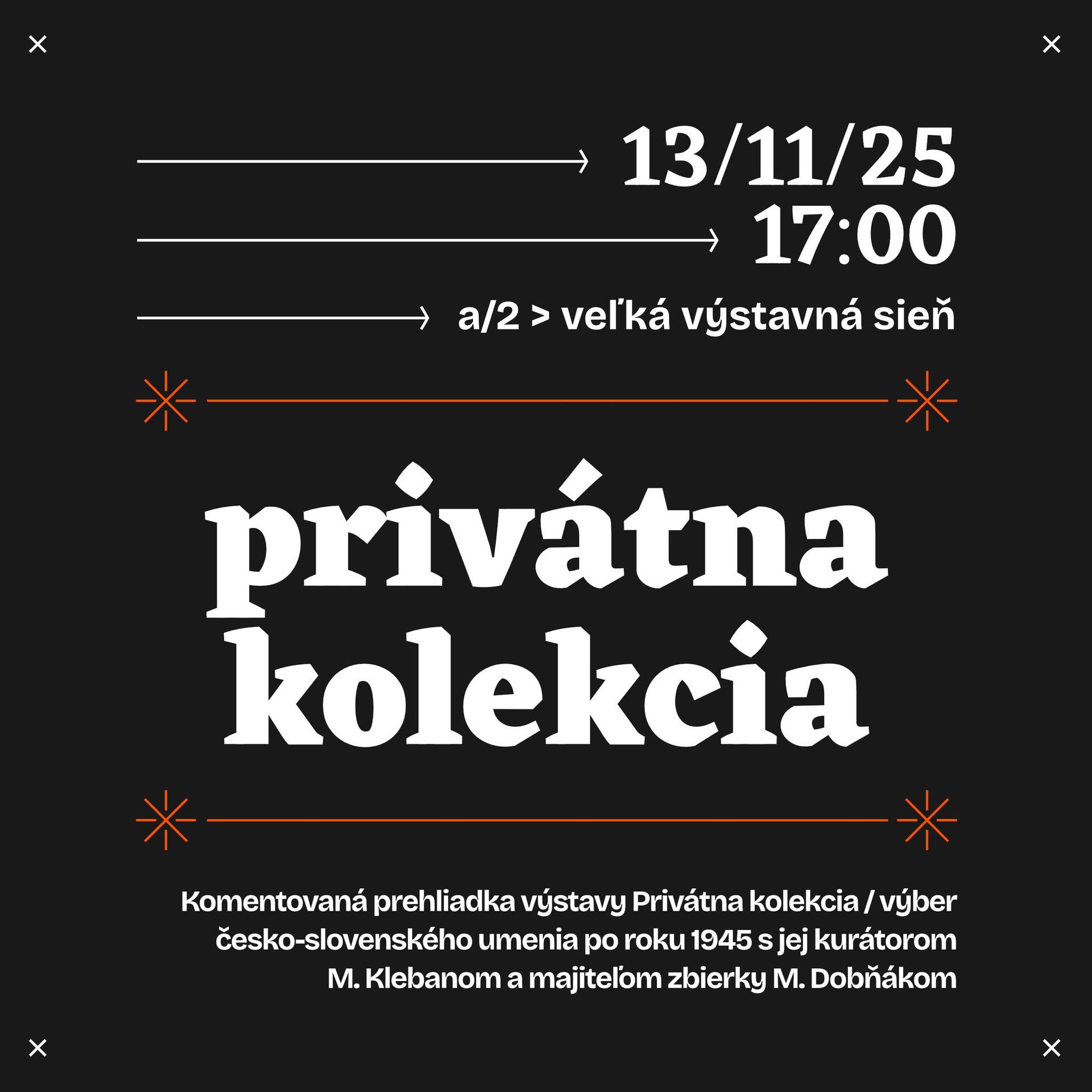
Komentovaná prehliadka výstavy Privátna kolekcia / výber česko-slovenského umenia po roku 1945
Commented tour of the exhibition Private collection / selection of Czech-Slovak art after 1945
Event by: Krajská galéria v Prešove
Location: Saris gallery in Prešov, Hlavná 2896, Prešov
Talks & discussions
About event
Commented tour of the exhibition Private collection / selection of Czech-Slovak art after 1945 with its curator M. Kleban and owner of the collection M. Dobňák.
Private collection / selection of Czech-Slovak art after 1945
Private collections of visual arts represent an important and often underappreciated phenomenon of cultural history. While public institutions – galleries and museums – are bound by institutional strategies, curatorial concepts and budget constraints, the individual collector can afford a more personal, flexible and often daring approach. His choices are guided by subjective taste, vision and sometimes also the ability to foresee artistic tendencies, which only become more widely known with the passage of time.
In the Slovak environment, and especially in Košice, where Central European cultural traditions have historically met, private collecting has a specific position. After the Second World War, the majority of artistic production was subordinated to state institutions, while the private art market developed only to a limited extent and under the supervision of official structures. Only after 1989 did a situation arise in which individuals began to systematically build collections based on the free market and art trade, which could in many cases compete with public collections. The systematically built collection of Milan Dobňák is among the important art collections of a private nature.
Dobňák's collection is primarily conceived as a collection of modern and contemporary art, but its specificity is that it connects several generations of authors - from representatives of the so-called "Košice modernity", through the fundamental figures of Slovak and Czech neo-avant-garde and post-modern art, to the young and middle generation of contemporary creators. It is a collection that not only documents, but also interprets the Czech-Slovak art of the last decades, while its strong point is the emphasis on originals, early works and moments in which the artistic program of individual authors was formed. In the context of contemporary collecting in Slovakia, Milan Dobňák's collection is an exceptional case - it is not built randomly, nor as an investment portfolio, but systematically and with a deep interest in art and culture. Without any pathos, it is appropriate to define this art collection as a mandatory textbook of regional and international art history. The first pillar of this concept is the older generation of authors who made their mark in the second half of the 20th century - from the neo-avant-garde of the 1960s, through conceptual experiments, to the postmodern strategies of the 1980s, such as representatives of the Bratislava scene - Stano Filko, Milan Dobeš, Jana Želibská, Peter and Veronika Rónai, or local authors with international influence such as Juraj Bartusz and Peter Kalmus. The art represented by the authors of the middle and younger generation is a cross between classical art forms (painting, sculpture, drawing) and between conceptual approaches in the form of new media, intermedia and installation art, which once again connects the individual works in an imaginary inclination towards conceptual art. While the older generation represents the solid foundation of the collection, its dynamism and topicality are made up of the works of authors of the middle and younger generation who entered the scene after 2000 and today are among the most prominent names in Czech-Slovak contemporary art. Among the exhibited artists are, for example, Slovak artists - Boris Sirka, Ján Vasilko, Lucia Dovičáková, Erik Binder, Rastislav Podoba, Erik Šille, Andrej Dúbravský, Marko Blažo, Denisa Lehocká, Bohad Hostiňák, Marek Kvetan, Vlasta Žáková, or famous names of the Czech art scene - Josef Bolf, Daniel Pitín, Eva Koťátková, Adam Štech, Jakub Matuška. The collector notices their early periods, follows the originals and works in which the manuscript or iconography crystallizes. With this selection strategy, it creates a bridge between generations. The collection does not only record the past, but actively maps the present. By focusing on the early works of younger authors, it follows the moment when they are not yet codified by the institutional discourse, but already have the potential to become future key names.
Miroslav Kleban
Private collection / selection of Czech-Slovak art after 1945
Private collections of visual arts represent an important and often underappreciated phenomenon of cultural history. While public institutions – galleries and museums – are bound by institutional strategies, curatorial concepts and budget constraints, the individual collector can afford a more personal, flexible and often daring approach. His choices are guided by subjective taste, vision and sometimes also the ability to foresee artistic tendencies, which only become more widely known with the passage of time.
In the Slovak environment, and especially in Košice, where Central European cultural traditions have historically met, private collecting has a specific position. After the Second World War, the majority of artistic production was subordinated to state institutions, while the private art market developed only to a limited extent and under the supervision of official structures. Only after 1989 did a situation arise in which individuals began to systematically build collections based on the free market and art trade, which could in many cases compete with public collections. The systematically built collection of Milan Dobňák is among the important art collections of a private nature.
Dobňák's collection is primarily conceived as a collection of modern and contemporary art, but its specificity is that it connects several generations of authors - from representatives of the so-called "Košice modernity", through the fundamental figures of Slovak and Czech neo-avant-garde and post-modern art, to the young and middle generation of contemporary creators. It is a collection that not only documents, but also interprets the Czech-Slovak art of the last decades, while its strong point is the emphasis on originals, early works and moments in which the artistic program of individual authors was formed. In the context of contemporary collecting in Slovakia, Milan Dobňák's collection is an exceptional case - it is not built randomly, nor as an investment portfolio, but systematically and with a deep interest in art and culture. Without any pathos, it is appropriate to define this art collection as a mandatory textbook of regional and international art history. The first pillar of this concept is the older generation of authors who made their mark in the second half of the 20th century - from the neo-avant-garde of the 1960s, through conceptual experiments, to the postmodern strategies of the 1980s, such as representatives of the Bratislava scene - Stano Filko, Milan Dobeš, Jana Želibská, Peter and Veronika Rónai, or local authors with international influence such as Juraj Bartusz and Peter Kalmus. The art represented by the authors of the middle and younger generation is a cross between classical art forms (painting, sculpture, drawing) and between conceptual approaches in the form of new media, intermedia and installation art, which once again connects the individual works in an imaginary inclination towards conceptual art. While the older generation represents the solid foundation of the collection, its dynamism and topicality are made up of the works of authors of the middle and younger generation who entered the scene after 2000 and today are among the most prominent names in Czech-Slovak contemporary art. Among the exhibited artists are, for example, Slovak artists - Boris Sirka, Ján Vasilko, Lucia Dovičáková, Erik Binder, Rastislav Podoba, Erik Šille, Andrej Dúbravský, Marko Blažo, Denisa Lehocká, Bohad Hostiňák, Marek Kvetan, Vlasta Žáková, or famous names of the Czech art scene - Josef Bolf, Daniel Pitín, Eva Koťátková, Adam Štech, Jakub Matuška. The collector notices their early periods, follows the originals and works in which the manuscript or iconography crystallizes. With this selection strategy, it creates a bridge between generations. The collection does not only record the past, but actively maps the present. By focusing on the early works of younger authors, it follows the moment when they are not yet codified by the institutional discourse, but already have the potential to become future key names.
Miroslav Kleban