This event has been ended!
Komentovaná prohlídka výstavy 1+2
Guided tour of the exhibition 1+2
Event by: Beseder Gallery
Location: Lihovarská 1060/12, Lihovarská 12, Praha 9
Talks & discussions
About event
The commented tour of the exhibition 1+2
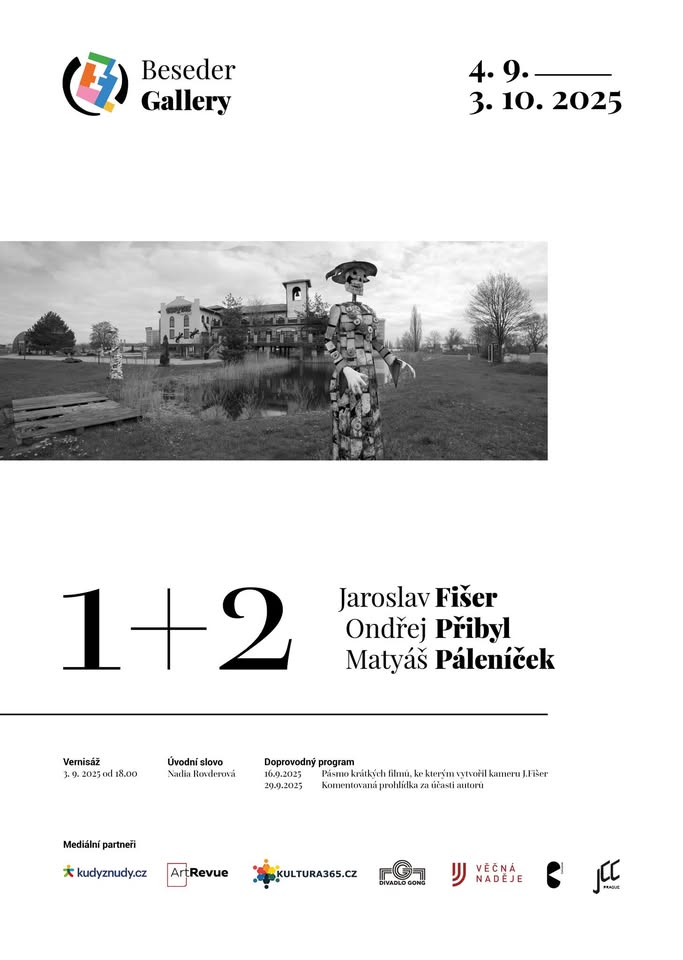
The Beseder Gallery launched a remarkable exhibition cycle at the beginning of the year, which emphasizes the intergenerational dialogue. It connects established personalities with their younger colleagues - often former students. As in Jiří Černický or Antonín Střížek, Jaroslav Fišer decided to address two creative individualities with which he is associated with the pedagogical relationship: Ondřej Přibyl, one of his first students from the time of the Academy of Arts, Architecture and Design and Matthias Páleníček Academy. All three authors meet over the topic of the landscape - specifically the landscape of the present, marked by anthropocene and civilization fingerprints of human activity. This creates a space full of Baudrillard's simulations - the paintings of the landscape that changes in front of our eyes, often into the form of kitschy imitations: cowboy towns, dinosaurs, smudges of villages or other pop -cultural curiosities. The real landscape is pushed through these "masks" and loses the opportunity to defend. The result is an environment whose real identity slowly disappears in favor of the illusive world of substitutes. His fascination with this medium contrast the modern issues of the technical reproducibility of the work of art, as thematized by Walter Benjamin. Daguerrotype - as a technique non -transferable and non -copying - opens the question of authenticity, uniqueness and durability of photographic record. Přibyl's films do not try to imitate nostalgic aesthetics of the 19th century. On the contrary, it focuses on current technical and industrial buildings whose rawness and functionality enter into tension with a fine and careful material nature of the technique itself. The result is a visual paradox, which raises disturbing questions about the form and importance of today's landscape in the viewer. In his work he transforms visions, dreams and imaginative landscapes into images that deceive the viewer and cross the boundaries of reality. In his studio he creates scenery and models, which then come to life as dreamy scenes through the camera. Its outlet ensemble is strongly influenced by sci-fi aesthetics and literary images-it was created as an illustration of the novel The Day of Trifids, the apocalyptic vision of John Wyndham. The Páleníčka landscape is not a reflection of the real world, but by autonomous fictional environments that also act foreign and subconsciously known.
The Beseder Gallery launched a remarkable exhibition cycle at the beginning of the year, which emphasizes the intergenerational dialogue. It connects established personalities with their younger colleagues - often former students. As in Jiří Černický or Antonín Střížek, Jaroslav Fišer decided to address two creative individualities with which he is associated with the pedagogical relationship: Ondřej Přibyl, one of his first students from the time of the Academy of Arts, Architecture and Design and Matthias Páleníček Academy. All three authors meet over the topic of the landscape - specifically the landscape of the present, marked by anthropocene and civilization fingerprints of human activity. This creates a space full of Baudrillard's simulations - the paintings of the landscape that changes in front of our eyes, often into the form of kitschy imitations: cowboy towns, dinosaurs, smudges of villages or other pop -cultural curiosities. The real landscape is pushed through these "masks" and loses the opportunity to defend. The result is an environment whose real identity slowly disappears in favor of the illusive world of substitutes. His fascination with this medium contrast the modern issues of the technical reproducibility of the work of art, as thematized by Walter Benjamin. Daguerrotype - as a technique non -transferable and non -copying - opens the question of authenticity, uniqueness and durability of photographic record. Přibyl's films do not try to imitate nostalgic aesthetics of the 19th century. On the contrary, it focuses on current technical and industrial buildings whose rawness and functionality enter into tension with a fine and careful material nature of the technique itself. The result is a visual paradox, which raises disturbing questions about the form and importance of today's landscape in the viewer. In his work he transforms visions, dreams and imaginative landscapes into images that deceive the viewer and cross the boundaries of reality. In his studio he creates scenery and models, which then come to life as dreamy scenes through the camera. Its outlet ensemble is strongly influenced by sci-fi aesthetics and literary images-it was created as an illustration of the novel The Day of Trifids, the apocalyptic vision of John Wyndham. The Páleníčka landscape is not a reflection of the real world, but by autonomous fictional environments that also act foreign and subconsciously known.