This event has been ended!
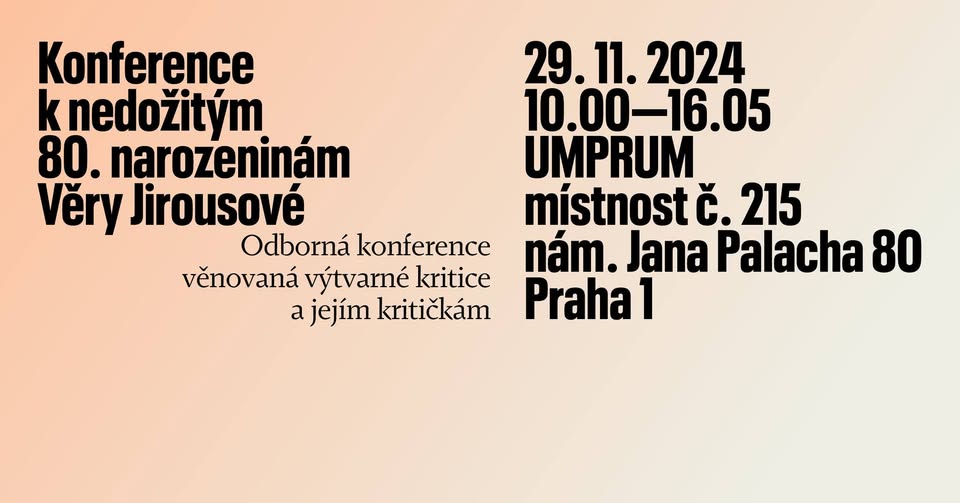
Konference k nedožitým 80. narozeninám Věry Jirousové
Conference for the late 80th birthday of Věra Jirousová
Event by: Vysoká škola uměleckoprůmyslová v Praze, Cena Věry Jirousové
Location: Academy of Arts, Architecture and Design in Prague, náměstí Jana Palacha 80/3, Praha 1
Talks & discussions
About event
The Věra Jirousová Prize cordially invites you to the professional conference, which is being held on the occasion of the 80th birthday of poet, critic and art historian Věra Jirousová. The one-day conference will focus not only on the personality of Věra Jirousová and other prominent critics, but also on broader issues of art criticism and the position of women critics in this profession - both in the period before 1989 and in the following decades.
The conference will offer four thematic blocks that will be devoted to the social and political conditions of critical work, different methodologies of critical writing or current challenges of contemporary criticism, such as the interconnection of roles female critics-curators or the newly emerging relationship between art criticism and artificial intelligence.
The conference is intended not only for members of the academic community, but also for all those interested in the issue of art criticism.
PROGRAM
Block 1
10.00 a.m.– 11.30
Introduction 10.00–10.10
10.10–10.40
Anežka Bartlová: Critics of the Golden 1960s
If we can say that the 1960s were truly a golden period of cultural (and artistic) criticism, was this also reflected in the number, status and positions of women? The article will focus more closely on who wrote in the most important media in the 1960s, what was the share or the difference in number, but also the position of women who contributed regularly, and will try to derive an answer to the question whether and to what extent it is true that the flourishing of criticism in general also brought benefits for publishing women.
Mgr. et Mgr. Anežka Bartlová Ph.D. she was the editor of the Art+antiques magazine, the Notebook for Art, Theory and Related Zones and is currently the editor-in-chief of Artalk.info and an assistant professor at the FAMU Center for Audiovisual Studies. She received her doctorate at AVU with the topic of art criticism in Czechoslovakia in the 1960s.
10.40–11.10
Veronika Soukupová: Ambivalence of thread. "Terminological embarrassments" and the theoretical grasp of the tapestry in the writing of Milena Lamarová
The art of the second half of the 20th century was also characterized by - overlooked by the dominant canon of art history - the extraordinary development of the tapestry. The new concept of working with textiles, which was defined in relation to its decorative and applied aspects and promoted a unique artistic expression, initiated theoretical discussions regarding an adequate methodological and conceptual anchoring. Czechoslovak artists, theorists, among whom Milena Lamarová has an important position, were also involved in the international debates.
Mgr. Veronika Soukupová is a graduate of the Master's course Theory and History of Modern and Contemporary Art at UMPRUM, where she is currently continuing her doctoral studies. The topic of her research is the Czechoslovak textile art of the twentieth century in a broader context.
11.30–12.00
Jana Migašová: Authenticity as mental work: selected aspects of Iva Mojžišová's art criticism (1939–2014)
The paper focuses on the work of the Slovak art historian and critic Iva Mojžišová, especially on the key concepts of her evaluative interpretations: authenticity and topicality. Mojžišová understands authenticity in the context of phenomenology, existentialism and the socio-political reality of the 1960s. In the end, she also turned to her own profession – she re-evaluated the role of an art critic and created a brief history of this genre, which became part of a book published in the Czech language, Criticism with Understanding (2011).
Doc. M.Sc. Jana Migašová, PhD. works at the Institute of Aesthetics and Artistic Culture (Faculty of Arts, University of Prešov) and the Society for Aesthetics in Slovakia. She focuses on Slovak and local visual art of the 20th century, she is interested in the concept of primitivism and kitsch. It also deals with innovative approaches in the teaching of art history.
12.00–12.30
Terezie Nekvindová: Critics or curators? Ambiguous roles in the 1990s
According to Paul O'Neill, in the Western environment at the turn of the 1980s and 1990s, the exhibition becomes a new discursive space for artistic practice. The creation of exhibitions thus began to prevail over critical writing to a certain extent, but most curators also devoted themselves to it in parallel. In the article, I will try to explain whether we can apply these observations to Czech art of the 90s, in which curation is establishing itself as a new profession thanks to prominent women such as Milena Slavická or the recently deceased Jana Ševčíková. In her case, a sub-question is also offered as to whether it is possible to consider her work independently, or only in a pair with Jiří Ševčík.
PhDr. Terezia Nekvindová, Ph. D. works at the Scientific and Research Department of the AVU and lectures at the Faculty of Arts of the Faculty of Economics of the UK. It deals with, among other things issues of the medium of the exhibition, the history of curatorship, socialist exhibition management and the representation of Czech art abroad. br/>
13.30–14.00
Milena Bartlová: Women in the art-historical samizdat of the eighties years
In the second half of the 1980s, two periodical samizdat titles focused on art history and art criticism were published: Sborníky památce and Někdo něko. In my contribution, I will briefly evaluate both "magazines" both within the framework of samizdat journalism and in a confrontation with both magazines published by the then Union of Czech Visual Artists, and I will think about the reasons why they remain neglected. Then I will focus in more detail on the activities of women in the production of these specific media.
Prof. PhDr. Milena Bartlová CSc. deals with the history of art in an expanded field and has been lecturing at UMPRUM since 2011. She is currently preparing for publication the book History of Czech Art History 1970–1990.
14.00–14.30
Marianna Placáková: Lamarová, Vachtová, Jirousová. Different paths of emancipation?
The paper deals with three figures of local art criticism – Milena Lamarová, Ludmila Vachtová and Věra Jirousová – or their creative periods, during which they spoke about the state socialist emancipation of women. Its goal is to present the problematics that arise in research related to the emancipation of women in connection with the preserved texts and expressions of individual authors. The paper will focus on how the narrative of women's emancipation before 1989 was constructed in different historical periods.
Mgr. Marianna Placáková, Ph.D. works at the Scientific and Research Department of the AVU. It deals with the gender contexts of artistic production in (post)socialism. The last article deals with the representation of female artists in the Czech canon of art history (Slavic Review, summer/2024).
break 14:30–14:50
Block 4
14.50–16.05
14.50–15.15
Tea Záchová: Exhibition experiment as garden
Curator and critic Ludmila Vachtová organized the groundbreaking exhibition Sculpture 1964 in 1964, the first major confrontational show of the middle and young generation of sculptors in Czechoslovakia, where sculptures were placed in direct dialogue with nature. Now, in collaboration with artist Matouš Lipus and architect Viktor Kákoš, we are developing Vachtová's idea of an experiment as a space not only for art, but also for the public, and we are bringing it to new contexts that go far beyond the original framework of the Liberec exhibition.
M.Sc. Tea Záchová is the chief curator at Galeria Lázně Liberec and a researcher of contemporary art. She graduated from three study programs: Curatorial Studies at FUD UJEP, Art Culture at PF UJEP and Humanities Studies at FF UJEP. He is currently studying at the Swedish University of Gothenburg at the Academy of Art and Design.
15.15–15.35 (in English)
Michał Łukaszuk: Institutionalization, commercialization, identity politics: How art criticism changed to example of the current exhibition of the avant-garde artist Anka Ptaszkowská
The paper focuses on how the avant-garde is interpreted and viewed from contemporary point of view, focusing on last year's exhibition by Anka Ptaszkowska at the Museum of Modern Art in Warsaw. The aim is to show how the critical reception and interpretation of the avant-garde has expanded to include feminist, class, gender and market dimensions, and to offer one's own interpretation of these issues.
Michał Łukaszuk received a master's degree in Cultural Studies from the University of Warsaw, he received the Sławomir Świontek Special Award for his thesis. In her work, she deals with new media, the interweaving of reality and the virtual, performance theory and visual culture.
15.35–15.55 (in English)
Ann-Sophie Gehrig: Art Criticism and AI
The principle of conformity in large language models shapes the result based on ethics, values and norms. The content may therefore lose its originality or its tone may be changed (or muted). If we rely on artificial intelligence without also using primary sources for art criticism, the critical approach to works and artists will be in jeopardy. Using the example of my own accompanying text for the exhibition, for which I drew comparisons from the life and work of Liselotte von der Pfalz, a German baroness known for her feminist values and uncompromisingness, I will explain how working with artificial intelligence led me to criticize its use.
< br/>Ann-Sophie Gehrig is a multidisciplinary artist and researcher. In his work, he explores the intersection of art, technology and the critical use of artificial intelligence. After completing his master's studies at UMPRUM and Konstfack Stockholm, he continues to study computational linguistics at the University of Heidelberg.
Ending 15.55–16.05
For professional help with the CVJ conference, z. with. thanks Lena Střeláková and Johana Lomová.
The conference will offer four thematic blocks that will be devoted to the social and political conditions of critical work, different methodologies of critical writing or current challenges of contemporary criticism, such as the interconnection of roles female critics-curators or the newly emerging relationship between art criticism and artificial intelligence.
The conference is intended not only for members of the academic community, but also for all those interested in the issue of art criticism.
PROGRAM
Block 1
10.00 a.m.– 11.30
Introduction 10.00–10.10
10.10–10.40
Anežka Bartlová: Critics of the Golden 1960s
If we can say that the 1960s were truly a golden period of cultural (and artistic) criticism, was this also reflected in the number, status and positions of women? The article will focus more closely on who wrote in the most important media in the 1960s, what was the share or the difference in number, but also the position of women who contributed regularly, and will try to derive an answer to the question whether and to what extent it is true that the flourishing of criticism in general also brought benefits for publishing women.
Mgr. et Mgr. Anežka Bartlová Ph.D. she was the editor of the Art+antiques magazine, the Notebook for Art, Theory and Related Zones and is currently the editor-in-chief of Artalk.info and an assistant professor at the FAMU Center for Audiovisual Studies. She received her doctorate at AVU with the topic of art criticism in Czechoslovakia in the 1960s.
10.40–11.10
Veronika Soukupová: Ambivalence of thread. "Terminological embarrassments" and the theoretical grasp of the tapestry in the writing of Milena Lamarová
The art of the second half of the 20th century was also characterized by - overlooked by the dominant canon of art history - the extraordinary development of the tapestry. The new concept of working with textiles, which was defined in relation to its decorative and applied aspects and promoted a unique artistic expression, initiated theoretical discussions regarding an adequate methodological and conceptual anchoring. Czechoslovak artists, theorists, among whom Milena Lamarová has an important position, were also involved in the international debates.
Mgr. Veronika Soukupová is a graduate of the Master's course Theory and History of Modern and Contemporary Art at UMPRUM, where she is currently continuing her doctoral studies. The topic of her research is the Czechoslovak textile art of the twentieth century in a broader context.
11.30–12.00
Jana Migašová: Authenticity as mental work: selected aspects of Iva Mojžišová's art criticism (1939–2014)
The paper focuses on the work of the Slovak art historian and critic Iva Mojžišová, especially on the key concepts of her evaluative interpretations: authenticity and topicality. Mojžišová understands authenticity in the context of phenomenology, existentialism and the socio-political reality of the 1960s. In the end, she also turned to her own profession – she re-evaluated the role of an art critic and created a brief history of this genre, which became part of a book published in the Czech language, Criticism with Understanding (2011).
Doc. M.Sc. Jana Migašová, PhD. works at the Institute of Aesthetics and Artistic Culture (Faculty of Arts, University of Prešov) and the Society for Aesthetics in Slovakia. She focuses on Slovak and local visual art of the 20th century, she is interested in the concept of primitivism and kitsch. It also deals with innovative approaches in the teaching of art history.
12.00–12.30
Terezie Nekvindová: Critics or curators? Ambiguous roles in the 1990s
According to Paul O'Neill, in the Western environment at the turn of the 1980s and 1990s, the exhibition becomes a new discursive space for artistic practice. The creation of exhibitions thus began to prevail over critical writing to a certain extent, but most curators also devoted themselves to it in parallel. In the article, I will try to explain whether we can apply these observations to Czech art of the 90s, in which curation is establishing itself as a new profession thanks to prominent women such as Milena Slavická or the recently deceased Jana Ševčíková. In her case, a sub-question is also offered as to whether it is possible to consider her work independently, or only in a pair with Jiří Ševčík.
PhDr. Terezia Nekvindová, Ph. D. works at the Scientific and Research Department of the AVU and lectures at the Faculty of Arts of the Faculty of Economics of the UK. It deals with, among other things issues of the medium of the exhibition, the history of curatorship, socialist exhibition management and the representation of Czech art abroad. br/>
13.30–14.00
Milena Bartlová: Women in the art-historical samizdat of the eighties years
In the second half of the 1980s, two periodical samizdat titles focused on art history and art criticism were published: Sborníky památce and Někdo něko. In my contribution, I will briefly evaluate both "magazines" both within the framework of samizdat journalism and in a confrontation with both magazines published by the then Union of Czech Visual Artists, and I will think about the reasons why they remain neglected. Then I will focus in more detail on the activities of women in the production of these specific media.
Prof. PhDr. Milena Bartlová CSc. deals with the history of art in an expanded field and has been lecturing at UMPRUM since 2011. She is currently preparing for publication the book History of Czech Art History 1970–1990.
14.00–14.30
Marianna Placáková: Lamarová, Vachtová, Jirousová. Different paths of emancipation?
The paper deals with three figures of local art criticism – Milena Lamarová, Ludmila Vachtová and Věra Jirousová – or their creative periods, during which they spoke about the state socialist emancipation of women. Its goal is to present the problematics that arise in research related to the emancipation of women in connection with the preserved texts and expressions of individual authors. The paper will focus on how the narrative of women's emancipation before 1989 was constructed in different historical periods.
Mgr. Marianna Placáková, Ph.D. works at the Scientific and Research Department of the AVU. It deals with the gender contexts of artistic production in (post)socialism. The last article deals with the representation of female artists in the Czech canon of art history (Slavic Review, summer/2024).
break 14:30–14:50
Block 4
14.50–16.05
14.50–15.15
Tea Záchová: Exhibition experiment as garden
Curator and critic Ludmila Vachtová organized the groundbreaking exhibition Sculpture 1964 in 1964, the first major confrontational show of the middle and young generation of sculptors in Czechoslovakia, where sculptures were placed in direct dialogue with nature. Now, in collaboration with artist Matouš Lipus and architect Viktor Kákoš, we are developing Vachtová's idea of an experiment as a space not only for art, but also for the public, and we are bringing it to new contexts that go far beyond the original framework of the Liberec exhibition.
M.Sc. Tea Záchová is the chief curator at Galeria Lázně Liberec and a researcher of contemporary art. She graduated from three study programs: Curatorial Studies at FUD UJEP, Art Culture at PF UJEP and Humanities Studies at FF UJEP. He is currently studying at the Swedish University of Gothenburg at the Academy of Art and Design.
15.15–15.35 (in English)
Michał Łukaszuk: Institutionalization, commercialization, identity politics: How art criticism changed to example of the current exhibition of the avant-garde artist Anka Ptaszkowská
The paper focuses on how the avant-garde is interpreted and viewed from contemporary point of view, focusing on last year's exhibition by Anka Ptaszkowska at the Museum of Modern Art in Warsaw. The aim is to show how the critical reception and interpretation of the avant-garde has expanded to include feminist, class, gender and market dimensions, and to offer one's own interpretation of these issues.
Michał Łukaszuk received a master's degree in Cultural Studies from the University of Warsaw, he received the Sławomir Świontek Special Award for his thesis. In her work, she deals with new media, the interweaving of reality and the virtual, performance theory and visual culture.
15.35–15.55 (in English)
Ann-Sophie Gehrig: Art Criticism and AI
The principle of conformity in large language models shapes the result based on ethics, values and norms. The content may therefore lose its originality or its tone may be changed (or muted). If we rely on artificial intelligence without also using primary sources for art criticism, the critical approach to works and artists will be in jeopardy. Using the example of my own accompanying text for the exhibition, for which I drew comparisons from the life and work of Liselotte von der Pfalz, a German baroness known for her feminist values and uncompromisingness, I will explain how working with artificial intelligence led me to criticize its use.
< br/>Ann-Sophie Gehrig is a multidisciplinary artist and researcher. In his work, he explores the intersection of art, technology and the critical use of artificial intelligence. After completing his master's studies at UMPRUM and Konstfack Stockholm, he continues to study computational linguistics at the University of Heidelberg.
Ending 15.55–16.05
For professional help with the CVJ conference, z. with. thanks Lena Střeláková and Johana Lomová.