This event has been ended!
KONFERENCIA O BERTHE VON SUTTNER
CONFERENCE O BERTHA VON SUTTNER
Event by: Zjednotení za mier
Location: Hotel Devin, Riečna ulica 4, Bratislava
Talks & discussions
About event
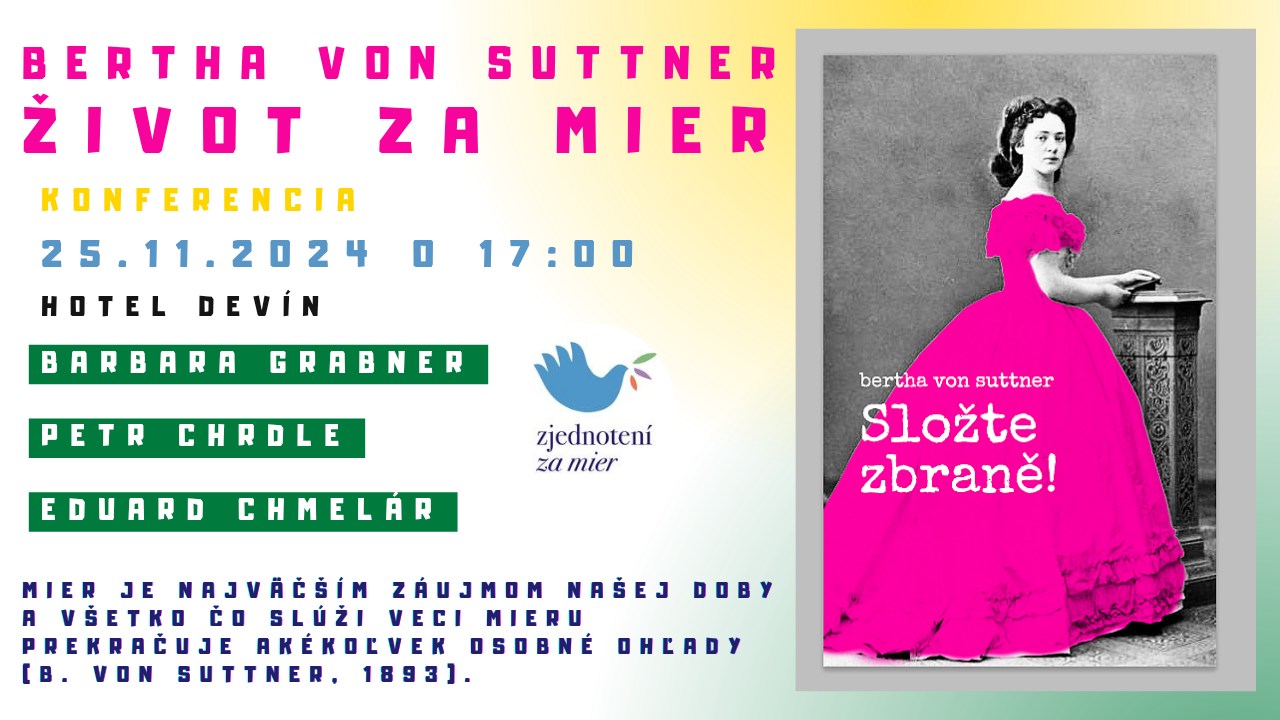
🔊WE INVITE YOU TO THE CONFERENCE - LECTURES ABOUT BERTH VON SUTTNER☮️
📅WHEN AND WHERE? 2️⃣5️⃣.1️⃣1️⃣.2️⃣0️⃣2️⃣4️⃣ AT 17:00 AT THE DEVÍN HOTEL IN BRATISLAVA
ATTENTION❗️ THE NUMBER OF PLACES IS LIMITED, so register as soon as possible on this link: https://bit.ly/Suttner
Lectures will be given by:
🔹Barbara Grabner - journalist and historian
🔹Petr Chrdle - publisher, traveler, Esperantist
🔹Eduard Chmelár - president of the United for Peace Association
FIGHTER FOR PEACE BERTHA VON SUTTNER🦸♀️🕊
Bertha von Suttner was born in Prague in 1843 as Countess Kinská and was the first woman in the world to win the Nobel Prize in 1905 for peace.
Within the rigid framework of the conventions of the highest society, she managed not only to preserve her individuality, but also to promote her ideals in a vehement way. At a time when a woman's opinion on politics was of little importance, she was able to participate in a relevant way in the pan-European debate, especially in the area of peace and alternative solutions to disputes. Bertha was one of the most important figures in the peace movement at the turn of the 19th and 20th centuries, she was one of the most influential journalists of her time and, as the founder of many peace societies, she advocated for peace, women's rights and national minorities. With his literary work and activities for the preservation of peace, he ranks among the leaders of the defenders of humanist ideas in Europe in the second half of the nineteenth century. HE CHANGED THE COURSE OF HISTORY
In the novel Lay Down Your Arms! (Die Waffen nieder!) the author portrays the horrors of war with such authenticity that the work was initially rejected by several publishers because it was said to shock the public too much, and after its publication in 1889, the book initially caused a huge wave of resentment and a great uproar. However, the book became an icon of pacifism and the peace movement, it made Berta famous and placed her among the leading representatives of the peace movement in the world. The novel was translated into many languages (including Czech and Esperanto) and published repeatedly.
The story, which takes place against the background of real military conflicts of the second half of the 19th century, questioned the notions of the nobility of war and the military profession in an unprecedented way. The author brought the suffering of soldiers at the front, which was taboo at the time due to massive military propaganda, to the general public, as well as the broader effects of wars on the entire society. However, one important thing sets it apart from a story that we would smile condescendingly at today: it touches on topics that were not discussed in the second half of the 19th century, so that people would not be socially disabled. The effort to remove the aura of heroism from fighting was completely shocking in the second half of the 19th century. As well as pointing out inconsistencies in our thinking about individual and collective violence. The story is interwoven with philosophical reflections on the absurdity of wars and power politics, but also with arguments supporting nascent peace movements.
The author has never hidden the fact that this is an agitational novel. The book Lay down your arms! it is still a very current source of ideas that need to be disseminated in order to support peaceful alternatives to dispute resolution and at the same time create space for establishing cooperation on the way to promoting peace and sustainable security. And she succeeds in doing something else - to show that some human tendencies have not changed much in the last 135 years - for example: what is usual is immutable; what is new is suspect.
After the publication of the novel Lay Down Your Arms! Bertha became a leading figure in the European peace movement, published an anti-war magazine, was at the birth of many peace associations and participated in the first peace congresses. She called for the creation of the European community (the peaceful coexistence of European states was, according to her, to be the first major stage on the way to world peace), she was at the birth of the Interparliamentary Union (established in 1889) and was responsible for the creation of the oldest institution for the resolution of international disputes - the Permanent Arbitration court, which was established in 1899 at the peace conference in The Hague on the initiative of the Russian Tsar Nicholas II.
Her work has a significant overlap even to the present day, when it is very important to point out the continuing relevance of Berta's ideas and their contribution to the field of peace politics. The criticism of the inhumanity of the conduct of war, which she presented during her lifetime, is still valid, all the more so at a time when we have at our disposal weapons with incredibly destructive properties and when many countries of the world are in the middle of armed conflict.
As early as 1893, she said: "I know very well that the peace movement alone will not eliminate war. Only he who has power in his hands - as the friends of peace know very well - can turn ideas into action. But even an idea is capable, as long as it is expressed clearly, repeatedly and unanimously, of influencing the will of the powerful. And that's exactly what we want. We are under no illusions that we will solve international legal issues...not us, but those who can must do so.
The maintenance of general peace and the possible reduction of excessive armaments, which burdens entire nations, are urged in the present world situation as an ideal towards which the efforts of all governments must be directed. The financial burden of armaments touches people's well-being right at the root. National culture, economic progress, creation of values - all this is crippled in its development and led in the wrong direction."
NOBEL PEACE PRIZE
Both Bertha Suttner and Alfred Nobel worked for of peace and against war; however, both tried to reach the goal by different means. Nobel relied on the method of intimidation using new types of weapons that would increase the fear of war so much that no ruler would be willing to unleash them. According to Berta, the best ways to prevent wars were international agreements, elimination of the causes of wars and demonization of the enemy, international understanding and connectivity on the broadest level. Despite their differences of opinion, both wanted to help ensure peace - that was their only goal.
In his 1893 New Year's wish to Berta, Alfred Nobel wrote:
"I would like to designate a part of my property in my will for prizes to be awarded once every five years... Let the prizes be they award the one or the one who takes the biggest step towards the reconciliation of Europe."
Bertha reacted to the idea of awarding prizes with skepticism and advocated that rich people like Rothschild, Hirsch or Nobel work they directly subsidized the fighters for peace. She argued that those who work for peace do not need prizes, but means for their work.
“Ministers of War have no financial worries and can devote themselves to their gratifying work with all their might; the rest of us, who are trying to work for peace, are oppressed on all sides by want," she claimed in 1895.
10. on December 1905, Bertha was the first woman in the world to receive the Nobel Peace Prize, which she accepted on April 18, 1906 in Christiania (Oslo). Here she gave a lecture "Development of the Peace Movement".
She received this peace prize for her book Lay Down Your Arms!, for her lifelong peace efforts, as well as for her peace activism, which consisted of establishing peace movement cells. Even then, she did not stop being involved in the promotion of peace themes, ideas of humanism and warnings against armaments and the threat of conflict. Von Suttner was a pioneer of many radical ideas. She argued that war was something we should eventually resign ourselves to as cannibalism. The goal of her efforts was that we should be able to conduct conversations about where the border should lead without a weapon in hand. She believed that the day would come when women would no longer admire war heroes, but the heroes of peace, who are much more important. peace will come, it will surely come, but only step by step."
"And so it is. Although the goal is so obvious, seemingly close and easy to reach, the path to it leads only step by step and countless obstacles must be overcome. about which countless people either know nothing at all or consider it a utopia. Power interests are also trying to prevent it from being achieved, so that everything remains the same. And the followers of the old, the existing, even have strong allies in the natural law of laziness, in the inertia inherent in all things, as if it were a protection against danger and destruction. The struggle that still awaits pacifism is therefore not an easy one..."
Said Bertha in her lecture "The Development of the Peace Movement", which she delivered in Oslo on April 18, 1906, at the official acceptance of the Nobel Prize.
Bertha not only introduced Nobel to the peace movement, inspired him to award the peace prize, but thanks to their long-term and intimate friendship, he supported peace propaganda and secured the peace movement with large financial sums. "The fraternization of nations, the reduction of armies, and the support of peace congresses are among the things which mean the most for the good of mankind," argued Bertha.
Bertha died five weeks before the Sarajevo assassination in June 1914 and this year we commemorated the 110th anniversary of her death.
The lectures will introduce this extraordinary and inspiring woman, who in many ways preceded her time, from all aspects of her complex life. As a fighter for peace, for women's rights, against anti-Semitism, as a writer. Their very complicated private life and lifelong friendship with Alfred Nobel and other representatives of the peace movement (e.g. Alfred Hermann Fried, who won the Nobel Peace Prize in 1911) will be brought closer.
📅WHEN AND WHERE? 2️⃣5️⃣.1️⃣1️⃣.2️⃣0️⃣2️⃣4️⃣ AT 17:00 AT THE DEVÍN HOTEL IN BRATISLAVA
ATTENTION❗️ THE NUMBER OF PLACES IS LIMITED, so register as soon as possible on this link: https://bit.ly/Suttner
Lectures will be given by:
🔹Barbara Grabner - journalist and historian
🔹Petr Chrdle - publisher, traveler, Esperantist
🔹Eduard Chmelár - president of the United for Peace Association
FIGHTER FOR PEACE BERTHA VON SUTTNER🦸♀️🕊
Bertha von Suttner was born in Prague in 1843 as Countess Kinská and was the first woman in the world to win the Nobel Prize in 1905 for peace.
Within the rigid framework of the conventions of the highest society, she managed not only to preserve her individuality, but also to promote her ideals in a vehement way. At a time when a woman's opinion on politics was of little importance, she was able to participate in a relevant way in the pan-European debate, especially in the area of peace and alternative solutions to disputes. Bertha was one of the most important figures in the peace movement at the turn of the 19th and 20th centuries, she was one of the most influential journalists of her time and, as the founder of many peace societies, she advocated for peace, women's rights and national minorities. With his literary work and activities for the preservation of peace, he ranks among the leaders of the defenders of humanist ideas in Europe in the second half of the nineteenth century. HE CHANGED THE COURSE OF HISTORY
In the novel Lay Down Your Arms! (Die Waffen nieder!) the author portrays the horrors of war with such authenticity that the work was initially rejected by several publishers because it was said to shock the public too much, and after its publication in 1889, the book initially caused a huge wave of resentment and a great uproar. However, the book became an icon of pacifism and the peace movement, it made Berta famous and placed her among the leading representatives of the peace movement in the world. The novel was translated into many languages (including Czech and Esperanto) and published repeatedly.
The story, which takes place against the background of real military conflicts of the second half of the 19th century, questioned the notions of the nobility of war and the military profession in an unprecedented way. The author brought the suffering of soldiers at the front, which was taboo at the time due to massive military propaganda, to the general public, as well as the broader effects of wars on the entire society. However, one important thing sets it apart from a story that we would smile condescendingly at today: it touches on topics that were not discussed in the second half of the 19th century, so that people would not be socially disabled. The effort to remove the aura of heroism from fighting was completely shocking in the second half of the 19th century. As well as pointing out inconsistencies in our thinking about individual and collective violence. The story is interwoven with philosophical reflections on the absurdity of wars and power politics, but also with arguments supporting nascent peace movements.
The author has never hidden the fact that this is an agitational novel. The book Lay down your arms! it is still a very current source of ideas that need to be disseminated in order to support peaceful alternatives to dispute resolution and at the same time create space for establishing cooperation on the way to promoting peace and sustainable security. And she succeeds in doing something else - to show that some human tendencies have not changed much in the last 135 years - for example: what is usual is immutable; what is new is suspect.
After the publication of the novel Lay Down Your Arms! Bertha became a leading figure in the European peace movement, published an anti-war magazine, was at the birth of many peace associations and participated in the first peace congresses. She called for the creation of the European community (the peaceful coexistence of European states was, according to her, to be the first major stage on the way to world peace), she was at the birth of the Interparliamentary Union (established in 1889) and was responsible for the creation of the oldest institution for the resolution of international disputes - the Permanent Arbitration court, which was established in 1899 at the peace conference in The Hague on the initiative of the Russian Tsar Nicholas II.
Her work has a significant overlap even to the present day, when it is very important to point out the continuing relevance of Berta's ideas and their contribution to the field of peace politics. The criticism of the inhumanity of the conduct of war, which she presented during her lifetime, is still valid, all the more so at a time when we have at our disposal weapons with incredibly destructive properties and when many countries of the world are in the middle of armed conflict.
As early as 1893, she said: "I know very well that the peace movement alone will not eliminate war. Only he who has power in his hands - as the friends of peace know very well - can turn ideas into action. But even an idea is capable, as long as it is expressed clearly, repeatedly and unanimously, of influencing the will of the powerful. And that's exactly what we want. We are under no illusions that we will solve international legal issues...not us, but those who can must do so.
The maintenance of general peace and the possible reduction of excessive armaments, which burdens entire nations, are urged in the present world situation as an ideal towards which the efforts of all governments must be directed. The financial burden of armaments touches people's well-being right at the root. National culture, economic progress, creation of values - all this is crippled in its development and led in the wrong direction."
NOBEL PEACE PRIZE
Both Bertha Suttner and Alfred Nobel worked for of peace and against war; however, both tried to reach the goal by different means. Nobel relied on the method of intimidation using new types of weapons that would increase the fear of war so much that no ruler would be willing to unleash them. According to Berta, the best ways to prevent wars were international agreements, elimination of the causes of wars and demonization of the enemy, international understanding and connectivity on the broadest level. Despite their differences of opinion, both wanted to help ensure peace - that was their only goal.
In his 1893 New Year's wish to Berta, Alfred Nobel wrote:
"I would like to designate a part of my property in my will for prizes to be awarded once every five years... Let the prizes be they award the one or the one who takes the biggest step towards the reconciliation of Europe."
Bertha reacted to the idea of awarding prizes with skepticism and advocated that rich people like Rothschild, Hirsch or Nobel work they directly subsidized the fighters for peace. She argued that those who work for peace do not need prizes, but means for their work.
“Ministers of War have no financial worries and can devote themselves to their gratifying work with all their might; the rest of us, who are trying to work for peace, are oppressed on all sides by want," she claimed in 1895.
10. on December 1905, Bertha was the first woman in the world to receive the Nobel Peace Prize, which she accepted on April 18, 1906 in Christiania (Oslo). Here she gave a lecture "Development of the Peace Movement".
She received this peace prize for her book Lay Down Your Arms!, for her lifelong peace efforts, as well as for her peace activism, which consisted of establishing peace movement cells. Even then, she did not stop being involved in the promotion of peace themes, ideas of humanism and warnings against armaments and the threat of conflict. Von Suttner was a pioneer of many radical ideas. She argued that war was something we should eventually resign ourselves to as cannibalism. The goal of her efforts was that we should be able to conduct conversations about where the border should lead without a weapon in hand. She believed that the day would come when women would no longer admire war heroes, but the heroes of peace, who are much more important. peace will come, it will surely come, but only step by step."
"And so it is. Although the goal is so obvious, seemingly close and easy to reach, the path to it leads only step by step and countless obstacles must be overcome. about which countless people either know nothing at all or consider it a utopia. Power interests are also trying to prevent it from being achieved, so that everything remains the same. And the followers of the old, the existing, even have strong allies in the natural law of laziness, in the inertia inherent in all things, as if it were a protection against danger and destruction. The struggle that still awaits pacifism is therefore not an easy one..."
Said Bertha in her lecture "The Development of the Peace Movement", which she delivered in Oslo on April 18, 1906, at the official acceptance of the Nobel Prize.
Bertha not only introduced Nobel to the peace movement, inspired him to award the peace prize, but thanks to their long-term and intimate friendship, he supported peace propaganda and secured the peace movement with large financial sums. "The fraternization of nations, the reduction of armies, and the support of peace congresses are among the things which mean the most for the good of mankind," argued Bertha.
Bertha died five weeks before the Sarajevo assassination in June 1914 and this year we commemorated the 110th anniversary of her death.
The lectures will introduce this extraordinary and inspiring woman, who in many ways preceded her time, from all aspects of her complex life. As a fighter for peace, for women's rights, against anti-Semitism, as a writer. Their very complicated private life and lifelong friendship with Alfred Nobel and other representatives of the peace movement (e.g. Alfred Hermann Fried, who won the Nobel Peace Prize in 1911) will be brought closer.