This event has been ended!
Kunst, Technik und Naturphilosophie I Vera Bühlmann (TUVienna)
Art, technology and natural philosophy I Vera Bühlmann (TUVienna)
Event by: Emerging Fields in Architecture, TU Wien
Location: EI 9 Hlawka Hörsaal, EG Gußhausstraße 27-29, Wien - Wieden
About event
Lecture by Vera Bühlmann (Professor for architecture theory at TU Vienna)
Art, technology and natural philosophy
As part of the module Emerging Fields in Architecture (++), lecture series: PERSPECTIVES, HB2, TU Wien
++
The Emerging Fields in Architecture module conveys current knowledge from new research fields in architectural and engineering disciplines , with the aim of current and to address future design challenges in a broader social context in an interdisciplinary and fundamental manner. The lectures convey knowledge about different and interdisciplinary approaches to design, current developments and results in materials and construction methods research, about planning and building under/in extreme conditions as well as about structures that change or develop due to changing parameters.
In this context, strategies for design development (from the initial idea to implementation) are questioned in interdisciplinary discourse, and the question of how the path from idea to realization can be shaped and to what extent it is possible to be systematically creative is examined to be.
++
PERSPECTIVES
continue building l Dietmar Feichtinger (architect, structural engineering, construction and design TU Vienna)
- Thu October 24th, 2024 6:00 p.m. AudiMax TU Vienna
AI: Opportunities, Challenges, Applications l Stefan Woltran (Databases and Artificial Intelligence, TU Vienna)
- Mon October 28th, 2024 5:00 p.m. HS El 8 Pötzl
What technical universities exist for or: In the search for the truth there is no end point l Jens Schneider (civil engineer, rector TU Vienna)
- Mon November 4th, 2024 5:00 p.m. HS El 8 Pötzl
Art, technology and natural philosophy l Vera Bühlmann (architectural theory and philosophy of technology, TU Vienna)
- Mon 02.12 .2024 17:00 HS El 11 Geodesy
Urban Sensors l Myrto Vitart (Ibos&Vitart, Architect, Guest Professor TU Vienna) (Talk in English)
- Thurs January 9, 2025 6:00 p.m. AudiMax TU Vienna
Vera Bühlmann is professor for architectural theory at TU Vienna, where she directs the Research Unit Architecture Theory and Philosophy of Technics ATTP since 2016 (attp.tuwien.ac.at). She studied English literature and linguistics, philosophy, and media theory at Zurich University and Basel University in Switzerland. Before joining the faculty at TU Vienna she taught at various Schools for Art and Design in Switzerland as well as ETH Zurich, and in 2012/13 she was visiting researcher at the NUS Singapore-ETH Zurich Future Cities Laboratory In 2020 she co-founded the inter-institutional online School for Materialist Research SMR (schoolofmaterialistresearch.org) and since 2023 she acts as a founding director of the Meteora Academy Buti (Italy), a place for academic exchange in Tuscany to revive the linkage between natural philosophy and artistic research. She is senior editor of two book series: applied virtuality book series with Birkhäuser ( since 2012, with 21 volumes published) and Meridian Architectonics with TU Academic Press (since 2024). Her most recent monograph is titled The Digital, a Continent? Nature and Poetics (Birkhäuser, 2023), and in October 2024 the first issue of Convivia, Journal for Architectonics was published on the topic of "Filth".
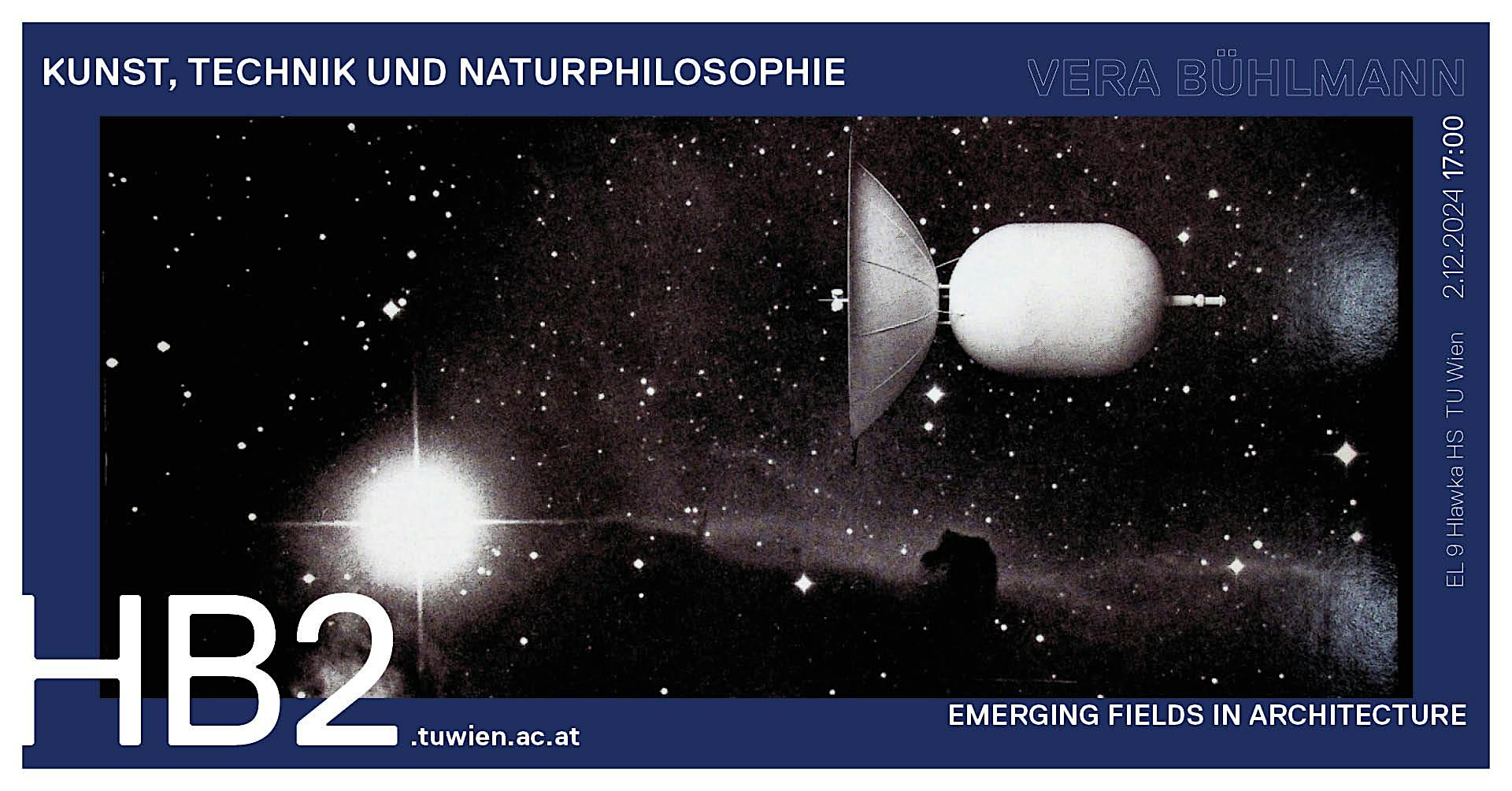
Natural philosophy names the pre-modern tradition of doing science in a way that is not quite< /em> metaphysics but also not not metaphysical: it involves principles (first things) and ratiocinations (mathematical thinking, metricity), it composes machinations (ideations that "work", physically functioning machines) – but philosophically, it resigns from aspiring to integrate its knowledge all into one coherent and exhaustive system. This commitment to Design is what has always linked architecture (and its theorization) to natural philosophy in the Renaissance legacy of generalist thought: it relates mechanics to the cosmos not only by representational "drawings" but by active "displays" of analogical set ups, where a house or a city is a miniature (a building) of the macroscale ideation (cosmos). This talk will expand on Fritz Haller’s 1987 project “Space Colony” as a case example to think about the Digital Renaissance we arguably find ourselves in today. Haller presented this project in a book aptly titled Bauen und Forschen (1987), and by exploring speculatively how this project has been thought, I will discuss it as the scientific and artistic parabolic mirror play of a "place" to think considerately – not quite a utopia but also not not utopian – about the changes in world that are moving with science progress.