This event has been ended!
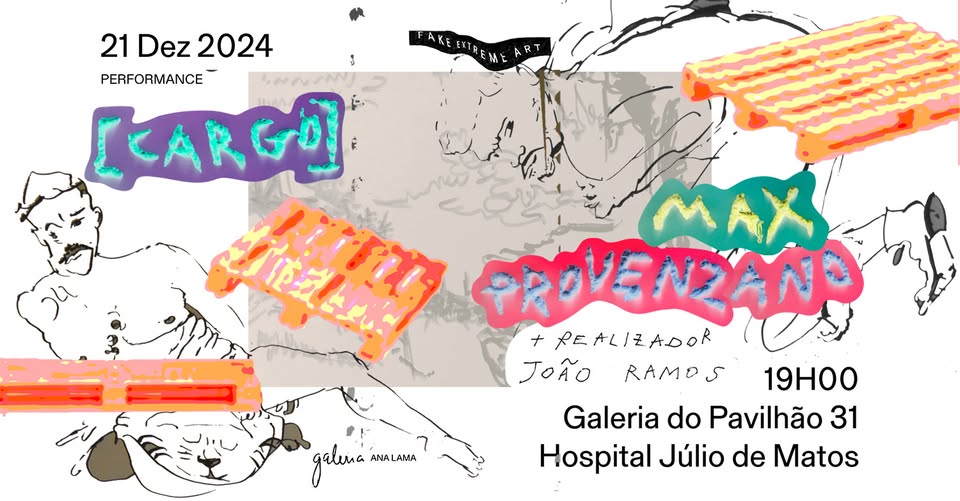
MAx Provenzano no Fake Extreme Art: [Cargo]
Event by: Galeria Ana Lama
Location: Júlio de Matos Hospital (Psychiatric Hospital Centre of Lisbon), Avenida do Brasil 53, Lisboa
Talks & discussions, Exhibitions
About event
A crumpled ball of paper, ready to go in the trash.
Ana Lama also thought about creating a kind of introductory essay text to present the performance of MAx Provenzano [Cargo] at the Pavilhão 31 Gallery, at P28 . But I wasn't seeing how to grasp the theme.
MAx Provenzano is an important Venezuelan conceptual artist born in 1986, currently living in Portugal. He is known for his interventions in performance, installation and photography.
His work has been presented in several international exhibitions and residencies, such as Galerie 21, in Germany, and in performance festivals, such as Starptelpa, in Latvia. This trajectory also earned him recognition in publications and awards in the contemporary art scene. Provenzano has been included in publications such as Contemporary Art of Venezuela Vol. 2 and Emergency Index, which document both emerging and established artistic practices.
Among his interventions, the exhibition «El Tercer Mundo» (2015), at the Valencia Art Museum (Venezuela), stands out, which was vandalized due to its critical content about power relations between China and Venezuela, becoming a testament to the artist's strength and commitment to sociopolitical issues. It is worth noting that, for example, the work of MAx Provenzano is referred to in Jair José Gauna Quiroz's dissertation «Censorship of underground memories in art museums», in the exhibitions «El Tercer Mundo» and «Queermuseu», about the work of MAx Provenzano».
Ana Lama (the curator) even thought about creating a kind of essayistic text about MAx, but, in the middle of the process, she found herself without the strength or theoretical tools to attack the subject. MAx Provenzano's work crossed multiple dimensions in a complex context of discussion about freedom of expression in museum and artistic spaces, configuring a context of trauma in contemporary art.
It was difficult to write about MAx Provenzano's work. For Ana Lama, dealing with a job that had a dramatic impact that was different from the size she was used to was challenging. She existed in an artistic environment full of freedom, an environment in which only more than a whisper could disturb.
A curator is mistaken.
A crumpled ball of paper, ready to go to the trash.
As part of the cycle of performance, video and literature carried out by Galeria Ana Lama, codenamed FEA, Fake ExtremeArt, we will perform at P28 with MAx.
< br/> The performance [Cargo] by MAx Provenzano (Venezuela/Portugal).
[Cargo] is an installation performance, or a happening environment, in which the performer's human body will be confronted with the industrial force of a forklift.
Ana Lama asked me to write this publicity text on her behalf. He didn't have the courage to attack the snail by its antennae. Ana Lama told me that she didn't feel like she had the right to talk about politics. He explains that he runs away from political issues due to his panic attacks...
MAx Provenzano, in the performance [Cargo] that we will see on Saturday, addresses dimensions such as queer identity, the condition of an emigrant or the dehumanization of work.
A crumpled ball of paper, ready to go in the trash.
Ana Lama refuses to write this publicity text, leaving the task to me, at least prepared for such a thing. He is horrified by the pornographic materiality of politics, he “says”, whatever that thing about the materiality of politics is… I am talking here too much about the curator, the theme of the issues surrounding the organization of the event, and less about the artist who we want to be received with the best possible way.
Ana Lama is not capable of facing a publicity text... The work of MAx Provenzano... Perhaps the justification for Ana Lama's curatorial indecision could be... perhaps it becomes complex in its rhetoric too much justification... It could be that, talking about Ana's reservations, the problems she has with writing, her analytical paranoia, it could be that, talking about this subject, we will reach MAx's work.
Ana Lama, as we know, in addition to being a curator is also a novelist, a pioneer in a type of writing. Ana and Michel Houellebecq represent the maximum exponent of an attempt at writing that is projected, today, as materialist terror.
For her, materialism is the true destroyer of human intimacy and spirituality. The author transmits to us a predominantly nihilistic and hedonistic worldview, in a post-modern and post-Christian Europe.
This «materialist horror» of Ana appears both in essay texts on visual arts, and in novels. It evokes philosophical and aesthetic concepts that describe and amplify contemporary moral and social decadence, forcing us, in its reading, to endure exile as a fictional manifesto.
It forces us Ana, in her materialist terror , to a forced exile, in his descriptions full of bitterness, of a physical and psychic impossibility of reality. We are pushed, in your reading, into a surreal dimension of peace. For her, only the dimension of lies and fiction becomes peaceful; we are buried in the world of fiction, a place where we didn't ask to be and where we perceive artifice.
A crumpled ball of paper, ready to go in the trash.
She she presents herself as an idealist on the run. He is afraid of writing about topics that are or were related to reality. Reality becomes reality when multiple descriptions of the same event coexist, a very described dimension (as opposed to the mental dimension). The more testimonies a dimension of our life has or the more it is observed from multiple angles, the less it is possible to speculate about that same dimension.
For Ana, violence and politics are characterized by an excess of observation. He often speaks of imagination and creativity as salvation. This does not mean that, in what he writes, he does not evoke dimensions of reality. On the contrary, it evokes the real to mark scars of subjectivity on its skin. Facts and real people are called as accomplices.
It is ridiculous that Ana Lama is often afraid of writing about real people, and has a megalomaniac and morbid fear of being accused of defamation.
It's caricatured because it doesn't actually describe negative facts about people, nothing that would actually lead someone to confront it. Even so, she takes promiscuous pleasure in hiding a truth that she thinks would leave her compromised. Your imagination increases the impact of things around you. He provokes himself in his writing, evoking the alien dimension of reality, projecting his fiction into the incomprehension of others as a selfish act, something that leaves his arms with chicken skin, a narcissistic fear but which is incomprehensible to the reader.< br/>
A crumpled ball of paper, ready to go in the trash.
He calls fiction questions that make him afraid, but always with the hope or despair that this fear will dissipate. This call to attention to the world of reality comes with the desire to crush it. He wants to propose to humanity the impossibility of journalism, a beautiful and gentle thing. In this attitude, we perceive an ineptitude, as if it were a machine malfunction, a trauma and a fear of reality, a projection.
I decided to write this text to publicize MAx Provenzano thinking: the curator of this event has a trauma, she is unable to fulfill her obligation, which is to value, through her writing, an artist who invited him because he is afraid to write about him.
And I think — what to do?
I come to a conclusion: should we force traumatized people, allergic to facing the real world, people who often have difficulty dealing with excess information?
A crumpled ball of paper, ready to go in the trash.
We must force people, I'm not talking about people who know the weight that reality has, the seriousness it have, and who by strategy relativize, I mean people who are missing a screw, I mean people who cognitively only see the relative? For example, someone who is always peeling back reality, who goes into a trance when they see the layers of reality coming loose, getting tangled up, losing focus, relativizing more than making a decision, and realizing it, having difficulty adhering to it. If someone cannot, due to ineptitude, get out of the relativization of everything.
If they do not accept even the majority will of the people closest to them, their collective morality, the morality of their neighbors, accept local morality for the less. If you don't accept it with confidence, what will you do?
Ana Lama has already confessed to me that she prefers not to adhere to moral standards because she is not sure — she is afraid of being deceived by people. She says that, despite not appearing to, she rarely has a personal opinion. She thinks that whenever she talks, she is like a parrot that repeats things. He spits out moral ideas and conclusions about facts that are not his moral ideas or conclusions about facts, and which is why he cannot assume them. These are things you heard from friends, in the news, or read in books. You often argue in public, but what you say is not yours; What you are talking about is the vomiting of excess information, it is a tendency that is in your mind, a collective stubbornness that condenses in your head. It's the best possible, but it's vomit, it's not yours — Ana Lama would take too long to think of something of her own.
The Gallery of Pavilion 31, a space promoted by the P28 association and located at the Júlio Psychiatric Hospital de Matos, currently hosts the exhibition «Taxi Square and an Airport», with works by João Louro and José Jorge Monteiro. It is in this environment that the performance [Cargo] will take place.
MAx Provenzano explores the body and physical resistance, the relationship between the artist and the public, the limits of pain and the availability of the mind. Graduated in Chemistry from UCV, his artistic process is divided into two dimensions, one more corporeal, with live (body) presentations, and one more archival. From the point of view of the archival dimension, it produces collections that are also part of an organization and conceptual investigation. This is distinguished by its analytical rigor, reflected in its material experiments. Often these are displayed in hybrid file format.
After migrating to Mexico in 2017, MAx developed the project «(IM)PORTAR» in collaboration with curator Pancho López, touching on migration issues. Influenced by concepts such as situationism and dérive, he catalogs data and materials that reflect his experiences.
On December 21st, we can also expect Provenzano's action to create a dialogue with director João Ramos, responsible for documentation and the creation of a video performance based on this live performance. It will be an opportunity for MAx Provenzano to explore, once again, the transience of matter and the dynamic relationship between his body, space and identity.
I reopen the sheet of paper and take over the text.< br/>
Director's minibio
João Ramos (b. 1991, Peso da Régua), descendant of Angolans, lives and works in Lisbon. Graduated in Photography and Video from ESART – Escola Superior de Artes Aplicadas, in Castelo Branco, and in Cinema – Moving Image, from Ar.Co – Center for Art and Visual Communication, he consolidated authorial skills in editing, directing and photography. In his work process, he uses various devices, from moving images to photography. The fictional and dreamlike dimension of the relationship between sound exploration and visual capture refers to an inherent mystery in his work. Furthermore, he dedicates himself to film programming and curating independent artists in Lisbon, publicly presenting his films in sessions such as «Jornal S/Título», «Cosmos», «Fuso» and «Batalha».
______________________________________________
Free entry M/16
Reservations: @[email protected]
Technical details:
PERFORMANCE : MAx Provenzano
CURATORY: Nuno Oliveira and Margarida Chambel
VIDEO PRODUCTION: João Ramos
TECHNICAL SUPPORT: Isabel Simões
< br />VIDEO AND COMMUNICATION SUPPORT: Gabriel Marmelo
COMMUNICATION SUPPORT:Luísa Morante, Teresa Melo
TEXT REVIEW: Joaquim E. Oliveira
TRANSLATION : Maia Horta
SUPPORT: Portuguese Republic - Culture DGARTES; Lisbon City Council; Gaivotas Cultural Center; Association P28