This event has been ended!
Mindsets and Literacy Development: How Beliefs About Ability Shape Reading
Event by: Ústav výskumu sociálnej komunikácie SAV, verejná výskumná inštitúcia
Location: Slovenská akadémia vied, Dúbravská cesta 9, Bratislava - Karlova Ves
Talks & discussions
About event
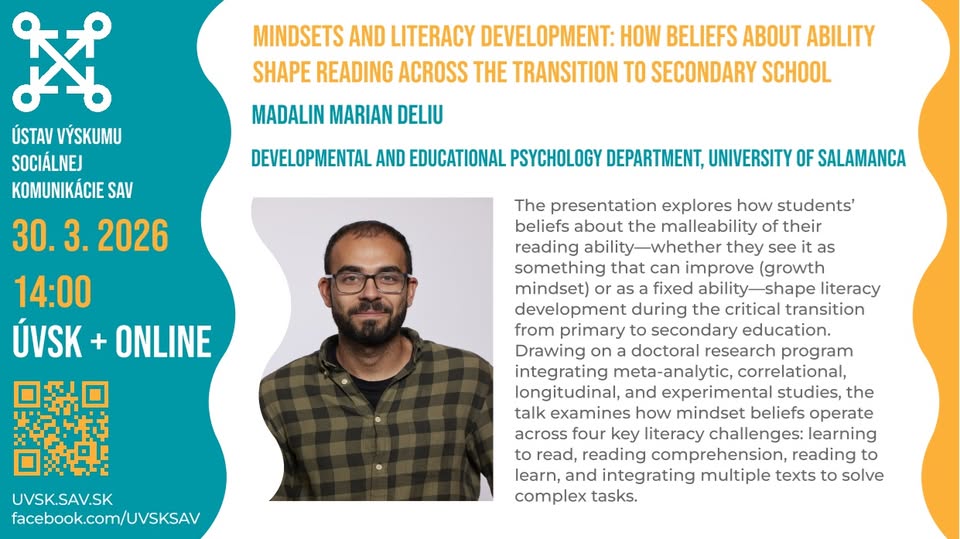
The presentation explores how students’ beliefs about the malleability of their reading ability—whether they see it as something that can improve (growth mindset) or as a fixed ability—shape literacy development during the critical transition from primary to secondary education. Drawing on a doctoral research program integrating meta-analytic, correlational, longitudinal, and experimental studies, the talk examines how mindset beliefs operate across four key literacy challenges: learning to read, reading comprehension, reading to learn, and integrating multiple texts to solve complex tasks.
Beyond cognitive skills, the research highlights the role of socio-cognitive factors such as self-efficacy, interest, enjoyment, persistence, and self-regulation. Findings suggest nuanced pathways from growth and fixed mindsets to reading socio-cognitive factors and reading achievement: growth mindset functions as a motivational scaffold that supports learners’ confidence and sustained engagement with reading tasks, whereas fixed relates negatively with reading achievement. In particular, self-efficacy emerges as a central mechanism linking growth-oriented beliefs to literacy performance.
The talk will also present evidence from a brief experimental manipulation designed to foster growth-oriented beliefs about reading ability in school settings. The findings illustrate how small changes in learning environments can influence students’ motivational resources and potentially support literacy development during educational transitions.
Overall, the presentation offers new insights into how beliefs about ability interact with motivational processes in literacy learning and discusses implications for research and theoretical underpinnings. The seminar will be in English.
Beyond cognitive skills, the research highlights the role of socio-cognitive factors such as self-efficacy, interest, enjoyment, persistence, and self-regulation. Findings suggest nuanced pathways from growth and fixed mindsets to reading socio-cognitive factors and reading achievement: growth mindset functions as a motivational scaffold that supports learners’ confidence and sustained engagement with reading tasks, whereas fixed relates negatively with reading achievement. In particular, self-efficacy emerges as a central mechanism linking growth-oriented beliefs to literacy performance.
The talk will also present evidence from a brief experimental manipulation designed to foster growth-oriented beliefs about reading ability in school settings. The findings illustrate how small changes in learning environments can influence students’ motivational resources and potentially support literacy development during educational transitions.
Overall, the presentation offers new insights into how beliefs about ability interact with motivational processes in literacy learning and discusses implications for research and theoretical underpinnings. The seminar will be in English.