This event has been ended!
MISA A BUENOS AIRES & SZMB
MASS IN BUENOS AIRES & SZMB
Event by: Les Sirènes, The Ladies Ensemble, Spevácky zbor mesta Bratislavy
Location: Church of the Elevation of the Holy Cross, Klariská, Bratislava - Staré Mesto
Tickets: Get tickets
Concerts
About event
MISA A BUENOS AIRES - Martín Palmeri
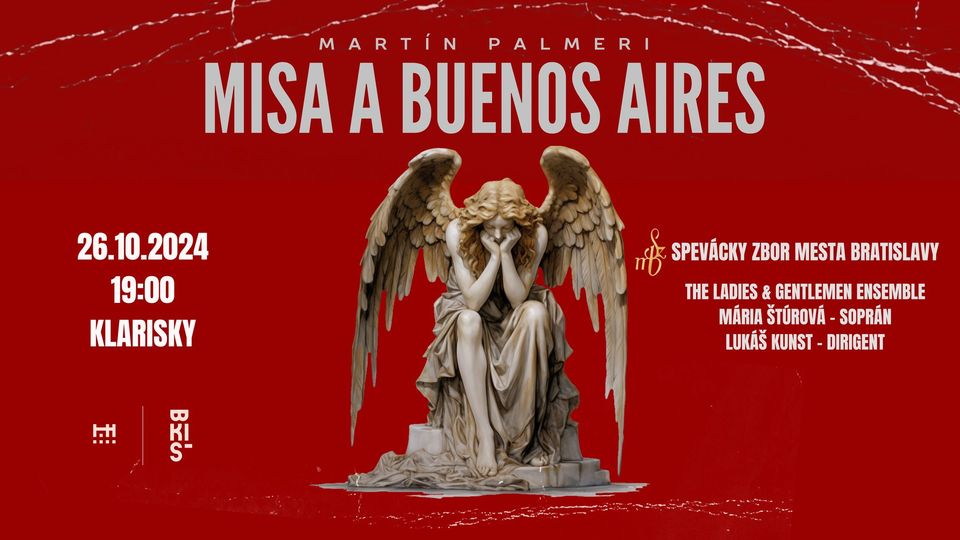
26.10.2024 l 19:00 l Klarisky
Choir of the City of Bratislava
Les Sirènes
The Ladies & Gentlemen Ensemble
Mária Štúrová - soprano
Lukáš Kunst - conductor
Tickets in the Predpredaj.sk network
Event partners:
BKIS, http://xn--mojakultra-udb.sk/
"This work it was written with the intention of offering my choirs music that could bring us closer to the style of the tango repertoire. Because it was while working with my choirs that I really discovered how difficult and complex the interpretation of traditional tango is by choirs. This work is therefore a tribute to choirs, tango and at the same time to its creators..."
Misa a Buenos Aires by Martín Palmeri is significantly inspired by the traditional tango typical of his native Argentina, or in the tango nuevo style, which was greatly popularized by the work of his famous compatriot Astor Piazzolla.
Misa a Buenos Aires, also called Misatango, was premiered by the Orquesta Sinfónica de Cuba in 1996 and was relatively unknown until 2013, when it was performed in Rome at the Church of Saint Ignatius of Loyola during the International Festival of Music and Sacred Art in the Vatican. The organizers then chose it in honor of the former cardinal from Buenos Aires, Jorge Mario Bergoglio, who became Pope Francis in 2013.
The Buenos Aires Mass was conceived by Palmeri based on the Mass Ordinary that we have been used to for centuries. : the mass consists of the classic liturgical parts Kyrie, Gloria, Credo, Sanctus, Benedictus and Agnus Dei, in which, however, the composer already demonstrates an impressive talent for integrating harmonies, syncopated rhythms and overall stylistic features of tango into his work, thus giving it an unusual appeal and uniqueness .
The score is intended for a solo female voice, a mixed choir, the impressive instrumental accompaniment includes a characteristic instrument for tango - the bandoneon or accordion - string quintet and piano.
The roots of the tango date back to South-West Africa and were brought to South America in the 17th and 18th centuries by people who were sold here as slaves. Over time, elements of music and dance from Europe, especially Italy, Spain and Portugal, as well as from the original indigenous people, especially in the socially weaker neighborhoods of Buenos Aires and Montevideo, were combined here with this African music.
The form of tango, which as we know it today, it developed around 1880 in the dance halls and possibly the brothels of Buenos Aires, where it initially acquired an infamous reputation as an uncouth and socially disturbing suggestive display of the lower classes. At the beginning of the 20th century, however, tango became socially acceptable and moved back across the Atlantic Ocean; until the outbreak of the First World War, it created a tango frenzy in
European upper class circles. The first tango-inspired music by well-known composers appeared around 1910. Beginning in the 1950s, tango composers and dancers began experimenting with new styles, harmonic progressions, and instrumentation. The most important among them was Astor Piazzolla, who in the form of the so-called he elevated tango nuevo from classical dance music to the repertoire of concert stages and, by applying
contemporary compositional forms, contributed to the creation of a new, unique and extremely complex musical artificial genre and thus opened the imaginary door for a number of other composers, including Martín Palmeri, to let themselves in their work be carried away by this inspiring and listener-appealing genre.
26.10.2024 l 19:00 l Klarisky
Choir of the City of Bratislava
Les Sirènes
The Ladies & Gentlemen Ensemble
Mária Štúrová - soprano
Lukáš Kunst - conductor
Tickets in the Predpredaj.sk network
Event partners:
BKIS, http://xn--mojakultra-udb.sk/
"This work it was written with the intention of offering my choirs music that could bring us closer to the style of the tango repertoire. Because it was while working with my choirs that I really discovered how difficult and complex the interpretation of traditional tango is by choirs. This work is therefore a tribute to choirs, tango and at the same time to its creators..."
Misa a Buenos Aires by Martín Palmeri is significantly inspired by the traditional tango typical of his native Argentina, or in the tango nuevo style, which was greatly popularized by the work of his famous compatriot Astor Piazzolla.
Misa a Buenos Aires, also called Misatango, was premiered by the Orquesta Sinfónica de Cuba in 1996 and was relatively unknown until 2013, when it was performed in Rome at the Church of Saint Ignatius of Loyola during the International Festival of Music and Sacred Art in the Vatican. The organizers then chose it in honor of the former cardinal from Buenos Aires, Jorge Mario Bergoglio, who became Pope Francis in 2013.
The Buenos Aires Mass was conceived by Palmeri based on the Mass Ordinary that we have been used to for centuries. : the mass consists of the classic liturgical parts Kyrie, Gloria, Credo, Sanctus, Benedictus and Agnus Dei, in which, however, the composer already demonstrates an impressive talent for integrating harmonies, syncopated rhythms and overall stylistic features of tango into his work, thus giving it an unusual appeal and uniqueness .
The score is intended for a solo female voice, a mixed choir, the impressive instrumental accompaniment includes a characteristic instrument for tango - the bandoneon or accordion - string quintet and piano.
The roots of the tango date back to South-West Africa and were brought to South America in the 17th and 18th centuries by people who were sold here as slaves. Over time, elements of music and dance from Europe, especially Italy, Spain and Portugal, as well as from the original indigenous people, especially in the socially weaker neighborhoods of Buenos Aires and Montevideo, were combined here with this African music.
The form of tango, which as we know it today, it developed around 1880 in the dance halls and possibly the brothels of Buenos Aires, where it initially acquired an infamous reputation as an uncouth and socially disturbing suggestive display of the lower classes. At the beginning of the 20th century, however, tango became socially acceptable and moved back across the Atlantic Ocean; until the outbreak of the First World War, it created a tango frenzy in
European upper class circles. The first tango-inspired music by well-known composers appeared around 1910. Beginning in the 1950s, tango composers and dancers began experimenting with new styles, harmonic progressions, and instrumentation. The most important among them was Astor Piazzolla, who in the form of the so-called he elevated tango nuevo from classical dance music to the repertoire of concert stages and, by applying
contemporary compositional forms, contributed to the creation of a new, unique and extremely complex musical artificial genre and thus opened the imaginary door for a number of other composers, including Martín Palmeri, to let themselves in their work be carried away by this inspiring and listener-appealing genre.