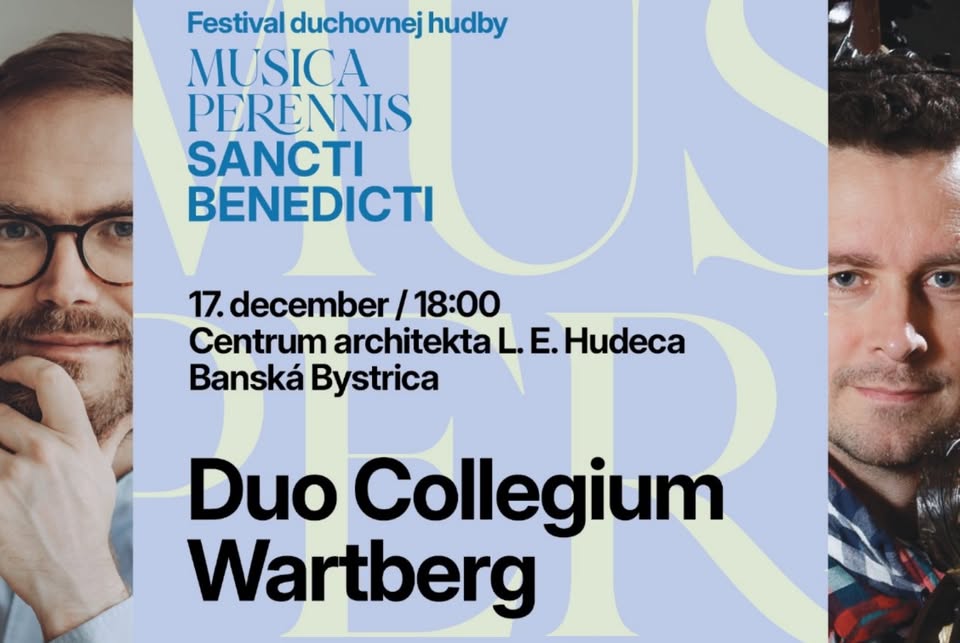
This event has been ended!
Musica Perenis Sancti Benedicti
The music of Perenis Saint Benedict
Event by: Bassfest+ 2025, Musica Perennis Sancti Benedicti
Location: CALEH n.o., Skuteckého 22, Banská Bystrica
Topics: Classical music
About event
Duo Collegium Wartberg, composed of Martin Rumler and Ján Krigovský, will play a collection of compositions for violin, baroque violin, viola, G violone, Viennese violon and double bass.
Brief about the concert:
> two renowned artists
> 6 musical instruments from different historical periods
> unique environment of Spathova Vila, an architectural monument, which you can read more about here: https://www.visitbanskabystrica.sk/art/spathova-vila/
> On the concert will feature a program that is not just a random selection of compositions, but an **ambitious study of the development of music for violin and double bass** - from historical roots to the latest challenging work, with an emphasis on the presentation of domestic authors and the solo mastery of both performers. cello).
Program:
1.
J. N. Hummel (1778-1837):
Divertimento in D for violin and Viennese violin
2.
D. Gabrieli (1659-1690):
Ricercar No. 3 in E flat for G-violon 4'
3.
J.S. Bach (1685-1750):
Two-part invention (arrangement for violin and cello) no. 13 in A minor BWV 784,
4.
E. Krák (*1958):
Hymn on a Muse for viola and double bass 5'
5.
D. Rumler (*1988):
Caprice for Violin and Double Bass (2020) 7'
6.
R. Glière (1875-1956): A
ndante and Gavotte from the suite "Huit Morceaux" op. 39 for violin and cello
7.
M. Gajdoš (*1948):
Song of the Troubadour for violin and double bass 3'
8.
V. Kubička (*1953):
Passacaglia "Es-D-B-C" for solo double bass (2018) 7'
9.
J. Hatrík (1941-2021):
Ciacona interrotta per violino solo (1976) 8'
10.
M, Gajdoš (*1948):
Toccata for double bass solo 3'
11.
K. Penderecki (1933-2020):
Duo Concertante per violino e contrabasso (2010) 6'
About the program:
-->
More detailed considerations and interesting things about the program, a critic's view:
The composition of the program seems very thoughtful and with a clear intention:
1. **Historical Presentation of the Repertoire:**
Show that music for violin and double bass is not only a modern thing, but has its roots in classicism (Hummel) and baroque (Bach adaptations, inspiration (Ciacona, Passacaglia)).
2. **Virtuosity and Technical Possibilities:**
Through solo pieces (Kubička, Hatrík, Gajdoš Toccata) and an extremely demanding Duo (Penderecki), show the **technical prowess and full-fledged role** of the double bass, which often remains in the shadow of stringed instruments.
3. **Dramaturgy of Contrasts:**
The program is based on rotation. For example:
* Old vs. New: Hummel (1) vs. Rumler (5).
* Tonality vs. Atonality: Gajdoš (7) vs. Penderecki (11).
* Duet vs. Solo: Rumler (5) vs. Kubička (8).
* Lyrics vs. Rhythm: Glière (6) vs. Bagpipe Toccata (10).
4. **Search and Discovery:**
The inclusion of lesser-known authors (Domenico **Gabrieli**, who focused mainly on cello and violin) and modern but important names (Penderecki, Krák) makes the program **discovery** for the audience.
## 🎻 Overview of interests and contrasts - even more in depth:
### 1. Timeline and Contrast Styles: Journey through the Centuries
The program covers a huge span of time, which is its greatest contrast.
### 2. Combination of Instruments: From Viola da Gamba to Double Bass
The program is based on a non-standard but historical combination of **violin** and **double bass**.
* **Historical Exotics:**
**Hummel's** *Divertimento* (1) is originally written for the *Viennese Violon*, which is basically the double bass of the time - shows the **historical function** of the double bass as a chamber, not just an orchestral instrument.
* **Adaptations:**
The adaptations of Bach's *Inventions* (3) and Glièr's *Huit Morceaux* (6) show that the **repertoire for violin and double bass is often expanded** thanks to arrangements from other combinations (violin/cello, two pianos, etc.), which is a common practice in chamber music.
* **Original Works:**
The highlight is a block of original works for this combination (Rumler, Gajdoš, Penderecki), which shows that **the double bass is a full-fledged solo and chamber partner**.
### 3. Performances of Solo Instruments
Inclusion the three solo pieces have a **expressive intention** that allows each artist to perform in full intensity.
* **Contrabass Solo:**
**Kubiček's** *Passacaglia* (8) and **Gajdoš's** *Toccata* (10) demonstrate the virtuosity and depth of the double bass - its rhythmic power (Toccata) and meditative/structural complexity (Passacaglia) (duo) parts.
### 4. Slovak and Czech Creation: Home Representation
The program has a strong representation of Slovak and Czech authors of different generations: **Krák** (SK), **Rumler** (CZ), **Gajdoš** (CZ), **Kubička** (SK), **Hatrík** (SK).
* **Compliance and Support:**
It looks like **knowing support of domestic work** and its presentation in the context of international names (Bach, Hummel, Penderecki).
* **Contrast Generations:**
From the older generation (Gajdoš, Hatrík) to the middle (Krák, Kubička) and young (Rumler). Rumler's *Caprice* is a very new work (2020), which shows that the artists are **actively looking for new compositions**.
Brief about the concert:
> two renowned artists
> 6 musical instruments from different historical periods
> unique environment of Spathova Vila, an architectural monument, which you can read more about here: https://www.visitbanskabystrica.sk/art/spathova-vila/
> On the concert will feature a program that is not just a random selection of compositions, but an **ambitious study of the development of music for violin and double bass** - from historical roots to the latest challenging work, with an emphasis on the presentation of domestic authors and the solo mastery of both performers. cello).
Program:
1.
J. N. Hummel (1778-1837):
Divertimento in D for violin and Viennese violin
2.
D. Gabrieli (1659-1690):
Ricercar No. 3 in E flat for G-violon 4'
3.
J.S. Bach (1685-1750):
Two-part invention (arrangement for violin and cello) no. 13 in A minor BWV 784,
4.
E. Krák (*1958):
Hymn on a Muse for viola and double bass 5'
5.
D. Rumler (*1988):
Caprice for Violin and Double Bass (2020) 7'
6.
R. Glière (1875-1956): A
ndante and Gavotte from the suite "Huit Morceaux" op. 39 for violin and cello
7.
M. Gajdoš (*1948):
Song of the Troubadour for violin and double bass 3'
8.
V. Kubička (*1953):
Passacaglia "Es-D-B-C" for solo double bass (2018) 7'
9.
J. Hatrík (1941-2021):
Ciacona interrotta per violino solo (1976) 8'
10.
M, Gajdoš (*1948):
Toccata for double bass solo 3'
11.
K. Penderecki (1933-2020):
Duo Concertante per violino e contrabasso (2010) 6'
About the program:
-->
More detailed considerations and interesting things about the program, a critic's view:
The composition of the program seems very thoughtful and with a clear intention:
1. **Historical Presentation of the Repertoire:**
Show that music for violin and double bass is not only a modern thing, but has its roots in classicism (Hummel) and baroque (Bach adaptations, inspiration (Ciacona, Passacaglia)).
2. **Virtuosity and Technical Possibilities:**
Through solo pieces (Kubička, Hatrík, Gajdoš Toccata) and an extremely demanding Duo (Penderecki), show the **technical prowess and full-fledged role** of the double bass, which often remains in the shadow of stringed instruments.
3. **Dramaturgy of Contrasts:**
The program is based on rotation. For example:
* Old vs. New: Hummel (1) vs. Rumler (5).
* Tonality vs. Atonality: Gajdoš (7) vs. Penderecki (11).
* Duet vs. Solo: Rumler (5) vs. Kubička (8).
* Lyrics vs. Rhythm: Glière (6) vs. Bagpipe Toccata (10).
4. **Search and Discovery:**
The inclusion of lesser-known authors (Domenico **Gabrieli**, who focused mainly on cello and violin) and modern but important names (Penderecki, Krák) makes the program **discovery** for the audience.
## 🎻 Overview of interests and contrasts - even more in depth:
### 1. Timeline and Contrast Styles: Journey through the Centuries
The program covers a huge span of time, which is its greatest contrast.
### 2. Combination of Instruments: From Viola da Gamba to Double Bass
The program is based on a non-standard but historical combination of **violin** and **double bass**.
* **Historical Exotics:**
**Hummel's** *Divertimento* (1) is originally written for the *Viennese Violon*, which is basically the double bass of the time - shows the **historical function** of the double bass as a chamber, not just an orchestral instrument.
* **Adaptations:**
The adaptations of Bach's *Inventions* (3) and Glièr's *Huit Morceaux* (6) show that the **repertoire for violin and double bass is often expanded** thanks to arrangements from other combinations (violin/cello, two pianos, etc.), which is a common practice in chamber music.
* **Original Works:**
The highlight is a block of original works for this combination (Rumler, Gajdoš, Penderecki), which shows that **the double bass is a full-fledged solo and chamber partner**.
### 3. Performances of Solo Instruments
Inclusion the three solo pieces have a **expressive intention** that allows each artist to perform in full intensity.
* **Contrabass Solo:**
**Kubiček's** *Passacaglia* (8) and **Gajdoš's** *Toccata* (10) demonstrate the virtuosity and depth of the double bass - its rhythmic power (Toccata) and meditative/structural complexity (Passacaglia) (duo) parts.
### 4. Slovak and Czech Creation: Home Representation
The program has a strong representation of Slovak and Czech authors of different generations: **Krák** (SK), **Rumler** (CZ), **Gajdoš** (CZ), **Kubička** (SK), **Hatrík** (SK).
* **Compliance and Support:**
It looks like **knowing support of domestic work** and its presentation in the context of international names (Bach, Hummel, Penderecki).
* **Contrast Generations:**
From the older generation (Gajdoš, Hatrík) to the middle (Krák, Kubička) and young (Rumler). Rumler's *Caprice* is a very new work (2020), which shows that the artists are **actively looking for new compositions**.
Events in Banská Bystrica today · Events in Banská Bystrica this weekend