This event has been ended!
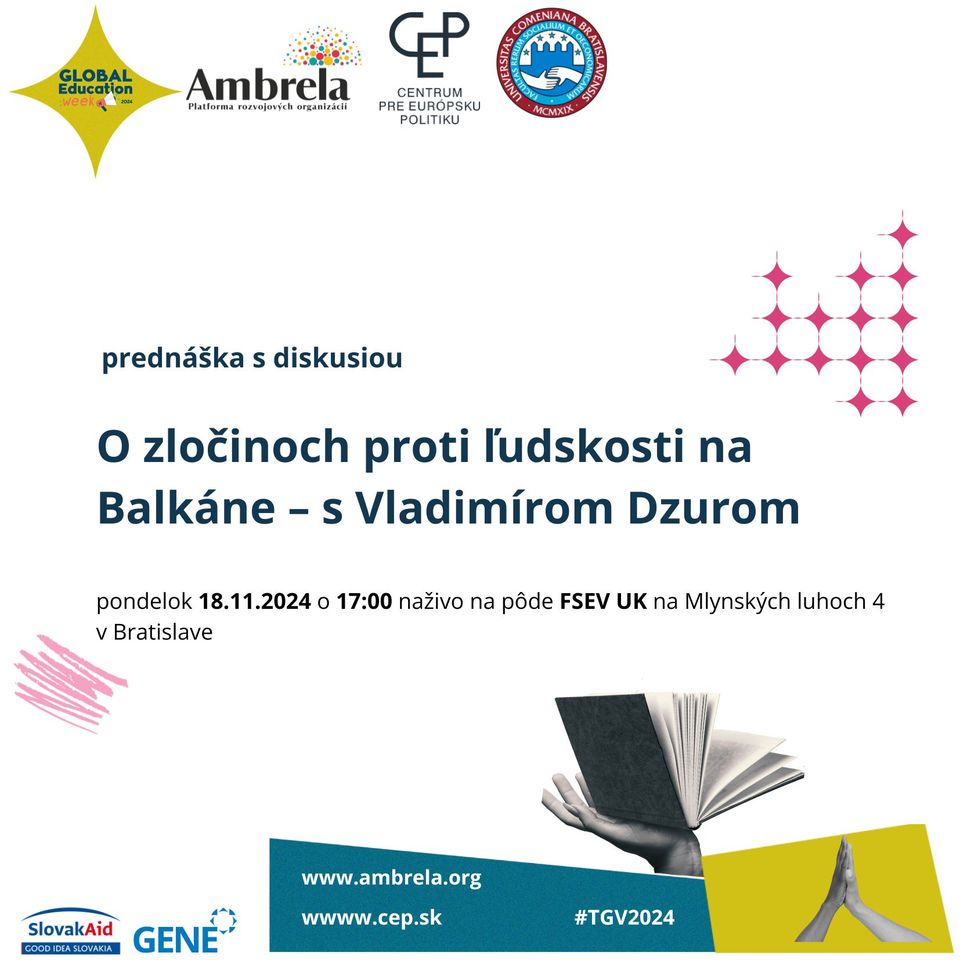
O zločinoch proti ľudskosti na Balkáne – s Vladimírom Dzurom (prednáška s diskusiou)
On crimes against humanity in the Balkans - with Vladimír Dzura (lecture with discussion)
Event by: Ambrela, Centrum pre európsku politiku
Location: Fakulta sociálnych a ekonomických vied Univerzity Komenského v Bratislave, Mlynské luhy, Bratislava
Talks & discussions
About event
You wonder what is a war crime and what is a chain of evil; how the investigation of crimes in the Balkans was conducted; and what similarities can be seen between the polarization of society in Slovakia, the Balkan wars and Russian aggression in Ukraine?
Come on Monday (18 November from 17:00 to 18:30) at the Faculty of Social and Economic Sciences Comenius University at Mlynské luhoch 4 in Bratislava, where there will be a lecture with a discussion in English on the topic: 'On crimes against humanity on Balkans' from the workshop of the Center for European Policy (CEP) in cooperation with the Umbrella platform and FSEV UK. Vladimír Dzuro - former investigator of the International Criminal Tribunal for the former Yugoslavia - will give a lecture.
In his narration, Mr. Dzuro takes you to places, only a few hours away by car from Slovakia, where thirty years ago the most terrible war crimes since the Second World War took place. You will also learn what we as humans are capable of doing when we stop controlling ourselves; also how the aforementioned Balkan wars and manifestations of Russian aggression beyond our borders affect us today in Central Europe. This will be followed by a live discussion between the speaker and the students present and the general public.
The lecture with a discussion is part of the Global Education Week (GVE), which is being implemented by Umbrella with its members and observers in Slovakia in the second half of November with the support of SlovakAid and GENE. Kamil Sládek - the chairman of the Center for European Policy (CEP) provided the thematic support and prepared it. More information about the discussion and the entire #TGV2024 program can be found at: www.ambrela.org.
More about the organizers lectures with discussion:
Platform of development organizations - Umbrella is an umbrella organization of 30 mostly non-governmental organizations in Slovakia, which are dedicated to development cooperation, humanitarian aid, sustainable development at home and/or abroad, with half of them engaged in global education. Umbrella actively represents the common interests of its members and observers at home and abroad, in addition to advocacy and capacity building, it is also dedicated to public awareness (increasing awareness of ODA - the Slovak Republic's official development aid in the world). Its goal is: to be a direct participant and actor in the field of development cooperation and foreign policy of the Slovak Republic, the EU and other institutions aimed at sustainable development in less developed countries and/or Slovakia; to contribute to the formation of the awareness of people in the Slovak Republic to solidarity and mutual aid, and thus contribute to solving the problem of poverty, lack of freedom and humanitarian crises in the world. Umbrella's flagship events are the Umbrella Development Forum (ADF) and the Global Education Week (TGV).
The Center for European Policy (CEP) is a member of the Umbrella platform, active in the field of global education. For a long time, he has been dedicated to learning about the integration process in Europe, strengthening active citizenship and preventing the radicalism of young people. It implements projects in Slovakia, Bosnia and Herzegovina (since 2004), Ukraine (since 2008) and the Czech Republic (2011). Since 2017, he has been working on projects focused on the issue of radicalization and de-radicalization against the background of developments in the former Yugoslavia in the 1980s and 1990s. CEP focuses its activities on sensitizing young people to manifestations of discrimination in public discourse and creating effective teaching materials.
Come on Monday (18 November from 17:00 to 18:30) at the Faculty of Social and Economic Sciences Comenius University at Mlynské luhoch 4 in Bratislava, where there will be a lecture with a discussion in English on the topic: 'On crimes against humanity on Balkans' from the workshop of the Center for European Policy (CEP) in cooperation with the Umbrella platform and FSEV UK. Vladimír Dzuro - former investigator of the International Criminal Tribunal for the former Yugoslavia - will give a lecture.
In his narration, Mr. Dzuro takes you to places, only a few hours away by car from Slovakia, where thirty years ago the most terrible war crimes since the Second World War took place. You will also learn what we as humans are capable of doing when we stop controlling ourselves; also how the aforementioned Balkan wars and manifestations of Russian aggression beyond our borders affect us today in Central Europe. This will be followed by a live discussion between the speaker and the students present and the general public.
The lecture with a discussion is part of the Global Education Week (GVE), which is being implemented by Umbrella with its members and observers in Slovakia in the second half of November with the support of SlovakAid and GENE. Kamil Sládek - the chairman of the Center for European Policy (CEP) provided the thematic support and prepared it. More information about the discussion and the entire #TGV2024 program can be found at: www.ambrela.org.
More about the organizers lectures with discussion:
Platform of development organizations - Umbrella is an umbrella organization of 30 mostly non-governmental organizations in Slovakia, which are dedicated to development cooperation, humanitarian aid, sustainable development at home and/or abroad, with half of them engaged in global education. Umbrella actively represents the common interests of its members and observers at home and abroad, in addition to advocacy and capacity building, it is also dedicated to public awareness (increasing awareness of ODA - the Slovak Republic's official development aid in the world). Its goal is: to be a direct participant and actor in the field of development cooperation and foreign policy of the Slovak Republic, the EU and other institutions aimed at sustainable development in less developed countries and/or Slovakia; to contribute to the formation of the awareness of people in the Slovak Republic to solidarity and mutual aid, and thus contribute to solving the problem of poverty, lack of freedom and humanitarian crises in the world. Umbrella's flagship events are the Umbrella Development Forum (ADF) and the Global Education Week (TGV).
The Center for European Policy (CEP) is a member of the Umbrella platform, active in the field of global education. For a long time, he has been dedicated to learning about the integration process in Europe, strengthening active citizenship and preventing the radicalism of young people. It implements projects in Slovakia, Bosnia and Herzegovina (since 2004), Ukraine (since 2008) and the Czech Republic (2011). Since 2017, he has been working on projects focused on the issue of radicalization and de-radicalization against the background of developments in the former Yugoslavia in the 1980s and 1990s. CEP focuses its activities on sensitizing young people to manifestations of discrimination in public discourse and creating effective teaching materials.