This event has been ended!
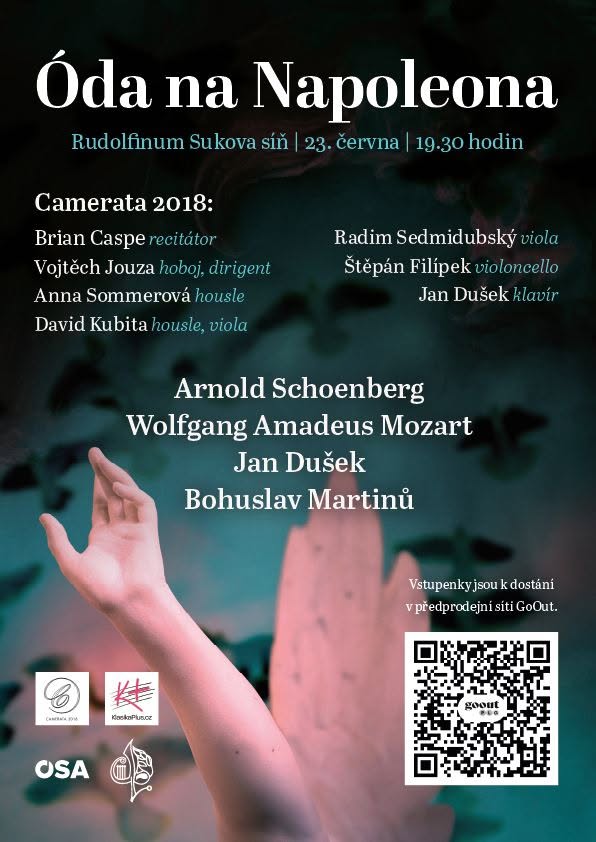
Óda na Napoleona
Ode to Napoleon
Event by: Camerata 2018
Location: Rudolfinum, Alšovo nábřeží 12, Staré město - Praha 1
Tickets: Get tickets
About event
6/23 at 7:30 p.m., Sukova hall of the Rudolfinum
A. Schoenberg: Ode to Napoleon Bonaparte Op. 41
J. Dušek: Appeal, quintet for oboe and string quartet - world premiere
W. A. Mozart: Quintet in C minor for oboe and strings
B. Martinů: Quartet for oboe, violin, cello and piano
Camerata 2018:
Brian Caspe – reciter
Vojtěch Jouza – oboe, conductor
Anna Sommerová – violin
David Kubita – violin, viola
Radim Sedmidubský – viola
Štěpán Filípek – cello
Jan Dušek – piano
Chamber the Camerata 2018 set presents rarely performed compositions of various styles that combine social appeal and depth of musical message that are very current. The concert is called "Ode to Napoleon" after Arnold Schoenberg's composition, which will be played at the end of the concert. This melodrama for reciter, string quartet and piano was created during the Second World War to a text by Lord Byron that is a protest against tyranny. Schoenberg used the text as a metaphor for the Nazi leaders of the time. The impressive anti-war work resonates even today. American actor Brian Caspe will perform as the reciter.
The concert will begin with the world premiere of Jan Dušek's composition Apel for oboe and string quartet. Here, the author resolves the conflict between the individual and society in a tense time, which requires hope, faith, but also determination and strength to fight for the right ideas despite the feeling of loneliness.
Wolfgang Amadeus Mozart's oboe quintet brings darker tones with its minor key. However, this is not a tragic work, rather it evokes a kind of special inner silence, seclusion or contemplation when listening.
The Bohuslav Martinů Quartet was created in 1947, the year when the author was recovering from a serious injury and the situation in the world began to deteriorate again after the optimism that occurred after the end of the war. Despite these tragic realities, which resonate in the slow movement, the extreme movements are full of joyful music that brings hope.
Tickets are available on the GoOut presale network.
J. Dušek: Appeal, quintet for oboe and string quartet - world premiere
W. A. Mozart: Quintet in C minor for oboe and strings
B. Martinů: Quartet for oboe, violin, cello and piano
A. Schoenberg: Ode to Napoleon Bonaparte Op. 41
Camerata 2018:
Brian Caspe – Reciter
Vojtěch Jouza – Oboe, Conductor
Anna Sommerová – Violin
David Kubita – Violin, Viola
Radim Sedmidubský – Viola
Štěpán Filípek – Cello
Jan Dušek – Piano
The Camerata 2018 chamber ensemble presents rarely performed compositions of various styles, which are connected by a social appeal and the depth of the musical message, which are very topical. The concert is called "Ode to Napoleon" after the composition by Arnold Schoenberg, which will be heard at the end of the concert. This melodrama for reciter, string quartet and piano was created during World War II to a text by Lord Byron, which is a protest against tyranny. Schoenberg used the text as a metaphor for the Nazi leaders of the time. The impressive anti-war work still resonates today.
Tickets on-line in GoOut.
A. Schoenberg: Ode to Napoleon Bonaparte Op. 41
J. Dušek: Appeal, quintet for oboe and string quartet - world premiere
W. A. Mozart: Quintet in C minor for oboe and strings
B. Martinů: Quartet for oboe, violin, cello and piano
Camerata 2018:
Brian Caspe – reciter
Vojtěch Jouza – oboe, conductor
Anna Sommerová – violin
David Kubita – violin, viola
Radim Sedmidubský – viola
Štěpán Filípek – cello
Jan Dušek – piano
Chamber the Camerata 2018 set presents rarely performed compositions of various styles that combine social appeal and depth of musical message that are very current. The concert is called "Ode to Napoleon" after Arnold Schoenberg's composition, which will be played at the end of the concert. This melodrama for reciter, string quartet and piano was created during the Second World War to a text by Lord Byron that is a protest against tyranny. Schoenberg used the text as a metaphor for the Nazi leaders of the time. The impressive anti-war work resonates even today. American actor Brian Caspe will perform as the reciter.
The concert will begin with the world premiere of Jan Dušek's composition Apel for oboe and string quartet. Here, the author resolves the conflict between the individual and society in a tense time, which requires hope, faith, but also determination and strength to fight for the right ideas despite the feeling of loneliness.
Wolfgang Amadeus Mozart's oboe quintet brings darker tones with its minor key. However, this is not a tragic work, rather it evokes a kind of special inner silence, seclusion or contemplation when listening.
The Bohuslav Martinů Quartet was created in 1947, the year when the author was recovering from a serious injury and the situation in the world began to deteriorate again after the optimism that occurred after the end of the war. Despite these tragic realities, which resonate in the slow movement, the extreme movements are full of joyful music that brings hope.
Tickets are available on the GoOut presale network.
J. Dušek: Appeal, quintet for oboe and string quartet - world premiere
W. A. Mozart: Quintet in C minor for oboe and strings
B. Martinů: Quartet for oboe, violin, cello and piano
A. Schoenberg: Ode to Napoleon Bonaparte Op. 41
Camerata 2018:
Brian Caspe – Reciter
Vojtěch Jouza – Oboe, Conductor
Anna Sommerová – Violin
David Kubita – Violin, Viola
Radim Sedmidubský – Viola
Štěpán Filípek – Cello
Jan Dušek – Piano
The Camerata 2018 chamber ensemble presents rarely performed compositions of various styles, which are connected by a social appeal and the depth of the musical message, which are very topical. The concert is called "Ode to Napoleon" after the composition by Arnold Schoenberg, which will be heard at the end of the concert. This melodrama for reciter, string quartet and piano was created during World War II to a text by Lord Byron, which is a protest against tyranny. Schoenberg used the text as a metaphor for the Nazi leaders of the time. The impressive anti-war work still resonates today.
Tickets on-line in GoOut.