This event has been ended!
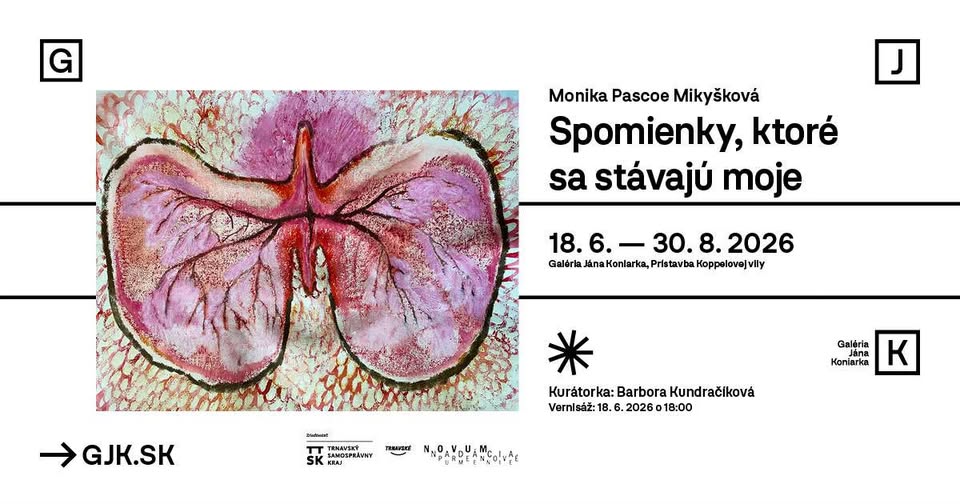
Opening: Spomienky, ktoré sa stávajú moje
Opening: Memories that become mine
Event by: Galéria Jána Koniarka v Trnave / Jan Koniarek Gallery in Trnava
Location: Zelený kríček, Štefánikova 114, Trnava
Talks & discussions, Exhibitions
About event
Memories that become mine
Monika Pascoe Mikyšková
Curator: Barbora Kundračíková
Graphic design of the exhibition: Palo Bálik
Architecture of the exhibition: Peter Liška
Extension of the Koppel villa (ground floor)
18.6. - 30.8. 2026
Monika Pascoe Mikyšková's long-term project builds on a classic paradox – it reflects memory as personal, but never fully private. Memory arises and is formed in relationships between people, generations, places and materials. It is lived, transformed and passed on through life experience. It is carried not only by the moments spent together, but also by the gestures themselves, involuntary reactions that we do not have full control over. As such, it is captured, sorted and institutionalized, it is experienced - and becomes a life trauma.
A childhood memory - a hot summer, the landscape is bathed in golden light, the flowers of the plants that the child collects with his grandmother in the meadow are also golden. The flower of tranquility, St. John's wort, distinctive not only with its flower, is transformed into a red concoction of sweet taste in the next memory. It is collected, dried, drunk, regaining its magical meaning - it is once again the "blood of St. John" that was hung above domestic altars in honor of good spirits (from where its Latin name, Hypericum perforatum, finally comes). parents and siblings. She follows the movement and flow of memory, from an intimate memory to its sharing, but she is also interested in returning to what disappears from official narratives, but continues to be experienced in small rituals and repeated practices. Why were flowers of reassurance actually necessary?
The central theme of the generously offered intimate story is the tension between personal narrative and memory, which is grasped and reshaped collectively - it is carried by the second or third generation, which does not have direct experience with the past, but recognizes its echoes not only in their dreams, but also in gestures and family communication habits. Overly violent reactions, tendencies towards melancholy, worries, all of this originates somewhere. While any articulate, however institutionalized, memory strives for the stability, clarity, and continuity of "big history," personal memory remains inherently fragmentary, fluid, and often ambiguous. Pascoe Mikyšková shows that it is precisely in this contradiction that a unique productive field arises - that small histories of everyday life, family relationships and bodily experiences are not only a supplement to official history, but its own prerequisite.
Fiction plays an important role here, as it always does when it comes to the human world. They are fictional structures that allow individual memory to not only become a document, but to remain open to both interpretation and transformation. So that what the grandmother experienced and had to cope with could be accepted unnoticed by a little girl, or an adult woman could consciously reflect on it. Fiction creates a space in which personal narrative can touch collective experience without being completely absorbed by a unified historical narrative. It has the possibility of (self) acceptance, understanding, reconciliation.
No narrative, no fiction, because trauma cannot do without substance. In the same way that Pascoe Mikyšková dealt with the memory of the plant world, the traumas of the ecosystem in the past, she now uses the plant wealth of her native land, the original land, and relates to the human world. He does not understand memory as abstract, symbolic or subconscious, but as bodily. He identifies it in actions that are repeated - and for their repetition they require materialization. They require things that can be touched, pressed, smelled, broken, poured with hot water.
And this is where Pascoe Mikyšková puts her strongest trump card on the table - she engages magic, while working with it not as a less rational belief, but as a specific - primary - model of relational thinking. He sees it as evidence that memory is transmitted through touch, repetition and presence rather than through recording or description. And that this is how the understanding is transmitted - in the family, in the intimacy of relationships with those closest to you - perhaps the most important relationship.
The exhibition itself, as an applied part of an informed long-term interest, then creates a space in which personal and shared narratives, small and large histories, individual memories and institutionalized memory meet - and it is not just the story of Monika Pascoe Mikyšková. It turns out that memory is first and foremost a process, and that we can share this process with each other, without necessarily sharing the same initiation. The movement along the thin line between self and other, us and them, between the personal and the shared is identified as one that allows memory to become alive and valid again within both small and large histories.
Monika Pascoe Mikyšková
Curator: Barbora Kundračíková
Graphic design of the exhibition: Palo Bálik
Architecture of the exhibition: Peter Liška
Extension of the Koppel villa (ground floor)
18.6. - 30.8. 2026
Monika Pascoe Mikyšková's long-term project builds on a classic paradox – it reflects memory as personal, but never fully private. Memory arises and is formed in relationships between people, generations, places and materials. It is lived, transformed and passed on through life experience. It is carried not only by the moments spent together, but also by the gestures themselves, involuntary reactions that we do not have full control over. As such, it is captured, sorted and institutionalized, it is experienced - and becomes a life trauma.
A childhood memory - a hot summer, the landscape is bathed in golden light, the flowers of the plants that the child collects with his grandmother in the meadow are also golden. The flower of tranquility, St. John's wort, distinctive not only with its flower, is transformed into a red concoction of sweet taste in the next memory. It is collected, dried, drunk, regaining its magical meaning - it is once again the "blood of St. John" that was hung above domestic altars in honor of good spirits (from where its Latin name, Hypericum perforatum, finally comes). parents and siblings. She follows the movement and flow of memory, from an intimate memory to its sharing, but she is also interested in returning to what disappears from official narratives, but continues to be experienced in small rituals and repeated practices. Why were flowers of reassurance actually necessary?
The central theme of the generously offered intimate story is the tension between personal narrative and memory, which is grasped and reshaped collectively - it is carried by the second or third generation, which does not have direct experience with the past, but recognizes its echoes not only in their dreams, but also in gestures and family communication habits. Overly violent reactions, tendencies towards melancholy, worries, all of this originates somewhere. While any articulate, however institutionalized, memory strives for the stability, clarity, and continuity of "big history," personal memory remains inherently fragmentary, fluid, and often ambiguous. Pascoe Mikyšková shows that it is precisely in this contradiction that a unique productive field arises - that small histories of everyday life, family relationships and bodily experiences are not only a supplement to official history, but its own prerequisite.
Fiction plays an important role here, as it always does when it comes to the human world. They are fictional structures that allow individual memory to not only become a document, but to remain open to both interpretation and transformation. So that what the grandmother experienced and had to cope with could be accepted unnoticed by a little girl, or an adult woman could consciously reflect on it. Fiction creates a space in which personal narrative can touch collective experience without being completely absorbed by a unified historical narrative. It has the possibility of (self) acceptance, understanding, reconciliation.
No narrative, no fiction, because trauma cannot do without substance. In the same way that Pascoe Mikyšková dealt with the memory of the plant world, the traumas of the ecosystem in the past, she now uses the plant wealth of her native land, the original land, and relates to the human world. He does not understand memory as abstract, symbolic or subconscious, but as bodily. He identifies it in actions that are repeated - and for their repetition they require materialization. They require things that can be touched, pressed, smelled, broken, poured with hot water.
And this is where Pascoe Mikyšková puts her strongest trump card on the table - she engages magic, while working with it not as a less rational belief, but as a specific - primary - model of relational thinking. He sees it as evidence that memory is transmitted through touch, repetition and presence rather than through recording or description. And that this is how the understanding is transmitted - in the family, in the intimacy of relationships with those closest to you - perhaps the most important relationship.
The exhibition itself, as an applied part of an informed long-term interest, then creates a space in which personal and shared narratives, small and large histories, individual memories and institutionalized memory meet - and it is not just the story of Monika Pascoe Mikyšková. It turns out that memory is first and foremost a process, and that we can share this process with each other, without necessarily sharing the same initiation. The movement along the thin line between self and other, us and them, between the personal and the shared is identified as one that allows memory to become alive and valid again within both small and large histories.