This event has been ended!
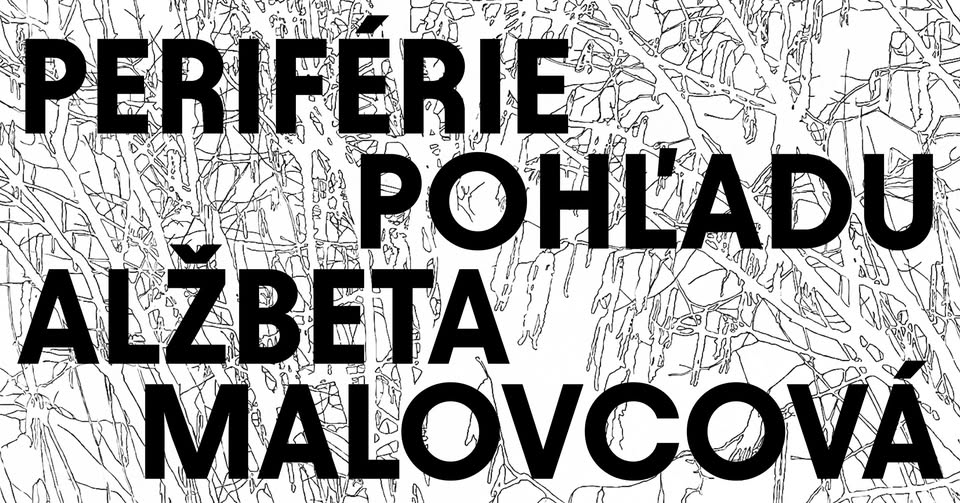
PERIFÉRIE POHĽADU | ALŽBETA MALOVCOVÁ | výstava predĺžená do 6. 12.
PERIPHERALS OF VIEW | ALŽBETA MALOVCOVÁ | exhibition extended until December 6.
Event by: Erzsébet Em
Location: Slovak National Theatre (Historical Building), Gorkého 2, Bratislava
Talks & discussions, Exhibitions
About event
"When an old man stands at the edge of a rice field, he just stands and looks. And it's beautiful! The old man is full of what surrounds him..."[1]
The exhibition of graphic sheets entitled Periphery of the view presents images taken from the ordinary world, in which Alžbeta Malovcová directs attention to the inconspicuous and neglected facts. The views anchored in the graphics reveal her attention, one might even say radical awareness, to the subtle forms of existence of animate and inanimate characters. We observe garden structures on them, which refer to the way of inhabiting this world and to the morphology of human intervention in the landscape. The author talks about objects that someone touched, someone manipulated them. About how he organized his space, spent his free time, and also about the fact that although people are not dependent on growing crops for their existence, they do it anyway. They do this almost obstinate activity out of the conviction that it has value and gives them meaning.
Malovcová chose motifs that are silent and nobody tells them a story or instructions on how people should look at them: I am interested in the poor phenomena. Phenomena on the brink of existence and extinction. Thinking about the quiet existence of things that seem to have nothing more to give. I focus my gaze on the periphery, as a result of oversaturation." He finds refreshment in the meditation (contemplation) of minimalistic images of uninteresting or even useless things for most people. She approaches them as an observer and collector. He peers over the fence and thinks about the situations he sees behind him. He chooses parts of the landscape, collects places and objects that are unnoticed and reveals their hidden potential.
The main line of the cycle offers a fascination with garden still lifes that people create intuitively, and thus something sincere from human activity. Objects that a person had at his disposal or sometimes just at hand served him for a specific purpose. He did not deal with their aesthetics and they remained reduced exclusively to function. The author perceives the shapes and relationships between the individual components of these unconscious abstract sculptures. He notices, for example, how waste in the form of tile stone is repeatedly concentrated in the gardens. How every yard has its own corner where we can find a discarded bathtub or sink. In these displaced phenomena, he finds the collective psyche stored more prominently than when the space is cleaned and ordered. He sees in it something that we can smile about and that we can include as part of our world.
The Periphery of the View exhibition in the premises of the K Theater presents eighteen graphic sheets. They depict everything from various small horticultural structures (greenhouses, sheds) to meshes and specific installations (bricks weighing sheets, under which the process of absorption of fertilizer into the soil takes place) to fragments of nature. The images are heterogeneous, they do not form a specific plot, but they are open and we can move between them. At the same time, they are all connected by a moment of sudden discovery, an appearance in an ordinary day, a stop on the way somewhere or in something. By appreciating what the observer suddenly sees, as if she were standing in front of a painting and wondering how beautiful it is!
Malovcová follows the stories of lines in her drawings, which she reduces and abstracts into signs. Empty spaces appear on them, which dynamize the motifs and stimulate the percipient's imagination. The shapes, structures and contrasts of subtle light and deep dark prints stand out even more. With the absent details, the depth of the imprinted reality is lost, perhaps precisely so that the viewer can find his depth there. To catch the rustling of grain, to hear soft music in the background or to discover an experimental notation with a hint of scratching.
The phenomenon of house and garden also represents the relationship between civilization and the environment. One of the other such examples that represent the connection between humans and nature in the exhibition is the pair of Pillars and Trees at the upper end. The organic charge of the series can also be perceived in the graphic with the crescent moon, the drawing of which is the only one not based on a photograph, but on a direct outline of the fruits of the plant. Her standing out from the cycle not only forms a bridge with the author's previous solo exhibition (Deficits and Saturations, 2021, when she processed this motif in the medium of painting), but perhaps already indicates Malovcová's next focus. Until now, nature has been rather marginal in her work and more abstract spaces and objects dominated her. With this series, it's as if you're pulling her back to you and returning to her. Is it perhaps the result of re-evaluating what we are a part of? The question that the peripheries open up in us much more intensively and fundamentally?
The peripheries of the view carry a silent resistance to the consumerist way of life. However, I do not think that this is activism, but authentic action and pointing out what the author considers important: "The answer to why I do it is how I do it." Imprints of her inner vision are the opposite of performance and efficiency trends, stopping in a competitive environment. They have the character of personal reasons, stories and inefficiency, which is also reflected in production-intensive graphic technology. We can observe it most prominently on the hazel motif. The reduced but still very detailed drawing is a concentrated memory of the enormous amount of time, energy, concentration and patience that the author transcribed into it. Raw zinc sheets installed in the center of the room and a display with a photo of one particular periphery where the works were created also refer to the process of line etching and aquatint techniques:
Imagine a November night in the garden of a family house in a part of Bratislava. The surrounding houses went out. It is quiet and the temperature is around 5°C. A woman wrapped in two warm blankets is etching metal matrices. An asphalt cover with an engraved pattern reveals a zinc sheet that corrodes on contact with nitric acid and emits toxic fumes. This is followed by sprinkling with water and drying with hot air. A few times a night, the woman runs to a nearby pump, where she buys coffee. She does so well at night! He applies asphalt varnish, dusts the grain and re-immerses in the etching bath. Stops time. He washes again, dries, washes off the asphalt with thinner. Along with the light comes a gentle rain, which forces her to move her desk closer to the tree and hide the plates ready for printing.
Japanese dancer Min Tanaka left Tokyo in the 1980s and began to practice in the mountain village of Hakushu farming and its connection with dance. He told the participants of his workshops, who came from all over the world: "In the history of dance, people use muscles a lot. I don't want any muscles, but an image. You will find the minimum. Get the feeling. But don't express it! You should feel it first. Getting that feeling is much more important.[2]
Before the actual printing of the graphics, the papers go through a wetting procedure, in which the glue is removed. The water loosens the structure holding the material together so it can more easily accept the color and impression of the die. Staying on the periphery, similar to the delicate process of graphic technology, allows us to allow certain withdrawals from planning and securing the future, catching up with an ever-accelerating civilization that generates more and more demands for our sufficiency. Therefore, I perceive the exhibited cycle Periérie de gaztu as an invitation to slow down, to uncover in ourselves the reliefs of our own feelings of meaningfulness and to become more receptive to them. Getting that feeling is much more important.
Mária Piatriková
Alžbeta Malovcová (*1987) graduated from VŠVU in Bratislava with prof. Robert Jančovič and prof. Daniel Fischer. She participated in a study stay at the Aristotle University of Thessaloniki. She is dedicated to free graphics, painting in combination with non-painting media, European calligraphy and also works as a composer of music in the productions of Divadla K Neistota (2022) and Memory of a Place (2024). She exhibited independently in Nitra and Bratislava, participated in several collective exhibitions of contemporary young Slovak art. He teaches at the School of Design.
______________________________________________________________________
[1] LANDA, O.: Min Tanaka and the Japanese way of the body, JAKUB HLAVÁČEK - MALVERN 2023, p. 142
[2] ibid
The event was supported in the form of a scholarship by the Art Support Fund
| Curator Mária Piatriková
| Divadlo K, Palackého 5, Bratislava - Staré Mesto
Opening hours
daily except Wednesday 16:00 - 19:00
and by appointment on tel. no. 0910 914 755
The exhibition of graphic sheets entitled Periphery of the view presents images taken from the ordinary world, in which Alžbeta Malovcová directs attention to the inconspicuous and neglected facts. The views anchored in the graphics reveal her attention, one might even say radical awareness, to the subtle forms of existence of animate and inanimate characters. We observe garden structures on them, which refer to the way of inhabiting this world and to the morphology of human intervention in the landscape. The author talks about objects that someone touched, someone manipulated them. About how he organized his space, spent his free time, and also about the fact that although people are not dependent on growing crops for their existence, they do it anyway. They do this almost obstinate activity out of the conviction that it has value and gives them meaning.
Malovcová chose motifs that are silent and nobody tells them a story or instructions on how people should look at them: I am interested in the poor phenomena. Phenomena on the brink of existence and extinction. Thinking about the quiet existence of things that seem to have nothing more to give. I focus my gaze on the periphery, as a result of oversaturation." He finds refreshment in the meditation (contemplation) of minimalistic images of uninteresting or even useless things for most people. She approaches them as an observer and collector. He peers over the fence and thinks about the situations he sees behind him. He chooses parts of the landscape, collects places and objects that are unnoticed and reveals their hidden potential.
The main line of the cycle offers a fascination with garden still lifes that people create intuitively, and thus something sincere from human activity. Objects that a person had at his disposal or sometimes just at hand served him for a specific purpose. He did not deal with their aesthetics and they remained reduced exclusively to function. The author perceives the shapes and relationships between the individual components of these unconscious abstract sculptures. He notices, for example, how waste in the form of tile stone is repeatedly concentrated in the gardens. How every yard has its own corner where we can find a discarded bathtub or sink. In these displaced phenomena, he finds the collective psyche stored more prominently than when the space is cleaned and ordered. He sees in it something that we can smile about and that we can include as part of our world.
The Periphery of the View exhibition in the premises of the K Theater presents eighteen graphic sheets. They depict everything from various small horticultural structures (greenhouses, sheds) to meshes and specific installations (bricks weighing sheets, under which the process of absorption of fertilizer into the soil takes place) to fragments of nature. The images are heterogeneous, they do not form a specific plot, but they are open and we can move between them. At the same time, they are all connected by a moment of sudden discovery, an appearance in an ordinary day, a stop on the way somewhere or in something. By appreciating what the observer suddenly sees, as if she were standing in front of a painting and wondering how beautiful it is!
Malovcová follows the stories of lines in her drawings, which she reduces and abstracts into signs. Empty spaces appear on them, which dynamize the motifs and stimulate the percipient's imagination. The shapes, structures and contrasts of subtle light and deep dark prints stand out even more. With the absent details, the depth of the imprinted reality is lost, perhaps precisely so that the viewer can find his depth there. To catch the rustling of grain, to hear soft music in the background or to discover an experimental notation with a hint of scratching.
The phenomenon of house and garden also represents the relationship between civilization and the environment. One of the other such examples that represent the connection between humans and nature in the exhibition is the pair of Pillars and Trees at the upper end. The organic charge of the series can also be perceived in the graphic with the crescent moon, the drawing of which is the only one not based on a photograph, but on a direct outline of the fruits of the plant. Her standing out from the cycle not only forms a bridge with the author's previous solo exhibition (Deficits and Saturations, 2021, when she processed this motif in the medium of painting), but perhaps already indicates Malovcová's next focus. Until now, nature has been rather marginal in her work and more abstract spaces and objects dominated her. With this series, it's as if you're pulling her back to you and returning to her. Is it perhaps the result of re-evaluating what we are a part of? The question that the peripheries open up in us much more intensively and fundamentally?
The peripheries of the view carry a silent resistance to the consumerist way of life. However, I do not think that this is activism, but authentic action and pointing out what the author considers important: "The answer to why I do it is how I do it." Imprints of her inner vision are the opposite of performance and efficiency trends, stopping in a competitive environment. They have the character of personal reasons, stories and inefficiency, which is also reflected in production-intensive graphic technology. We can observe it most prominently on the hazel motif. The reduced but still very detailed drawing is a concentrated memory of the enormous amount of time, energy, concentration and patience that the author transcribed into it. Raw zinc sheets installed in the center of the room and a display with a photo of one particular periphery where the works were created also refer to the process of line etching and aquatint techniques:
Imagine a November night in the garden of a family house in a part of Bratislava. The surrounding houses went out. It is quiet and the temperature is around 5°C. A woman wrapped in two warm blankets is etching metal matrices. An asphalt cover with an engraved pattern reveals a zinc sheet that corrodes on contact with nitric acid and emits toxic fumes. This is followed by sprinkling with water and drying with hot air. A few times a night, the woman runs to a nearby pump, where she buys coffee. She does so well at night! He applies asphalt varnish, dusts the grain and re-immerses in the etching bath. Stops time. He washes again, dries, washes off the asphalt with thinner. Along with the light comes a gentle rain, which forces her to move her desk closer to the tree and hide the plates ready for printing.
Japanese dancer Min Tanaka left Tokyo in the 1980s and began to practice in the mountain village of Hakushu farming and its connection with dance. He told the participants of his workshops, who came from all over the world: "In the history of dance, people use muscles a lot. I don't want any muscles, but an image. You will find the minimum. Get the feeling. But don't express it! You should feel it first. Getting that feeling is much more important.[2]
Before the actual printing of the graphics, the papers go through a wetting procedure, in which the glue is removed. The water loosens the structure holding the material together so it can more easily accept the color and impression of the die. Staying on the periphery, similar to the delicate process of graphic technology, allows us to allow certain withdrawals from planning and securing the future, catching up with an ever-accelerating civilization that generates more and more demands for our sufficiency. Therefore, I perceive the exhibited cycle Periérie de gaztu as an invitation to slow down, to uncover in ourselves the reliefs of our own feelings of meaningfulness and to become more receptive to them. Getting that feeling is much more important.
Mária Piatriková
Alžbeta Malovcová (*1987) graduated from VŠVU in Bratislava with prof. Robert Jančovič and prof. Daniel Fischer. She participated in a study stay at the Aristotle University of Thessaloniki. She is dedicated to free graphics, painting in combination with non-painting media, European calligraphy and also works as a composer of music in the productions of Divadla K Neistota (2022) and Memory of a Place (2024). She exhibited independently in Nitra and Bratislava, participated in several collective exhibitions of contemporary young Slovak art. He teaches at the School of Design.
______________________________________________________________________
[1] LANDA, O.: Min Tanaka and the Japanese way of the body, JAKUB HLAVÁČEK - MALVERN 2023, p. 142
[2] ibid
The event was supported in the form of a scholarship by the Art Support Fund
| Curator Mária Piatriková
| Divadlo K, Palackého 5, Bratislava - Staré Mesto
Opening hours
daily except Wednesday 16:00 - 19:00
and by appointment on tel. no. 0910 914 755
Events in Bratislava today · Events in Bratislava this weekend