This event has been ended!
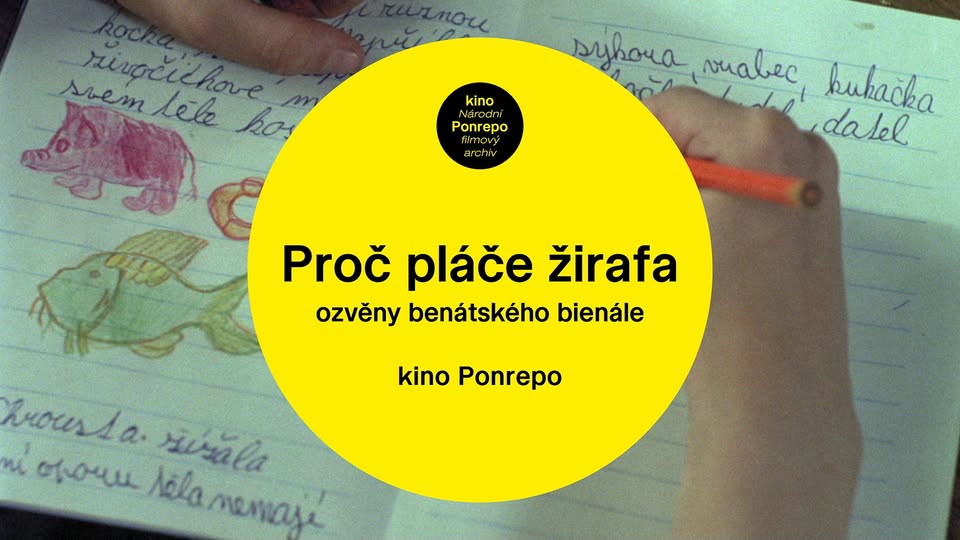
Proč pláče žirafa – ozvěny benátského bienále | doprovodný filmový cyklus k výstavě
Why weeps giraffe - echoes of the Venetian Biennial accompanying film cycle to the exhibition
Event by: Ponrepo
Location: Bartolomějská 291/11, Bartolomějská 11, Praha 1
Tickets: Get tickets
Talks & discussions, Films
About event
🟡 The idea is based on the story of the first Czechoslovak giraffe Lenka, imported to the Prague Zoo in 1954. This motif became the basis of the exhibition Eva Koťátková Heart of Giraffe in captivity is a twelve pound lighter, which represented the Czech Republic at 60. You can see the exhibition from 28 March to 27 July at the Veletržní Palace. It examines how animals presented themselves in the former Czechoslovakia - from entertainment and shows to raising children in educational films. It also affects the role of Josef Vágner, who brought animals from Africa, and shows how Czechoslovakia interfered with nature in post -colonial Africa. Overall, films map how institutions form our relationship to animals and what paradoxes bring their protection. Giraffe: Extraction, institutions and discipline
The first part of the cycle why the crying giraffe takes us to museums, zoos and expeditions for nature conservation. Films show how these institutions have shaped social and gender standards in post -war Czechoslovakia. The expedition of Josef Vágner and the Great Adventure (1953) reflect the uncritical approach to the sub -nature and cultures in Africa.
The projection will be presented by curator Hana Janečková. And is he stuffed with a mammoth still an animal? We think about these questions with children in the projection of fairy tales where animals play a major role. We will see the story of a awakened mammoth (do not be mammoth), a wizard trying to cheer up a sad giraffe, a playful collage about cows (about a cow) and the mystery of the whale in Trnka's garden. Shipping giraffe: consumerism, spectacle, metaphor
The second part of the cycle why the crying of the giraffe opens the critical and imaginative dialogue between the world of humans and animals. Morituri Te Salutant (Michael Havas) shows the ecological impact of hunting in Africa, while the fairy tale for Madies from Pigi brings a unique vision of the Czech dissent. A demonstration of the film Two People in the Zoo reflects the corruption of the late 80s. The idea of liberating animals is also examined by contemporary artists Denisa Langrová and Dominique Knowles. Tickets can be booked on our website.
More information and details of projected films: https://bit.ly/422ycwf
The first part of the cycle why the crying giraffe takes us to museums, zoos and expeditions for nature conservation. Films show how these institutions have shaped social and gender standards in post -war Czechoslovakia. The expedition of Josef Vágner and the Great Adventure (1953) reflect the uncritical approach to the sub -nature and cultures in Africa.
The projection will be presented by curator Hana Janečková. And is he stuffed with a mammoth still an animal? We think about these questions with children in the projection of fairy tales where animals play a major role. We will see the story of a awakened mammoth (do not be mammoth), a wizard trying to cheer up a sad giraffe, a playful collage about cows (about a cow) and the mystery of the whale in Trnka's garden. Shipping giraffe: consumerism, spectacle, metaphor
The second part of the cycle why the crying of the giraffe opens the critical and imaginative dialogue between the world of humans and animals. Morituri Te Salutant (Michael Havas) shows the ecological impact of hunting in Africa, while the fairy tale for Madies from Pigi brings a unique vision of the Czech dissent. A demonstration of the film Two People in the Zoo reflects the corruption of the late 80s. The idea of liberating animals is also examined by contemporary artists Denisa Langrová and Dominique Knowles. Tickets can be booked on our website.
More information and details of projected films: https://bit.ly/422ycwf