This event has been ended!
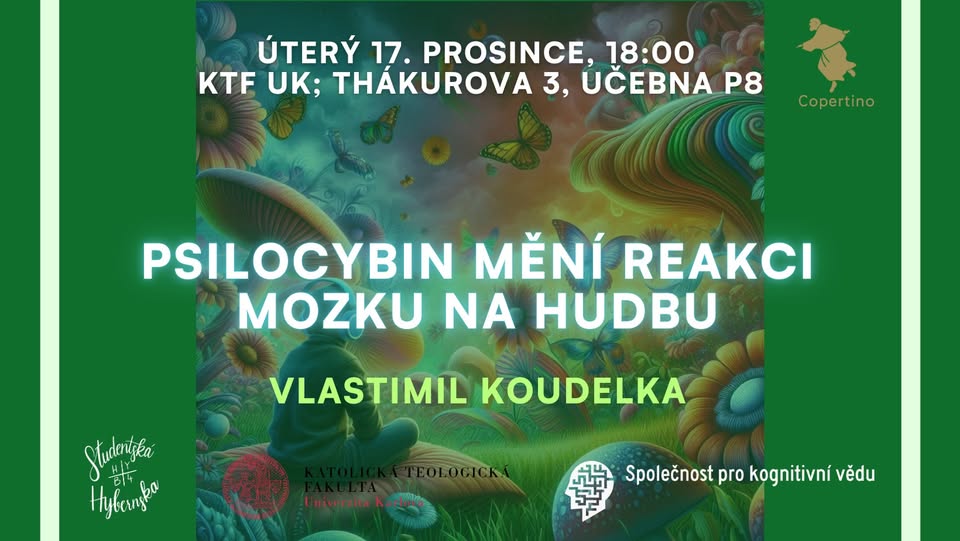
Psilocybin mění reakci mozku na hudbu
Psilocybin alters the brain's response to music
Event by: Studentský spolek Copertino, z.s., Společnost pro kognitivní vědu
Location: Charles University: Catholic Theological Faculty, Thákurova 676/3, Praha 6
About event
🧠We cordially invite you to the lecture entitled: "Psilocybin changes the brain's response to music" by Vlastimil Koudelka, head of the Applied Technologies in Neuroscience (ATiN) group from the National Institute of Mental Health (NÚDZ).
🗣 Annotation:
Music is considered a key mediator in psychedelic therapy (Kaelen, 2018), (Barret, 2018). It attracts attention, evokes emotion and provides inspiration. Therefore, music is a natural part of spiritual and therapeutic sessions that involve psychedelics. At the same time, music is hierarchically structured, thus requiring the listener to engage brain regions and networks of neurons across different levels of abstraction in order to fully perceive it. This is the reason for the assumption that brain dynamics are intricately connected with musical stimuli when listening to music (Schaefer, 2011), (Bonetti, 2020). This lecture addresses the question of how music and psychedelics interact with each other, and how this interaction supports healing processes.
During the lecture, we will approach the topic and try to answer the following questions: How does music synchronize the dynamics of neural networks and brain activity? How does this synchronization change after psilocybin administration? And finally, how do these changes relate to the audiovisual synaesthesia experienced by participants in similar therapy sessions?
📍Catholic Theological Faculty of Charles University, classroom P8
The lecture is, as always, free.
We look forward to seeing you!
🗣 Annotation:
Music is considered a key mediator in psychedelic therapy (Kaelen, 2018), (Barret, 2018). It attracts attention, evokes emotion and provides inspiration. Therefore, music is a natural part of spiritual and therapeutic sessions that involve psychedelics. At the same time, music is hierarchically structured, thus requiring the listener to engage brain regions and networks of neurons across different levels of abstraction in order to fully perceive it. This is the reason for the assumption that brain dynamics are intricately connected with musical stimuli when listening to music (Schaefer, 2011), (Bonetti, 2020). This lecture addresses the question of how music and psychedelics interact with each other, and how this interaction supports healing processes.
During the lecture, we will approach the topic and try to answer the following questions: How does music synchronize the dynamics of neural networks and brain activity? How does this synchronization change after psilocybin administration? And finally, how do these changes relate to the audiovisual synaesthesia experienced by participants in similar therapy sessions?
📍Catholic Theological Faculty of Charles University, classroom P8
The lecture is, as always, free.
We look forward to seeing you!