This event has been ended!
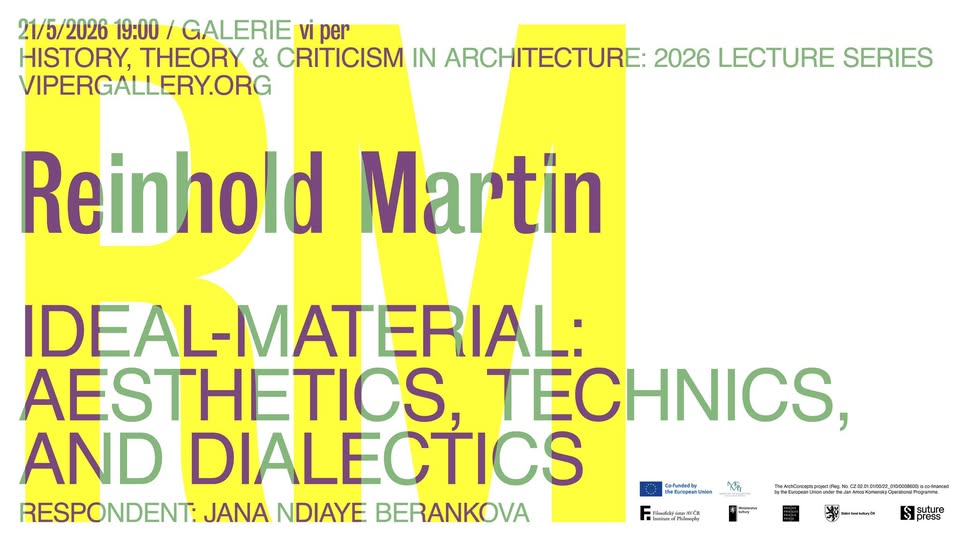
Reinhold Martin: Ideal-Material: Aesthetics, Technics, and Dialectics
Event by: Filosofický ústav Akademie věd České republiky, VI PER, Éditions Suture, Suture Press
Location: Gallery VIPER, Vítkova 293, Praha 8
Talks & discussions
About event
/Please scroll down for English/
Moving on the border of historical materialism, the lecture proposes instead of the metaphysics of the material basis - whether it is technology or work - an inexhaustible dialectic of ideal and material processes. Aesthetics, which perceives the work of art as a medium of thought rather than as a medium of experience or ideological expression, provides the basis for the study of technical media, including architecture, within this ideal-material dialectic. To give an idea of the implications of this approach, the lecture will outline the concept of technology as a symbolic form, which goes back to the neo-Kantian philosophy of Ernst Cassirer and from there moves through the philosophical aesthetics of the twentieth century to the contemporary politics of technological meaning. It is a dialectic in the full sense of the word: the constant meeting of the world of ideas and the world of material production, both of which remain vividly real.
Reinhold Martin is a professor at Columbia University's Graduate School of Architecture, Planning, and Preservation and a historian of architecture and media. His research addresses the intersections of architecture, media, and political economy, focusing on corporate spaces, postmodernism, urban infrastructure, and universities as media complexes. He is the author of several books, including The Organizational Complex: Architecture, Media, and Corporate Space (2003), Utopia's Ghost: Architecture and Postmodernism, Again (2010), The Urban Apparatus: Mediapolitics and the City (2016), and Knowledge Worlds: Media, Materiality, and the Making of the Modern University (2021). He is co-editor of Architecture against Democracy: Histories of the Nationalist International (with Claire Zimmerman, 2024). At Columbia University, Martin is affiliated with the Center for Comparative Media, the Institute for Comparative Literature and Society, and the Committee on Global Thought. He previously directed the Temple Hoyne Buell Center for the Study of American Architecture and was also co-founder and co-editor of the interdisciplinary journal Gray Room. More at https://www.reinholdmartin.net
Respondent: Jana Ndiaye Beránková
The lecture is held in cooperation with the Philosophical Institute of the Academy of Sciences of the Czech Republic and the Suture Press publishing house as part of the ArchConcepts project (reg. no. CZ.02.01.01/00/22_010/0008600), which is co-financed by the European Union as part of the operational program Jan Amos Komenský.
----------------------------------------------------------------
Balanced at the limits of historical materialism, this talk proposes an inexhaustible dialectic of ideal and material processes in place of a metaphysics of the material base, whether of technology or of labor. An aesthetics that regards the artwork as a medium of thought rather than of experience or of ideological expression provides a resource for the study of technical media, including architecture, within this ideal-material dialectic. To preview the implications, the talk will outline an approach to technology as symbolic form that returns to the neo-Kantian philosophy of Ernst Cassirer and moves from there through twentieth-century philosophical aesthetics towards a contemporary politics of technological meaning. This is dialectics all the way down: an incessant encounter between a world of ideas and a world of material production, both of which remain vividly real.
Reinhold Martin is a professor at Columbia University’s Graduate School of Architecture, Planning and Preservation (GSAPP) and a historian of architecture and media. His research explores the intersections of architecture, media, and political economy, with a focus on corporate space, postmodernism, urban infrastructure, and universities as media complexes. He is the author of several books, including The Organizational Complex: Architecture, Media, and Corporate Space (2003), Utopia's Ghost: Architecture and Postmodernism, Again (2010), The Urban Apparatus: Mediapolitics and the City (2016), and Knowledge Worlds: Media, Materiality, and the Making of the Modern University (2021). His latest book is the edited volume Architecture against Democracy: Histories of the Nationalist International (with Claire Zimmerman, 2024). At Columbia, Martin is affiliated with the Center for Comparative Media, the Institute for Comparative Literature and Society, and the Committee on Global Thought. He previously directed the Temple Hoyne Buell Center for the Study of American Architecture and was also a founding co-editor of the interdisciplinary journal Gray Room. https://www.reinholdmartin.net
Respondent: Jana Ndiaye Beránková
The lecture is organized in collaboration with the Institute of Philosophy of the Czech Academy of Sciences and Suture Press as part of the ArchConcepts project (reg. no. CZ.02.01.01/00/22_010/0008600), co-financed by the European Union under the Jan Amos Komenský Operational Program.
Moving on the border of historical materialism, the lecture proposes instead of the metaphysics of the material basis - whether it is technology or work - an inexhaustible dialectic of ideal and material processes. Aesthetics, which perceives the work of art as a medium of thought rather than as a medium of experience or ideological expression, provides the basis for the study of technical media, including architecture, within this ideal-material dialectic. To give an idea of the implications of this approach, the lecture will outline the concept of technology as a symbolic form, which goes back to the neo-Kantian philosophy of Ernst Cassirer and from there moves through the philosophical aesthetics of the twentieth century to the contemporary politics of technological meaning. It is a dialectic in the full sense of the word: the constant meeting of the world of ideas and the world of material production, both of which remain vividly real.
Reinhold Martin is a professor at Columbia University's Graduate School of Architecture, Planning, and Preservation and a historian of architecture and media. His research addresses the intersections of architecture, media, and political economy, focusing on corporate spaces, postmodernism, urban infrastructure, and universities as media complexes. He is the author of several books, including The Organizational Complex: Architecture, Media, and Corporate Space (2003), Utopia's Ghost: Architecture and Postmodernism, Again (2010), The Urban Apparatus: Mediapolitics and the City (2016), and Knowledge Worlds: Media, Materiality, and the Making of the Modern University (2021). He is co-editor of Architecture against Democracy: Histories of the Nationalist International (with Claire Zimmerman, 2024). At Columbia University, Martin is affiliated with the Center for Comparative Media, the Institute for Comparative Literature and Society, and the Committee on Global Thought. He previously directed the Temple Hoyne Buell Center for the Study of American Architecture and was also co-founder and co-editor of the interdisciplinary journal Gray Room. More at https://www.reinholdmartin.net
Respondent: Jana Ndiaye Beránková
The lecture is held in cooperation with the Philosophical Institute of the Academy of Sciences of the Czech Republic and the Suture Press publishing house as part of the ArchConcepts project (reg. no. CZ.02.01.01/00/22_010/0008600), which is co-financed by the European Union as part of the operational program Jan Amos Komenský.
----------------------------------------------------------------
Balanced at the limits of historical materialism, this talk proposes an inexhaustible dialectic of ideal and material processes in place of a metaphysics of the material base, whether of technology or of labor. An aesthetics that regards the artwork as a medium of thought rather than of experience or of ideological expression provides a resource for the study of technical media, including architecture, within this ideal-material dialectic. To preview the implications, the talk will outline an approach to technology as symbolic form that returns to the neo-Kantian philosophy of Ernst Cassirer and moves from there through twentieth-century philosophical aesthetics towards a contemporary politics of technological meaning. This is dialectics all the way down: an incessant encounter between a world of ideas and a world of material production, both of which remain vividly real.
Reinhold Martin is a professor at Columbia University’s Graduate School of Architecture, Planning and Preservation (GSAPP) and a historian of architecture and media. His research explores the intersections of architecture, media, and political economy, with a focus on corporate space, postmodernism, urban infrastructure, and universities as media complexes. He is the author of several books, including The Organizational Complex: Architecture, Media, and Corporate Space (2003), Utopia's Ghost: Architecture and Postmodernism, Again (2010), The Urban Apparatus: Mediapolitics and the City (2016), and Knowledge Worlds: Media, Materiality, and the Making of the Modern University (2021). His latest book is the edited volume Architecture against Democracy: Histories of the Nationalist International (with Claire Zimmerman, 2024). At Columbia, Martin is affiliated with the Center for Comparative Media, the Institute for Comparative Literature and Society, and the Committee on Global Thought. He previously directed the Temple Hoyne Buell Center for the Study of American Architecture and was also a founding co-editor of the interdisciplinary journal Gray Room. https://www.reinholdmartin.net
Respondent: Jana Ndiaye Beránková
The lecture is organized in collaboration with the Institute of Philosophy of the Czech Academy of Sciences and Suture Press as part of the ArchConcepts project (reg. no. CZ.02.01.01/00/22_010/0008600), co-financed by the European Union under the Jan Amos Komenský Operational Program.