This event has been ended!
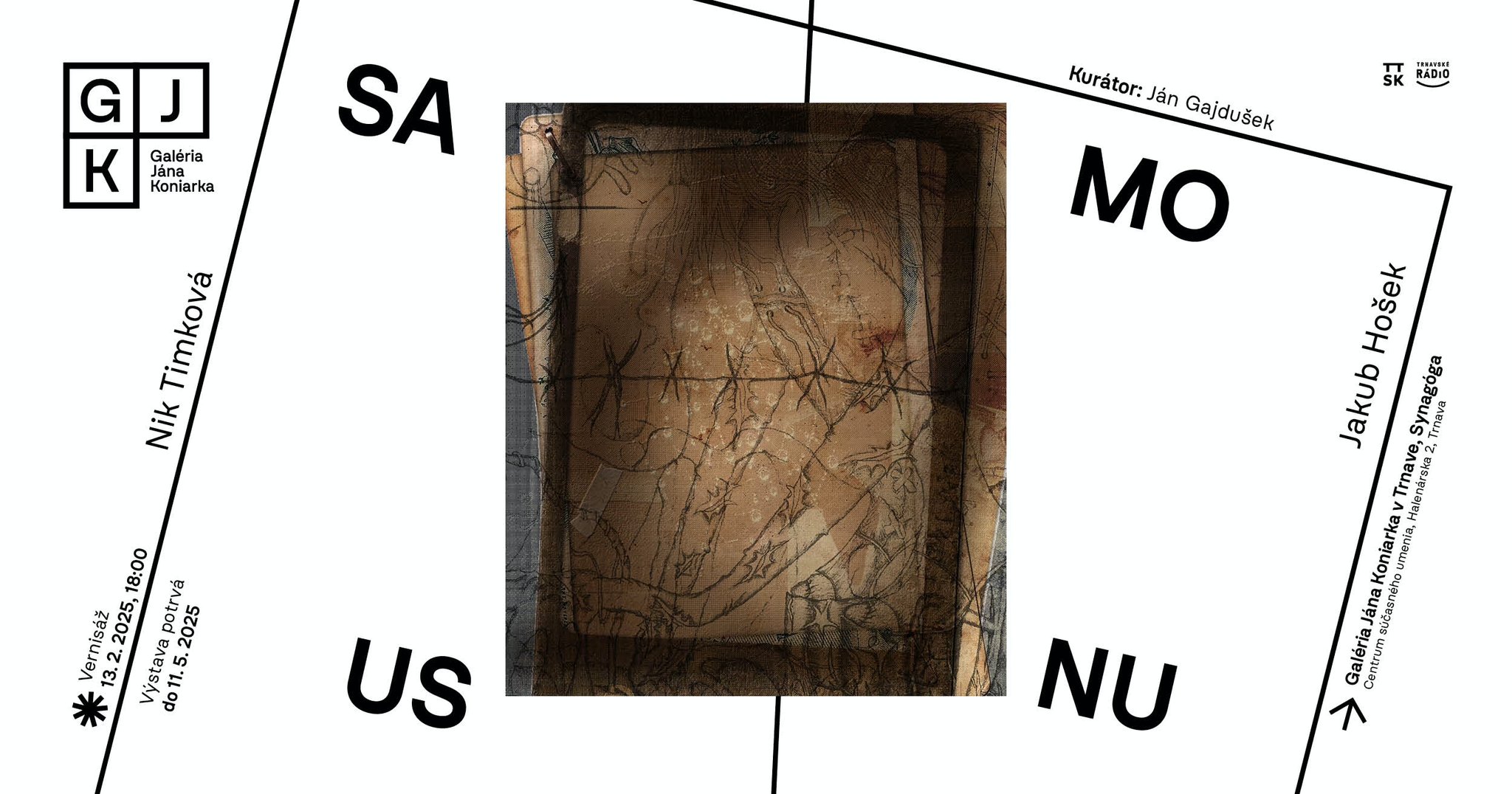
SAMOUSNU- Vernisáž výstavy Jakuba Hošeka a Nik Timkovej
Samousnu- The opening of the exhibition of Jakub Hošek and Nik Timková
Event by: Galéria Jána Koniarka v Trnave / Jan Koniarek Gallery in Trnava
Location: Synagogue, Halenárska 407, Trnava
Exhibitions
About event
We invite you to open the exhibition Samousna, which will take place on Thursday 13 February at 18:00 in the chapter of the Synagogue-Center of Contemporary Art. 13. Scenes of contemporary art - Nik Timkova and Jakub Hoska. Their works are between visual arts, DIY culture, subcultures and experimental work. Together they try to disturb conventional approaches in art and seek new dialogues between the local and international scene.
-
As if our hands had their own language they speak to us. In addition to spoken speech, they communicate with their own speech of gestures and smaller signs. The exhibition of Samousna, whose name is based on the unspecified dream of Nik Timka, draws the attention of the viewer just to the motive of the hand. The exhibited works represent new and older works of authors and demonstrates the fact that their hands are continuously appearing in different processing and context. , in his latest works, their lines cross the edge of the canvas and acquire up to organic, convulsive forms of branches or roots. DISSOLVE inscriptions, Anger (Anger) and Loseing Potential (Loss of potential), along with the motive of stitched patches and scars, are a metaphor of our imperfect efforts to create from injuries and cracks at least partial integrity. Timka's hands refers to fortune -teller practices and multiple gestures - it can become a glove, container or oversized spatial object to which it is possible to enter, whether physically or mentally. For example, in the form of a monumental tracksuit, which we can perceive as a metaphor of communication, protection and vulnerability. In its large -format textile installations and soft statues (where it uses materials such as denim, tint, batik or translucent fabrics), it follows the principles of collage, staples individual parts and layers like "fragments" on the image area.
The exhibition thus accentuates the tension between the hint of injury and the potential of recovery. In the way the human gesture motif connects Hoskov stitched canvas and Timka's textile objects, the hand becomes a universal symbol of combination and manipulation, but also a symbol of intersection of the material world with internal, even magical meanings.
-
Jakub Hošek ( *1979, Prague) studied painting studio at the Academy of Fine Arts in Prague. His work is based on the confrontation of flatness, sharp lines and text fragments, while the key technique is "cut painting", where instead of painting uses hand -carved templates that lay on the canvas. It draws inspiration from the packaging of albums, comics, punk, pop-art, New York's street-art of the 1980s and Postinternet. His paintings combine abstract lines and surreally stylized characters, often complemented by text excerpts that can come from songs, movies or books. Hošek is also curators, DJ and graphic designer. In 2005 and 2007 he was the finalist of Jindřich Chalupecký Award. His works are part of collections in the Czech Republic and abroad. She studied at the Faculty of Arts in Košice, Central Saint Martins in London and the Royal Institute of Art in Stockholm. Her work is connected by new media, installations, sculpture and textiles, focusing on deconstrating clothing in art. It creates textile objects and digital collages that combine pop culture, esoteric and goth aesthetics. Since 2015, he has been working in the Björnson team, which is dedicated to feminist and eco -infeminist themes. Her works include performance and rituals that open up space for joint imagination and protest. In 2017 she was the finalist of the Oskar Čepan Award.
Looking forward to your participation!
-
As if our hands had their own language they speak to us. In addition to spoken speech, they communicate with their own speech of gestures and smaller signs. The exhibition of Samousna, whose name is based on the unspecified dream of Nik Timka, draws the attention of the viewer just to the motive of the hand. The exhibited works represent new and older works of authors and demonstrates the fact that their hands are continuously appearing in different processing and context. , in his latest works, their lines cross the edge of the canvas and acquire up to organic, convulsive forms of branches or roots. DISSOLVE inscriptions, Anger (Anger) and Loseing Potential (Loss of potential), along with the motive of stitched patches and scars, are a metaphor of our imperfect efforts to create from injuries and cracks at least partial integrity. Timka's hands refers to fortune -teller practices and multiple gestures - it can become a glove, container or oversized spatial object to which it is possible to enter, whether physically or mentally. For example, in the form of a monumental tracksuit, which we can perceive as a metaphor of communication, protection and vulnerability. In its large -format textile installations and soft statues (where it uses materials such as denim, tint, batik or translucent fabrics), it follows the principles of collage, staples individual parts and layers like "fragments" on the image area.
The exhibition thus accentuates the tension between the hint of injury and the potential of recovery. In the way the human gesture motif connects Hoskov stitched canvas and Timka's textile objects, the hand becomes a universal symbol of combination and manipulation, but also a symbol of intersection of the material world with internal, even magical meanings.
-
Jakub Hošek ( *1979, Prague) studied painting studio at the Academy of Fine Arts in Prague. His work is based on the confrontation of flatness, sharp lines and text fragments, while the key technique is "cut painting", where instead of painting uses hand -carved templates that lay on the canvas. It draws inspiration from the packaging of albums, comics, punk, pop-art, New York's street-art of the 1980s and Postinternet. His paintings combine abstract lines and surreally stylized characters, often complemented by text excerpts that can come from songs, movies or books. Hošek is also curators, DJ and graphic designer. In 2005 and 2007 he was the finalist of Jindřich Chalupecký Award. His works are part of collections in the Czech Republic and abroad. She studied at the Faculty of Arts in Košice, Central Saint Martins in London and the Royal Institute of Art in Stockholm. Her work is connected by new media, installations, sculpture and textiles, focusing on deconstrating clothing in art. It creates textile objects and digital collages that combine pop culture, esoteric and goth aesthetics. Since 2015, he has been working in the Björnson team, which is dedicated to feminist and eco -infeminist themes. Her works include performance and rituals that open up space for joint imagination and protest. In 2017 she was the finalist of the Oskar Čepan Award.
Looking forward to your participation!