This event has been ended!
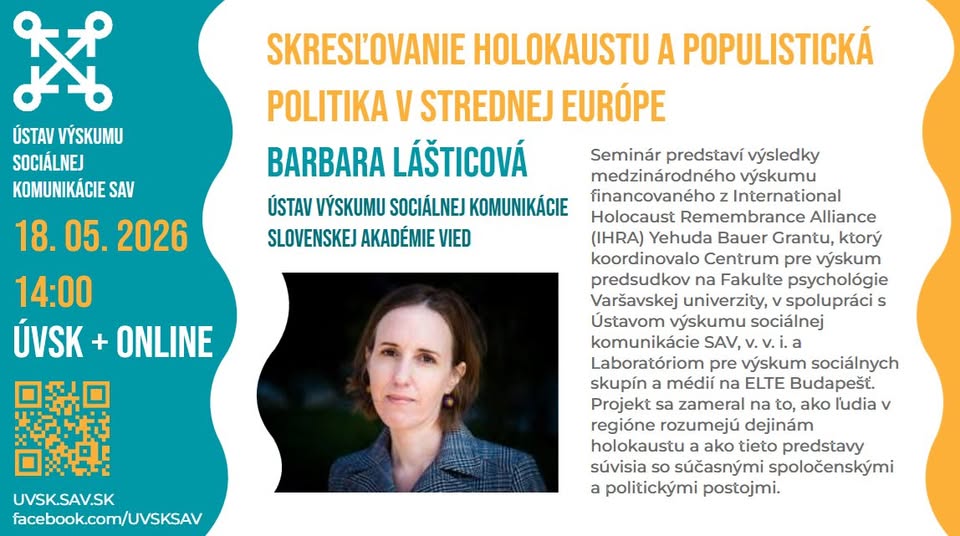
Skresľovanie holokaustu a populistická politika v Strednej Európe
Holocaust distortion and populist politics in Central Europe
Event by: Ústav výskumu sociálnej komunikácie SAV, verejná výskumná inštitúcia
Talks & discussions
About event
The seminar will present the results of international research funded by the International Holocaust Remembrance Alliance (IHRA) Yehuda Bauer Grant, which was coordinated by the Center for Research on Prejudice at the Faculty of Psychology of the University of Warsaw, in cooperation with the Institute of Social Communication Research, SAV, v. v. i. and the Laboratory for Social Groups and Media Research at ELTE Budapest. The project focused on how people in the region understand the history of the Holocaust and how these ideas are related to current social and political attitudes.
The results of a representative survey in six countries (Slovakia, Poland, Hungary, Czech Republic, Austria, Germany) indicate that distorted ideas about the Holocaust are relatively widespread in the region. For example, many people believe that their own nation suffered more than the Jews during the Second World War, and at the same time they greatly overestimate the amount of aid to the Jews from the majority population.
It turns out that these distortions are closely related to the so-called populist attitudes - that is, with the belief that "the people" are in conflict with the elites, and that history should primarily serve national interests. Almost half of the respondents think that the interpretation of history should support the current interests of the country, and some of them even agree that some historical facts should be hidden so as not to damage the image of the nation.
Interviews with teachers in Poland, Hungary and Slovakia were also an important part of the project. They showed that the way the Holocaust is taught is largely influenced by the current social and political climate. Sometimes teachers face pressure from parents or the school environment and prefer to omit or moderate certain topics.
The seminar concludes the project and offers an overview of its main findings, as well as suggestions for practice - especially for the education and work of teachers in the field of history and civic education.
The seminar will be in the Slovak language.
The results of a representative survey in six countries (Slovakia, Poland, Hungary, Czech Republic, Austria, Germany) indicate that distorted ideas about the Holocaust are relatively widespread in the region. For example, many people believe that their own nation suffered more than the Jews during the Second World War, and at the same time they greatly overestimate the amount of aid to the Jews from the majority population.
It turns out that these distortions are closely related to the so-called populist attitudes - that is, with the belief that "the people" are in conflict with the elites, and that history should primarily serve national interests. Almost half of the respondents think that the interpretation of history should support the current interests of the country, and some of them even agree that some historical facts should be hidden so as not to damage the image of the nation.
Interviews with teachers in Poland, Hungary and Slovakia were also an important part of the project. They showed that the way the Holocaust is taught is largely influenced by the current social and political climate. Sometimes teachers face pressure from parents or the school environment and prefer to omit or moderate certain topics.
The seminar concludes the project and offers an overview of its main findings, as well as suggestions for practice - especially for the education and work of teachers in the field of history and civic education.
The seminar will be in the Slovak language.