This event has been ended!
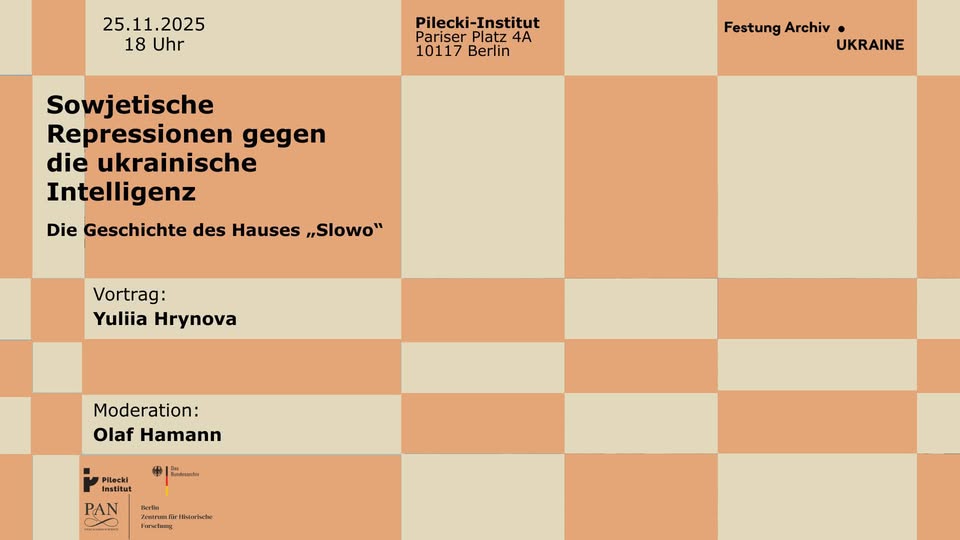
Sowjetische Repressionen gegen die ukrainische Intelligenz. Die Geschichte des Hauses „Slowo“
Soviet repressions against the Ukrainian intelligentsia. The history of the house “Slowo”
Event by: Pilecki-Institut
Location: Pariser Platz, Pariser Platz, Berlin - Mitte
Tickets: Get tickets
About event
Soviet repressions against the Ukrainian intelligentsia. The history of the “Slowo” house and the “Shot Renaissance” | November 25, 2025, 6 p.m. | Pariser Platz 4A, 10117 Berlin
Registration: https://forms.gle/Msv5kUCnADdyiaaw6
Co-organizer: Federal Archives, Center for Historical Research Berlin of the Polish Academy of Sciences Sciences
Our Fortress Archive Ukraine series offers archivists from Ukraine a platform to talk about their work in times of the Russian war of aggression, but also to present their holdings and the extraordinary stories they contain.
This time, Olaf Hamann, head of the Eastern Europe department of the Berlin State Library, speaks with Yuliia Hrynova, head of the department for organization, coordination of archiving and digital transformation of the region's state archive Kharkiv, about the history of the house “Slovo” - about what it reveals about Soviet policy towards Ukrainian intellectuals, and about the term “Shot Renaissance” coined by the Polish thinker Jerzy Giedroyc.
In the center of Kharkiv, on Kulturstrasse 9, there is still a striking five-story building whose floor plan is reminiscent of the letter “C”. It represents the Ukrainian word слово (slovo) – “word”; no coincidence, as the building was built specifically for writers. A memorial plaque also indicates this: it bears 123 engraved names of well-known writers and artists who lived and worked here. The length of the list, especially since it is incomplete anyway, is a telling symbol in itself. A particularly large number of documents that help to reconstruct their fate are currently in the State Archives of the Kharkiv Region.
Following Karl Schlögel's reflections on the meaning of space, the “Slovo” house can be read as a historical artifact in which central processes of Soviet and Ukrainian history of the 20th century are condensed: the initially changeable Soviet Ukraine policy, which at times, for purely strategic reasons, mind you, allowed more space for Ukrainian in order to then suppress it even more radically. The history of the “Slowo” house illustrates this exemplarily. After the Soviet leadership failed to win over the Ukrainian elites politically, they were crushed with the hammer of Russian ethno-nationalism in Soviet guise. The building's historical-current message thus demythologizes the ideas that are still widespread today of a harmonious, multicultural coexistence in the Soviet Union and brings them back to earth.
The building was designed in 1927 by the architect Mychajlo (Mytrofan) Dashkewytsch and has clear constructivist features. It was built in a design that was exceptionally comfortable for the Soviet Union in the interwar period. Each apartment contained three to four rooms - private, spacious rooms that stood in clear, almost bourgeois-seeming contrast to the “Kommunalkas” that were widespread at the time and the collectivist ideology that underpinned them. These living conditions followed the idea that comfort and intellectual freedom were essential for creative work. But this was precisely what turned out to be a trap: the supposed El Dorado of artistic appreciation brought all Ukrainian writers together in one place, making them easy targets for state surveillance, interrogations and arrests. A microcosm of Vienna's fin de siècle became a panopticon like the works of Bentham and Foucault. For a whole generation of outstanding Ukrainian writers and artists known as the “Shot Renaissance”, the house became a symbol of Stalinist terror.
Current developments also show that history, as Mark Twain wrote, does not repeat itself, but does rhyme. The “Slovo” house was added to the State Register of Monuments of Ukraine in 2019 - but this status did not protect it from Russian bombings and may even have made it an even more important target for the occupiers. The Russian grenades that damaged the building on March 7, 2022 also fit into the long tradition of Soviet-Russian suppression of Ukrainian characteristics as well as independent thinking and action coined in the 1950s by the Polish journalist and cultural politician Jerzy Giedroyc, the editor of the Paris exile magazine Kultura. It refers to the generation of Ukrainian writers, artists and intellectuals who fell victim to Stalinist terror in the 1930s: shot, deported or silenced. Giedroyc's conscious use of the term helped to revive the memory of this era of intense cultural development, which had been erased by Soviet historiography, and to place it in the larger European context of totalitarian violence of the 20th century.
After the revolution of 1917, Lenin, whose concept of power was tied to totalitarian principles and practices from the start, initially tried to use strategic calculation to control the local elites of the multi-ethnic Soviet republics to lull. "The 1920s were a time of astonishing cultural flourishing for Ukraine. Under the policy of Ukrainization, new schools, theaters, publishing houses and literary circles emerged. But this renaissance was short-lived - it was literally wiped out by Stalin's terror in the 1930s," wrote Serhii Plokhy in his classic The Gates of Europe. When Stalin came to power, these strategically used spaces were also destroyed. Aggressive Russification began - teachers, poets and intellectuals were arrested, deported or shot en masse, many of them in Sandarmoch in Karelia in 1937–1938. This anti-Ukrainian policy found its cruelest expression in the targeted extermination campaign of the Holodomor.
Registration: https://forms.gle/Msv5kUCnADdyiaaw6
Co-organizer: Federal Archives, Center for Historical Research Berlin of the Polish Academy of Sciences Sciences
Our Fortress Archive Ukraine series offers archivists from Ukraine a platform to talk about their work in times of the Russian war of aggression, but also to present their holdings and the extraordinary stories they contain.
This time, Olaf Hamann, head of the Eastern Europe department of the Berlin State Library, speaks with Yuliia Hrynova, head of the department for organization, coordination of archiving and digital transformation of the region's state archive Kharkiv, about the history of the house “Slovo” - about what it reveals about Soviet policy towards Ukrainian intellectuals, and about the term “Shot Renaissance” coined by the Polish thinker Jerzy Giedroyc.
In the center of Kharkiv, on Kulturstrasse 9, there is still a striking five-story building whose floor plan is reminiscent of the letter “C”. It represents the Ukrainian word слово (slovo) – “word”; no coincidence, as the building was built specifically for writers. A memorial plaque also indicates this: it bears 123 engraved names of well-known writers and artists who lived and worked here. The length of the list, especially since it is incomplete anyway, is a telling symbol in itself. A particularly large number of documents that help to reconstruct their fate are currently in the State Archives of the Kharkiv Region.
Following Karl Schlögel's reflections on the meaning of space, the “Slovo” house can be read as a historical artifact in which central processes of Soviet and Ukrainian history of the 20th century are condensed: the initially changeable Soviet Ukraine policy, which at times, for purely strategic reasons, mind you, allowed more space for Ukrainian in order to then suppress it even more radically. The history of the “Slowo” house illustrates this exemplarily. After the Soviet leadership failed to win over the Ukrainian elites politically, they were crushed with the hammer of Russian ethno-nationalism in Soviet guise. The building's historical-current message thus demythologizes the ideas that are still widespread today of a harmonious, multicultural coexistence in the Soviet Union and brings them back to earth.
The building was designed in 1927 by the architect Mychajlo (Mytrofan) Dashkewytsch and has clear constructivist features. It was built in a design that was exceptionally comfortable for the Soviet Union in the interwar period. Each apartment contained three to four rooms - private, spacious rooms that stood in clear, almost bourgeois-seeming contrast to the “Kommunalkas” that were widespread at the time and the collectivist ideology that underpinned them. These living conditions followed the idea that comfort and intellectual freedom were essential for creative work. But this was precisely what turned out to be a trap: the supposed El Dorado of artistic appreciation brought all Ukrainian writers together in one place, making them easy targets for state surveillance, interrogations and arrests. A microcosm of Vienna's fin de siècle became a panopticon like the works of Bentham and Foucault. For a whole generation of outstanding Ukrainian writers and artists known as the “Shot Renaissance”, the house became a symbol of Stalinist terror.
Current developments also show that history, as Mark Twain wrote, does not repeat itself, but does rhyme. The “Slovo” house was added to the State Register of Monuments of Ukraine in 2019 - but this status did not protect it from Russian bombings and may even have made it an even more important target for the occupiers. The Russian grenades that damaged the building on March 7, 2022 also fit into the long tradition of Soviet-Russian suppression of Ukrainian characteristics as well as independent thinking and action coined in the 1950s by the Polish journalist and cultural politician Jerzy Giedroyc, the editor of the Paris exile magazine Kultura. It refers to the generation of Ukrainian writers, artists and intellectuals who fell victim to Stalinist terror in the 1930s: shot, deported or silenced. Giedroyc's conscious use of the term helped to revive the memory of this era of intense cultural development, which had been erased by Soviet historiography, and to place it in the larger European context of totalitarian violence of the 20th century.
After the revolution of 1917, Lenin, whose concept of power was tied to totalitarian principles and practices from the start, initially tried to use strategic calculation to control the local elites of the multi-ethnic Soviet republics to lull. "The 1920s were a time of astonishing cultural flourishing for Ukraine. Under the policy of Ukrainization, new schools, theaters, publishing houses and literary circles emerged. But this renaissance was short-lived - it was literally wiped out by Stalin's terror in the 1930s," wrote Serhii Plokhy in his classic The Gates of Europe. When Stalin came to power, these strategically used spaces were also destroyed. Aggressive Russification began - teachers, poets and intellectuals were arrested, deported or shot en masse, many of them in Sandarmoch in Karelia in 1937–1938. This anti-Ukrainian policy found its cruelest expression in the targeted extermination campaign of the Holodomor.