This event has been ended!
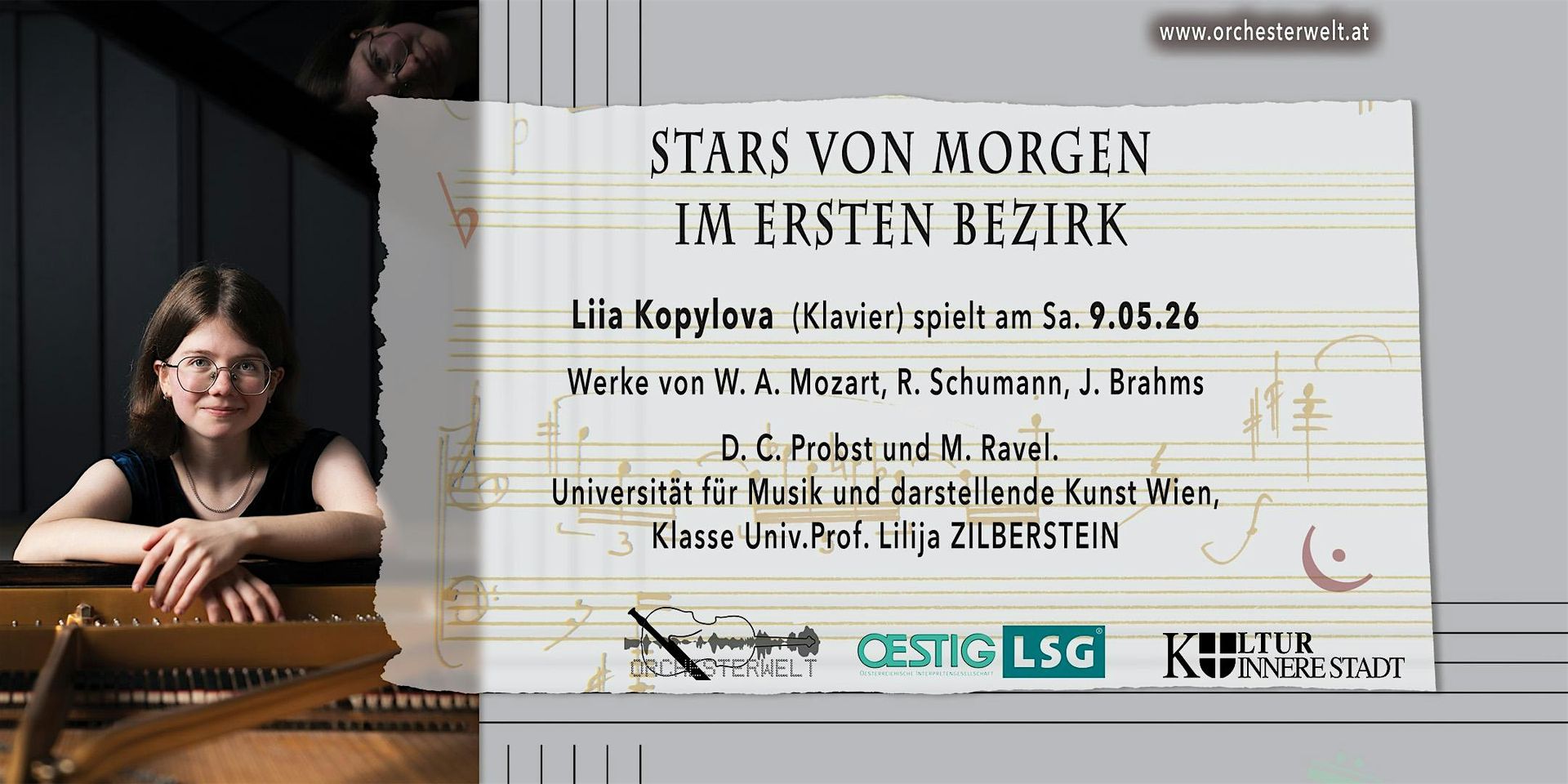
STARS VON MORGEN - Liia Kopylova 9.05.2026
STARS OF TOMORROW - Liia Kopylova May 9, 2026
Event by: Verein "Orchesterwelt"
Concerts
About event
Admission: free Donation.
Registration required!
The 51st episode of the series Stars of Tomorrow in the first district features the 19-year-old Russian LIIA KOPYLOVA, who won the prize shower during competitions one can speak of hail. We have never had such a young person with so many awards! We are accordingly curious about their interpretation of the Austrian MOZART and his very well-known, 20-minute piano sonata No. 10 in C major, KV 330 from his time in Vienna in 1783 with a cheerful, lyrical character, followed by the German friends ROBERT SCHUMANN with the baroque, the Viennese classical music and the music of the Romantic period, containing Symphonic Etudes Opus 13, which Schumann began composing in 1837 out of a stormy youthful love, as well as JOHANNES BRAHMS with6 piano pieces, op. 118, completed in 1893 and dedicated to Robert Schumann's wife Clara, which are "slow, quiet and lonely" and are among Brahms' late, most-played piano works.
After so much musical feeling of romanticism, there is also a seven and a half minute new musical piece by the Romanian-Austrian composer DANA CRISTINA PROBST, born in Bucharest in 1961 of the title at least conceptually for poetic and philosophical romanticism: "Sans nuages, la lumière n'aurait pas de mystères, pas des hésitations, pas de victoires" means "Without clouds there would be no secrets for the light, no hesitation, none Siege“.Whether the work composed in 2021 actually sounds more romantic, philosophical or even spiritual remains to be seen. In any case, LIIA KOPYLOVA chose it from an anonymous selection of several pieces of new music.
Finally follows La Valse, poème chorégraphique pour orchestre by the real Frenchman and impressionist MAURICE RAVEL from 1920 in the version for piano by the Georgian composer ALEXANDER KORSANTIA. It is a choreographic poem as a dark deification of the Viennese waltz. After World War I, RAVEL saw the classic waltz form as a swirling, tragic dance that symbolized the disintegration of European culture. The work begins quietly, builds into a rushing waltz and ends in a chaotic, frenetic apotheosis. (text: Elfi Oberhuber)
Program:
W. A. Mozart: Sonata in C major, KV 330
R. Schumann: Symphonic Etudes for piano, op. 13
J. Brahms: 6 piano pieces, op. 118
Dana Cristina Probst: "Sans nuages, la lumière n'aurait pas de mystères, pas des hésitations, pas de victoires" (2021)
M. Ravel: La Valse, poème chorégraphique pour orchestre, version for piano by Alexander Korsantia
Introduction: Evgeniia Lianskaya-Lininger.
Liia Kopylova was born in Moscow in 2007 into a family of musicians. At the age of 9 she made her debut with Mozart's Concerto in the Great Hall of the P. Tchaikovsky Conservatory. After completing her studies with distinction at the Central Music School - Academy for Performing Arts with Prof. Maxim Filippov, she continued her further education at the University of Music and Performing Arts Vienna with Univ.-Prof. Lilija Zilberstein.
The pianist regularly performs at major venues in Russia, Denmark and Austria. She is the winner of numerous international competitions.