This event has been ended!
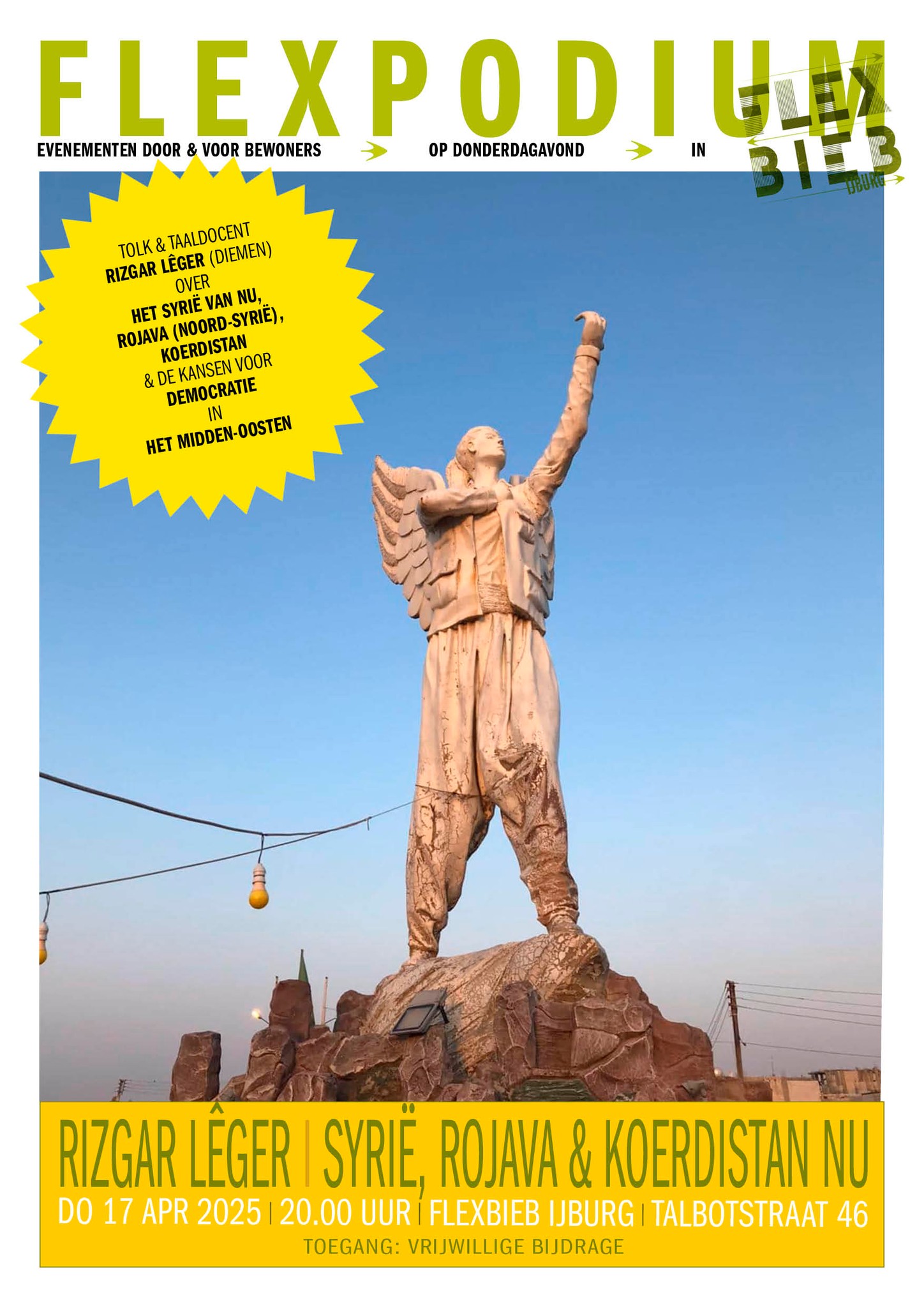
Syrië, Rojava & Koerdistan nu
Syria, Rojava & Kurdistan now
Event by: FlexBieb
Location: Talbotstraat 46, Talbotstraat 46, Amsterdam - Amsterdam-Oost
Tickets: Get tickets
About event
The Syrian Civil War seems to have ended at the end of last year with the departure of dictator Bashar al-Assad by rebel groups. These groups are the Alliance HTS, a collaboration of strict Islamic militias, partly with roots in the Muslim fundamentalist movement al-Qaida.
The new regime of present-day Syria seems to be very peacefully operating for the average Westerner. Would permanent peace in the Middle East be possible? Is Syria a prelude to more positive sounds from that region?
appears to be deceived, for the time being: Syria still has a lot of unrest, especially in the north, where ethnic and religious minorities such as Alevis, Christians and Druzen are persecuted.
What does the future bring for Syria?
That question is difficult to answer, partly because there are few independent journalists in that region.
Anyway, this is also a complex historical, religious, cultural, political matter.
For example, a large part of Northern Syria has been known for more than ten years as the autonomous region of Northern and East Syria, also called Rojava. The situation there is largely the result of the decades of Kurdish liberation struggle. Rojava is characterized by a peaceful, multi-ethnic, self-sufficient, gender and ecologically conscious self-government.
Rojava managed to stand well against the dictator Assad that has since resigned until the end of 2024. The board of Rojava was also able to defy other violent, largely Muslim fundamentalist, jihadist forces such as ISIS. Citizens of the region formed the People's Protection Units (YPG), a force that protected them against the slaughter of ISIS. The fully female self -defense units (YPJ) played a decisive role in the defeat of the jihadists. Kurds, Arabs, Syrian Orthodox and Assyrian Christians, Alevis, Armenians, Druze, Turkmen and other ethnic and religious communities stand together in their pursuit of a democratic and just Syria.
but it is certainly not a rose scent and Manehine, for the time being. Especially people and groups who are suspected of having supported ex-dictator Assad have often endured it hard.
During this Flex stage we will talk to Rizgar Lêger about the past and present in Syria, Rojava and the surrounding area.
Rizgar Lêger is a Kurdish Taaldocent and the Psychology. He lives in Diemen. As a volunteer social worker, he helps refugees who have experienced traumas. He supports them in their integration into our society and with learning Dutch. He also helps them with studies and careers. He is also committed to cultural projects, and he gives and gives lectures and conversations about topics such as history, sociology, political science, human rights, philosophy, behavioral science and pedagogy. He strives to spread knowledge and connect cultures. For example, he contributes to the development of both new and "native" Dutch people, resulting in more mutual understanding.
Access: voluntary contribution.
Reserve: via the Chipta link on this page.
The new regime of present-day Syria seems to be very peacefully operating for the average Westerner. Would permanent peace in the Middle East be possible? Is Syria a prelude to more positive sounds from that region?
appears to be deceived, for the time being: Syria still has a lot of unrest, especially in the north, where ethnic and religious minorities such as Alevis, Christians and Druzen are persecuted.
What does the future bring for Syria?
That question is difficult to answer, partly because there are few independent journalists in that region.
Anyway, this is also a complex historical, religious, cultural, political matter.
For example, a large part of Northern Syria has been known for more than ten years as the autonomous region of Northern and East Syria, also called Rojava. The situation there is largely the result of the decades of Kurdish liberation struggle. Rojava is characterized by a peaceful, multi-ethnic, self-sufficient, gender and ecologically conscious self-government.
Rojava managed to stand well against the dictator Assad that has since resigned until the end of 2024. The board of Rojava was also able to defy other violent, largely Muslim fundamentalist, jihadist forces such as ISIS. Citizens of the region formed the People's Protection Units (YPG), a force that protected them against the slaughter of ISIS. The fully female self -defense units (YPJ) played a decisive role in the defeat of the jihadists. Kurds, Arabs, Syrian Orthodox and Assyrian Christians, Alevis, Armenians, Druze, Turkmen and other ethnic and religious communities stand together in their pursuit of a democratic and just Syria.
but it is certainly not a rose scent and Manehine, for the time being. Especially people and groups who are suspected of having supported ex-dictator Assad have often endured it hard.
During this Flex stage we will talk to Rizgar Lêger about the past and present in Syria, Rojava and the surrounding area.
Rizgar Lêger is a Kurdish Taaldocent and the Psychology. He lives in Diemen. As a volunteer social worker, he helps refugees who have experienced traumas. He supports them in their integration into our society and with learning Dutch. He also helps them with studies and careers. He is also committed to cultural projects, and he gives and gives lectures and conversations about topics such as history, sociology, political science, human rights, philosophy, behavioral science and pedagogy. He strives to spread knowledge and connect cultures. For example, he contributes to the development of both new and "native" Dutch people, resulting in more mutual understanding.
Access: voluntary contribution.
Reserve: via the Chipta link on this page.
Events in Amsterdam today · Events in Amsterdam this weekend