This event has been ended!
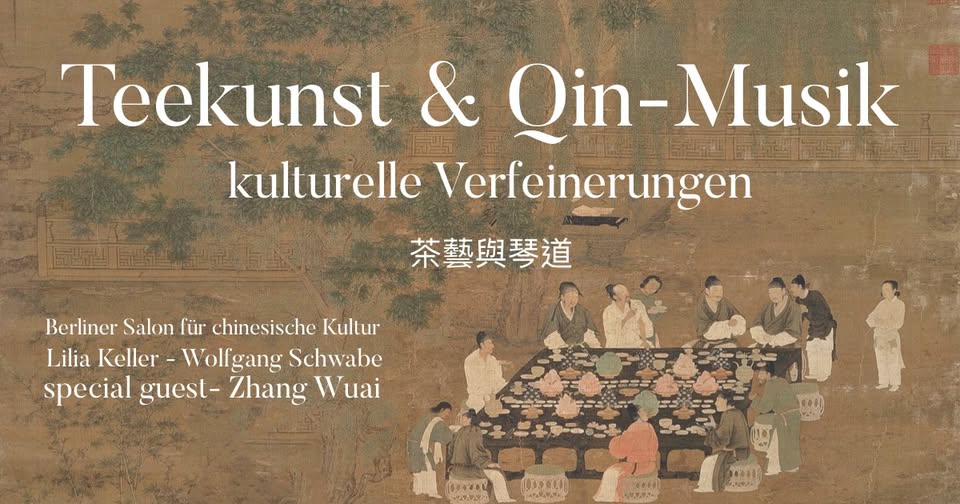
Teekunst & Qin-Musik, kulturelle Verfeinerungen
Tea art & Qin music, cultural refinements
Event by: Lilia Keller, Wolfgang Schwabe
Location: Berliner Salon für chinesische Kultur, Feilnerstraße 10, Berlin - Bezirk Friedrichshain-Kreuzberg
About event
An afternoon with tea from Taiwan, prepared in the traditional Gongfu Cha way and complemented by musical performances on the Chinese zither Guqin.
Tea from various growing regions in Taiwan is served.
Continuing cultural traditions also includes refining what has been handed down. In music, this happens through more precise notations and individual interpretations, in tea cultivation through refined work processes and a differentiation of the taste spectrum.
/// New types of tea, refined taste ///
New tea cultivars are continually being developed in Taiwan. Three particularly successful ones will be presented this time.
::: Green jade tea (CuiYu) emerged in the 1980s from crossing two indigenous Taiwanese tea plants (Yingzhi hongxin and Tainong No.80). Its particularly fragrant aroma is particularly effective in the variant processed by tea farmers in Pinling as Baozhong tea.
::: “Black Ruby” (Hongyu) black tea was developed in 1999 in Yuchi County on Sun-Moon Lake in central Taiwan. Big leaf tea from Burma was crossed with wild tea from Taiwan. Its taste stands out clearly from all other types of black tea. The summer harvest is particularly noble.
::: Hongyun black tea was developed in 2008 by crossing a Chinese and an Indian tea plant. Difficult to grow, the annual harvest is very small. Accordingly, it is rare to find outside of Taiwan.
/// Old melodies brought back to life ///
Intellectual history has always been refined in Qin music.
::: The “Melody of King Wen” is attributed to 1000 BC. Attributed to King Wen, who lived in BC, it was written down in the 15th century; In the 20th century, the Qin master Chen Gongliang worked on them. Today ZHANG Wuai plays her interpretation of this piece.
::: The “Song of the Fisherman” celebrates the simple life in nature, a place of longing for so many Chinese writers. It goes back to the Song Period composer Mao Mingzhong and is about his own withdrawal from society. In the 20th century, well-known performers such as ZHA Fuxi and WU Zhaoji attempted this piece. Wolfgang Schwabe's interpretation is based on the adaptation by GE Hancong.
Cost: €25/ reduced €20
https://liliakeller.de/2025/11/03/teekunst-qin-musik-kultur-verfeinerung/
Tea from various growing regions in Taiwan is served.
Continuing cultural traditions also includes refining what has been handed down. In music, this happens through more precise notations and individual interpretations, in tea cultivation through refined work processes and a differentiation of the taste spectrum.
/// New types of tea, refined taste ///
New tea cultivars are continually being developed in Taiwan. Three particularly successful ones will be presented this time.
::: Green jade tea (CuiYu) emerged in the 1980s from crossing two indigenous Taiwanese tea plants (Yingzhi hongxin and Tainong No.80). Its particularly fragrant aroma is particularly effective in the variant processed by tea farmers in Pinling as Baozhong tea.
::: “Black Ruby” (Hongyu) black tea was developed in 1999 in Yuchi County on Sun-Moon Lake in central Taiwan. Big leaf tea from Burma was crossed with wild tea from Taiwan. Its taste stands out clearly from all other types of black tea. The summer harvest is particularly noble.
::: Hongyun black tea was developed in 2008 by crossing a Chinese and an Indian tea plant. Difficult to grow, the annual harvest is very small. Accordingly, it is rare to find outside of Taiwan.
/// Old melodies brought back to life ///
Intellectual history has always been refined in Qin music.
::: The “Melody of King Wen” is attributed to 1000 BC. Attributed to King Wen, who lived in BC, it was written down in the 15th century; In the 20th century, the Qin master Chen Gongliang worked on them. Today ZHANG Wuai plays her interpretation of this piece.
::: The “Song of the Fisherman” celebrates the simple life in nature, a place of longing for so many Chinese writers. It goes back to the Song Period composer Mao Mingzhong and is about his own withdrawal from society. In the 20th century, well-known performers such as ZHA Fuxi and WU Zhaoji attempted this piece. Wolfgang Schwabe's interpretation is based on the adaptation by GE Hancong.
Cost: €25/ reduced €20
https://liliakeller.de/2025/11/03/teekunst-qin-musik-kultur-verfeinerung/