This event has been ended!
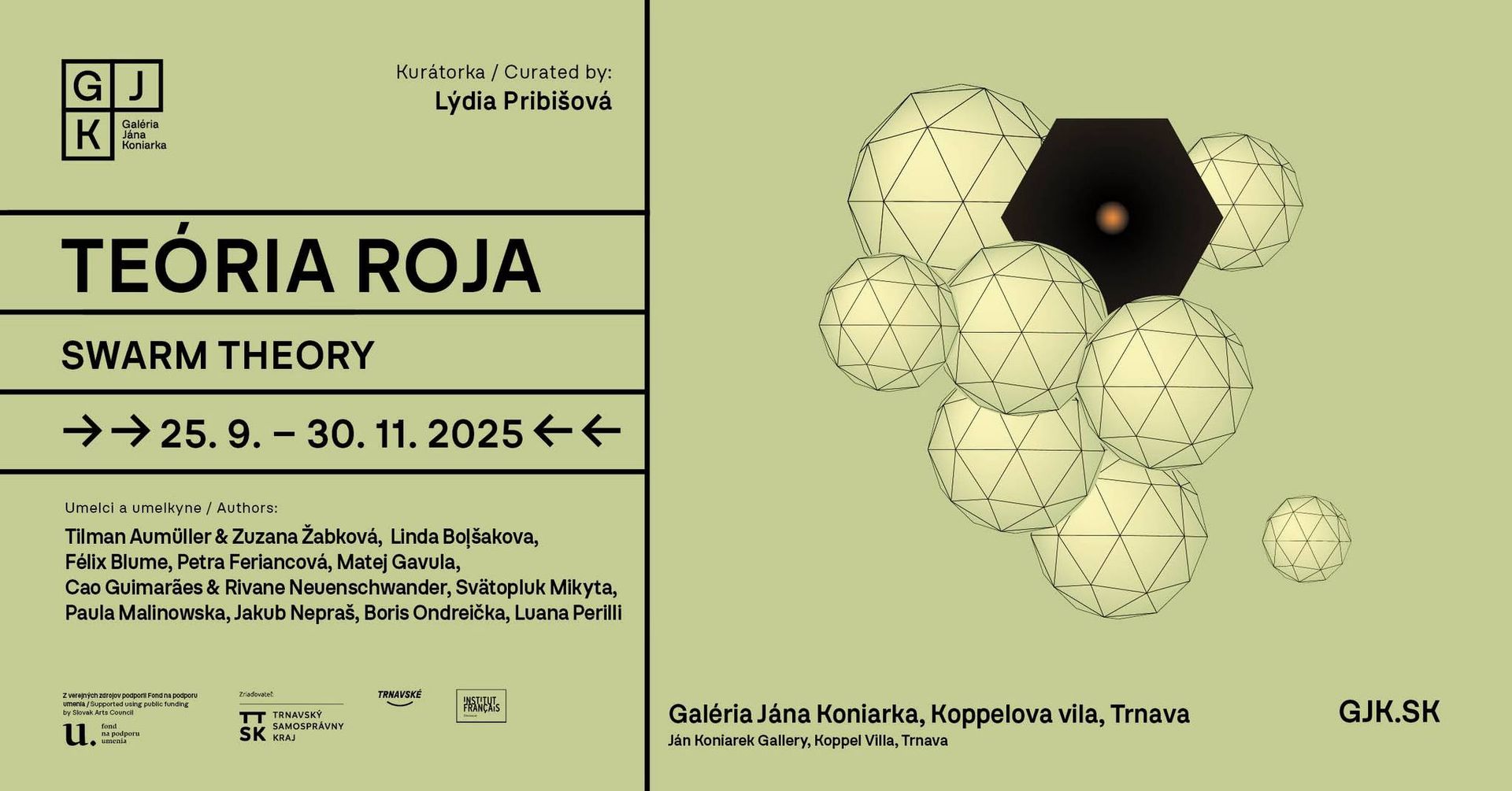
Teória roja
Roja theory
Event by: Galéria Jána Koniarka v Trnave / Jan Koniarek Gallery in Trnava
Location: Zelený kríčok 598/3, Zelený kríčok 3, Trnava
About event
Roja theory
*Authors*Author: Tilman Aumüller & Zuzana Žabková, Linda Boš! Felix Blume, Petra Feriancová, Matej Gavula, Cao Guimarães & Rivane Neunschwander, Svätopluk Mikyta, Paula Malinowská, Jakub Nepros, Boris Ondreička Perilli
Curator: Lydia Pribišová
Mravce, bees, birds and other animals living in communities teach us how to succeed with the complex problems of the world. We might think that ants know why they go somewhere, that they have a plan they fulfill. However, this is not the case when we observe an ant, we see that it is helpless and inept. The ants are not bright, but their colonies are bright, which react quickly and efficiently. They can solve the problems that would be unsurpassed for the individual. Do so on the basis of the intelligence of the Community.
Where does this wisdom come from? How do the individual's actions contribute to the actions of the whole colony? How do hundreds of bees come to a fundamental decision, even if many of them disagree? The collective abilities of animals, of which no one understands what the whole group does, but everyone contributes to making the whole successful, acting as a miracle. Nobody does an ant colony, they have no leader. Their actions are governed by simple rules, each member or ankle is acting on the basis of immediate local information, but none of them understand the situation. Scientists describe this system as self -organizational. When dividing the tasks of the ants colony, he calculates how many members of the Community will be looking for food, given the current situation.
This model is inspired, for example, many transport companies, using artificial intelligence inspired by algorithms behavior of ants in finding food. This is also used by investors on the stock exchange, racing bettors, using collective judgment, voting mechanisms, auctionaling, averaging.
Although bees in a swarm often have a different view of where it is best to build a new nest, they usually choose the best group. The decision is made when they gather enough information, then they carry out an independent evaluation and then vote. For example, a colony of crucifixes follows the rules: to notice your neighbors, avoid collisions, stick together, swim in one direction. There is another kind of collective intelligence that is related to coordinated movement. Self -organizational models in the field of robotics are also inspired by imitating the behavior of animal groupings. Here, too, the management of the group is decentralized, does not depend on a leader. Similarly, on the principle of self -organization, Wikipedia works.
In nature, animals often move in large groups. It is because the members of the swarm, the bunch of or the herds increase the individual's chances to protect themselves from the predator, find food or partner, or follow the migration route. When the predator attacks a bunch of fish, the group dispels into such formations that it is almost impossible to hitchhike the individual. However, large groups tend to be wise only when individuals act alone and responsibly. Each member must contribute individual deposits. Through the exhibition we will explore how it is possible to inspire these skills. The question remains, why it does not work for people and what place here plays individual will. The inspiration of this exhibition was the contribution of Petr Miller theory Hejn in National Geographic [1].
[1] Petr Miller, Theoria Hejna, National Geographic, vol. 2007, no. 7, 2007, p. 104-125.
*Authors*Author: Tilman Aumüller & Zuzana Žabková, Linda Boš! Felix Blume, Petra Feriancová, Matej Gavula, Cao Guimarães & Rivane Neunschwander, Svätopluk Mikyta, Paula Malinowská, Jakub Nepros, Boris Ondreička Perilli
Curator: Lydia Pribišová
Mravce, bees, birds and other animals living in communities teach us how to succeed with the complex problems of the world. We might think that ants know why they go somewhere, that they have a plan they fulfill. However, this is not the case when we observe an ant, we see that it is helpless and inept. The ants are not bright, but their colonies are bright, which react quickly and efficiently. They can solve the problems that would be unsurpassed for the individual. Do so on the basis of the intelligence of the Community.
Where does this wisdom come from? How do the individual's actions contribute to the actions of the whole colony? How do hundreds of bees come to a fundamental decision, even if many of them disagree? The collective abilities of animals, of which no one understands what the whole group does, but everyone contributes to making the whole successful, acting as a miracle. Nobody does an ant colony, they have no leader. Their actions are governed by simple rules, each member or ankle is acting on the basis of immediate local information, but none of them understand the situation. Scientists describe this system as self -organizational. When dividing the tasks of the ants colony, he calculates how many members of the Community will be looking for food, given the current situation.
This model is inspired, for example, many transport companies, using artificial intelligence inspired by algorithms behavior of ants in finding food. This is also used by investors on the stock exchange, racing bettors, using collective judgment, voting mechanisms, auctionaling, averaging.
Although bees in a swarm often have a different view of where it is best to build a new nest, they usually choose the best group. The decision is made when they gather enough information, then they carry out an independent evaluation and then vote. For example, a colony of crucifixes follows the rules: to notice your neighbors, avoid collisions, stick together, swim in one direction. There is another kind of collective intelligence that is related to coordinated movement. Self -organizational models in the field of robotics are also inspired by imitating the behavior of animal groupings. Here, too, the management of the group is decentralized, does not depend on a leader. Similarly, on the principle of self -organization, Wikipedia works.
In nature, animals often move in large groups. It is because the members of the swarm, the bunch of or the herds increase the individual's chances to protect themselves from the predator, find food or partner, or follow the migration route. When the predator attacks a bunch of fish, the group dispels into such formations that it is almost impossible to hitchhike the individual. However, large groups tend to be wise only when individuals act alone and responsibly. Each member must contribute individual deposits. Through the exhibition we will explore how it is possible to inspire these skills. The question remains, why it does not work for people and what place here plays individual will. The inspiration of this exhibition was the contribution of Petr Miller theory Hejn in National Geographic [1].
[1] Petr Miller, Theoria Hejna, National Geographic, vol. 2007, no. 7, 2007, p. 104-125.