This event has been ended!
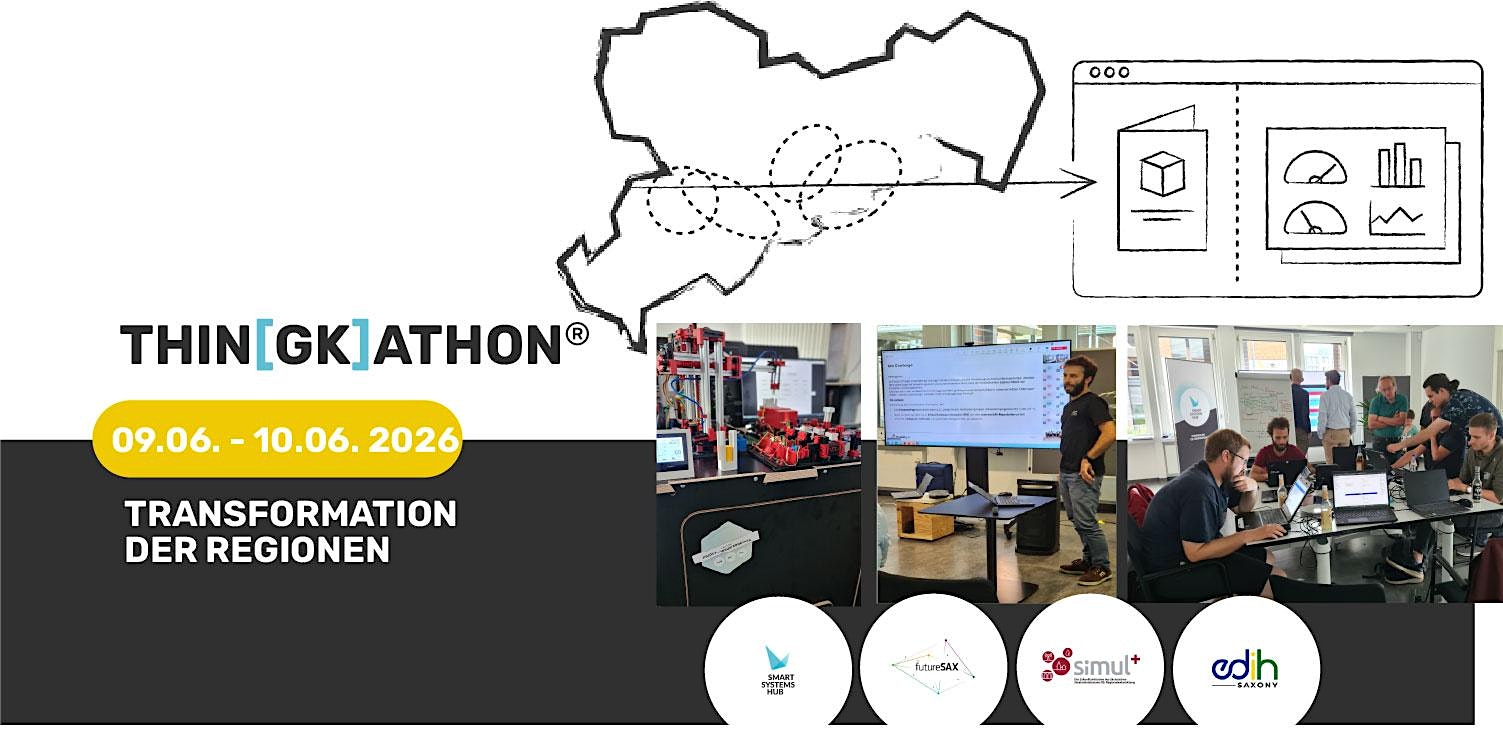
Thin[gk]athon Transformation der Regionen
Thin[gk]athon transformation of the regions
Event by: Smart Systems Hub GmbH
Location: Buntspeicher, Speicherstraße 1, Zwönitz
Talks & discussions
About event
powered by Smart Systems Hub, Buntspeicher Zwönitz, Sellium GmbH, Erzgebirge District Office, futureSAX GmbH, simul⁺
CONDITIONS
The Thin[gk]athon will take place from 09. until June 10that various locations. The Thin[gk]athon lasts two days at each location (also virtual). If you would like to participate virtually, you must indicate which time slot you prefer.
Buntspeicher Zwönitz: June 9th - June 10th, 2026
⇾ Speicherstraße 1 · 08297 Zwönitz
Business and Innovation Center (BIC) Zwickau: June 9th - June 10th, 2026
⇾ Lessingstraße 4, 08058 Zwickau
ABOUT THE THIN[GK]ATHON
The Thin[gk]athon is more than a classic hackathon. It is an intensive co-innovation sprint in which interdisciplinary teams work on real industrial challenges.
Within less than 3 days, teams from software development, data science, embedded engineering and industry develop working prototypes and technical architecture concepts together.
The focus is on:
- the integration of hardware and software
- working with real data and Technologies
- the development of solutions under practical conditions
The Thin[gk]athon offers a space in which new technical approaches can be quickly tested, evaluated and further developed.
THE CHALLENGE
There are currently more than 140 applications in the Erzgebirgskreis district office. The aim is to make optimal use of these existing applications and to avoid multiple systems with similar or identical functions being operated in parallel. At the same time, it is hardly realistic for individual people to maintain a complete overview of all applications, functions and possible uses at all times.
The challenge is to develop a technical prototype that reads requirements from a structured requirements document and compares them with existing information on existing applications. The basis for this is, on the one hand, the requirements collected in the conversation, currently in a Word document, and, on the other hand, the information about the applications maintained in the IT wiki. The goal: A requirement profile should be used to automatically create a prioritized list of potentially suitable applications - including an assessment of the fit, transparent justification and a direct link to the respective documentation shows how such an app matching process can work technically and organizationally.The ideal process looks like this:
- A conversation takes place with the department and the request form is filled out.
- The content of the Word document is read out automatically.
- The requirements are checked against existing applications and their documented functions.
- The relevant information is used from the IT wiki.
- The result is a list of possible applications with matching rating, for example “very likely to match” or “partially match”.
- For each result, a link to the appropriate wiki documentation is displayed.
- For the documentation, the result can be exported as a PDF and later stored in the DMS.
Important: Technical support does not replace the dialogue between the department and IT. Rather, it should help to create a well-founded basis for decision-making more quickly.
KEY OBJECTIVES:
1. Make better use of existing applications: The prototype is intended to show how existing software solutions can be systematically tested against new requirements. This means that duplicate structures can be avoided and existing investments can be better utilized.
2. Make complexity manageable: With over 140 applications, it is difficult to keep an overview manually. App-Match is intended to help make functional knowledge from existing documentation usable by machine.
3. Evaluate requirements more quickly: An initial preselection should be automatically created from a completed request form. This reduces research effort and speeds up coordination between the department and IT.
4. Make decisions comprehensible: The matching results should not just appear as a hit list, but should be justified and linked. This means it remains transparent why an application was deemed suitable.
5. Develop a realistic prototype: The Thingkathon is not about a finished productive system, but rather a reliable proof of concept:
What is technically possible? What data quality is required? Where are the limits and potential?
TECHNOLOGICAL FOCUS
The focus is on a practical prototype that intelligently combines various technical components:
- Document processing: Reading out structured requirements from Word documents or perspective digital forms
- Knowledge Extraction: Preparation of information from the IT wiki on applications, functions and areas of application
- Semantic matching: Comparison of requirements with existing functional descriptions
- Scoring & prioritization: Evaluation of the fit, for example in categories such as over 80 percent or over 50 percent
- Explainability: Display of which requirements are covered by which application could
- Link: Direct jump to the respective wiki documentation
- Export: Generation of a PDF result for documentation and later storage in the DMS
- User Interface: A simple front end for input, checking and display of results
Possible technological approaches include semantic search, embeddings, Retrieval-augmented generation, classic rules, structured metadata models or hybrid matching logics.
WHAT SHOULD COME INTO THE THIN[GK]ATHON
The teams develop a prototype solution approach for App-Match within the format. Possible results are:
- a clickable process prototype,
- a technical demonstrator for reading out and matching requirements,
- a matching algorithm with comprehensible evaluation,
- a proposal for a data model of the application information,
- a UI concept for IT employees,
- a PDF export as result documentation,
- an evaluation of the technical Feasibility and next implementation steps.
At the end it should be visible how what was previously a highly manual evaluation process can become a supported, comprehensible and scalable process.
Sought participant profiles
Different perspectives are needed for the challenge. Particularly valuable are:
- Software developers for document processing, data integration, backend, front-end and prototyping.
- Data scientists / AI engineers for semantic matching, embeddings, classification, scoring and explainable result logic.
- Enterprise / solution architects for Classification in existing IT landscapes, interfaces, wiki structures, DMS and possible operating models.
- UX/UI designers for an understandable presentation of results and user-friendly process management.
- IT process and requirements managers for understanding the real requirements discussions, decision-making processes and documentation requirements.
- Domain experts from administration, IT or specialist departments to evaluate whether the solution would really be helpful in everyday life.
Expected results
At the end of the Thingkathon there should not be perfect software, but a clear basis for decision-making:
- Is app matching based on existing requirement documents and wiki information realistically possible?
- What data quality and structure is needed the IT wiki?
- How well can requirements be extracted automatically?
- Which matching logic delivers comprehensible results?
- What does a result have to look like so that IT and the department can work with it?
- What steps would be necessary to develop a usable system from the prototype?
Why is this challenge relevant is
App-Match addresses a problem that many organizations are familiar with: the software landscape grows over years, knowledge is distributed across documentation and people, and new requirements quickly lead to new solutions. At the same time, the pressure to use existing systems more efficiently, control costs and make decisions more quickly is increasing.
An intelligent matching process can create real added value here: It brings transparency to the application landscape, supports IT in assessing new requirements and helps departments to find suitable solutions more quickly.
PARTNERS
Smart Systems Hub
Buntspeicher Zwönitz
Sellium GmbH
futureSAX GmbH
Erzgebirge District Office
simul⁺