This event has been ended!
Transitorius mundus? Emblematika a efemérní slavnosti raného novověku
Transitorius mundus? Emblematics and ephemeral festivities of the early modern period
Event by: Ústav dějin umění Akademie věd ČR, v. v. i.
Location: Sklepení domu pánů z Kunštátu a Poděbrad, Řetězová 222/3, Praha 1
About event
We cordially invite you to participate in the interdisciplinary colloquium Transitorius mundus? Emblematic and ephemeral festivities of the early modern period, which will take place on 22-23 June 2026 in Prague. Organized by the Institute of Art History of the Academy of Sciences of the Czech Republic and the Institute of Christian Art History of the Catholic Theological Faculty of the UK.
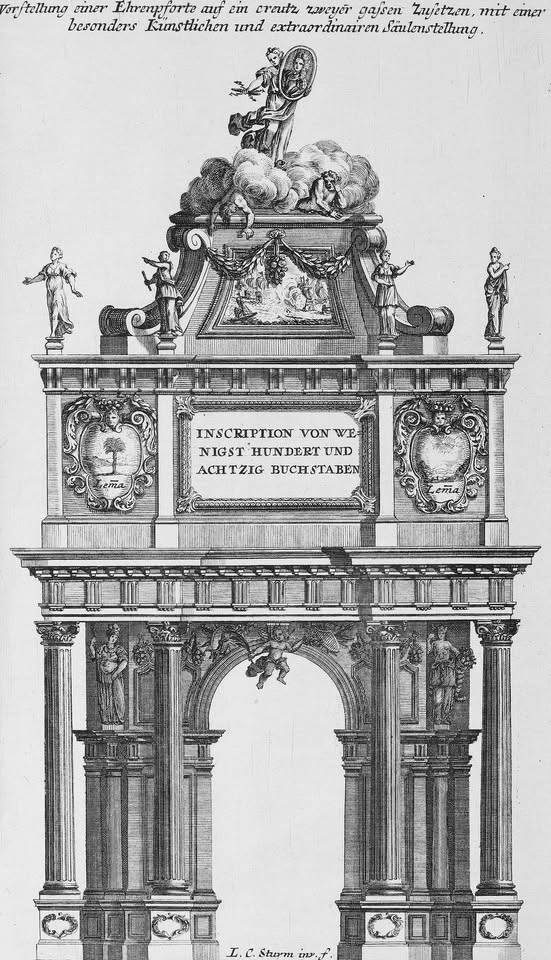
"These things are little more than games, so they are not really serious considerations. However, since the rulers require such things, they should stand out for their charm rather than their costliness." In the essay On Masques and Triumphal Festivities (1625), Francis Bacon captured the dual nature of early modern festivities: playfulness and seriousness, modesty and expense, ephemerality and flamboyance. In a culture that often viewed life as a theater, emblematics permeated even the festivities and co-formed their meaning – on the ephemeral stage and on the pages of the occasional press. Emblems became carriers of meaning, a source of emotions, a medium of power rhetoric and political or religious messages. Festivities—from entrances and welcoming parties, through ephemeral architecture and installations, school dramas or occasional sermons and panegyric literature, to illuminations, fireworks, and urban decorations—required experimentation, ingenuity, and local adaptation. Emblematics were their organic part and a form of communication realized in various media.
One of the emblems dedicated to the theater in Picinelli's Mundus symbolicus (1681), an encyclopedia of the known world in emblems, is based on the motto "Mundus est transitorius". It points to transience and impermanence as well as permeability between everyday and staged reality. The celebration functions as a mirror: the interface between the lived and the other world, a place where the world is simultaneously represented and overturned. It is a space of social communication in which visual, literary, theatrical or musical culture enters the public space and becomes a form of sharing experience. Whether we understand the celebration as a departure from the normal rhythm of life with a specific organization of space, temporality and modes of access, or as a liminal situation in which social roles, norms and ways of seeing and reading are temporarily reconfigured and reframed, we are concerned with the situated action of emblematics within its framework. Therefore, we are interested not only in the repertoire of emblems, but also in what the emblem does in the event: its staging, location, timing and mediation as well as reception.
The colloquium opens up the topic across media and contexts and welcomes papers from the field of visual, literary, theatrical and musical culture, as well as studies by historians and experts from related fields. Thematically, we prefer contributions to emblematics in ephemeral architecture, ceremonial entrances and celebrations, panegyrics, school/Jesuit theater, occasional publications, musical accompaniment to festivities, to the rhetoric of power, contemporary audience reception and its traces in sources, ways of integrating emblems into ceremonial performances and production strategies.
Kateřina Dolejší - Daniela Lunger Štěrbová - Stanislava Fedrová
We invite those interested to send a proposal for a contribution of a maximum of 1000 characters together with a brief professional medallion by 04/08/2026 to the e-mail [email protected].
Estimated duration of the presentation: 20 minutes. The organizing team expects to publish contributions.
8. 4. 2026 application deadline
15. 4. notification of acceptance of contribution
22.-23. 6th colloquium term
31. 12. submission of contributions for publication
More events: Ústav dějin umění Akademie věd ČR, v. v. i.
- Transnational Artistic Relations in the Cold War Era ·
- Asymmetrical Views: Art Exhibitions of the Nineteenth Century Revisited ·
- Call for Papers: Metals, Minerals, and Material Worlds: Art, Extraction, and Knowledge ·
- Call for Papers: Women and Musical Mobility in Nineteenth-Century Europe (c. 1800–1850) ·