This event has been ended!
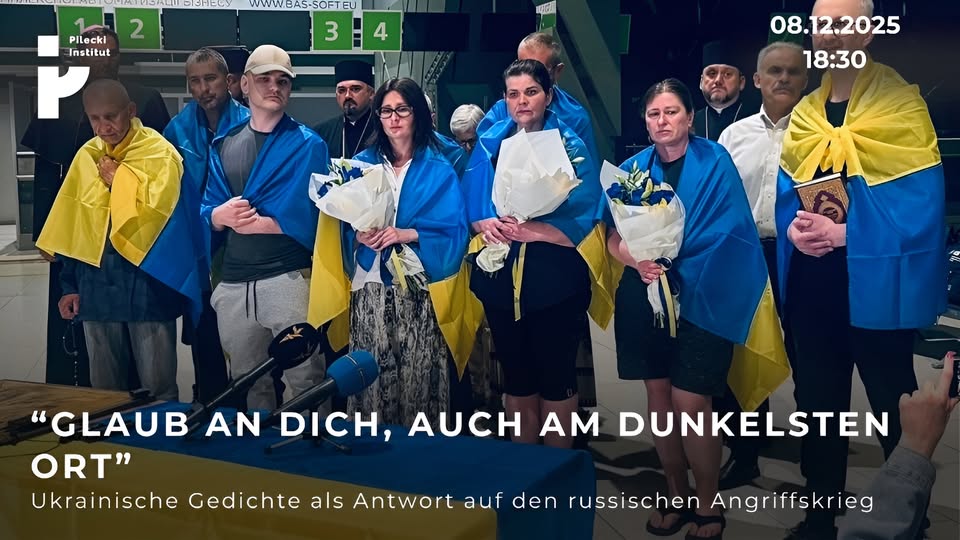
Ukrainische Gedichte als Antwort auf den russischen Angriffskrieg
Ukrainian poems in response to the Russian war of aggression
Event by: Pilecki-Institut
Location: Pariser Platz, Pariser Platz, Berlin - Mitte
Tickets: Get tickets
About event
"Believe in yourself, even in the darkest place" - Ukrainian poems as a response to the Russian war of aggression
Our next event is therefore dedicated to poems by Ukrainian poets that were written after the large-scale invasion - read by Olena Piekh and Elwira Niewiera.
08.12, 6:30 p.m. | Pariser Platz 4A, 10117 Berlin | Registration: https://forms.gle/VxcwVYWypqFdBmD46
The year 2025 is coming to an end - another year of continued Russian attack on Ukraine, insufficient international support, supposed (diktat) "peace plans" and a public debate in which Ukrainian voices still rarely have a direct say.
Especially in such moments of growing indifference, which is both dishonest and directed against the West's own interests, there is a need for journalistic and historical classification as well as artistic forms that make the reality of the war visible and break through cognitive comfort zones. The reading by Olena Piekh and Elwira Niewiera focuses in particular on the fate of Ukrainian women who have suffered and continue to suffer from war crimes.
Olena Piekh is an art curator from Donbas and survived six years of Russian captivity. During this time she wrote her own poems, which gave her the strength to survive this terrible time. In 2024 she was released through a prisoner exchange. Her life story has been picked up internationally in recent years, and her release was finally made possible, not least thanks to the commitment of many people.
Her daughter Izabella, among other things, worked closely with the Lemkin Documentation Center, which was set up at the Pilecki Institute a few days after the full-scale invasion. The Pilecki Institute had already made the dramatic situation public at the beginning of 2024 in the internationally received report “Sexual violence as a weapon in the Russian war of aggression against Ukraine”. At that time we published our own press release with significantly more details - you can find it in the original version below.
Elwira Niewiera is a film director and founder of the Existentia e.V. association, which provides humanitarian support to civilians in the contested areas and gives women access to trauma therapy programs. The evening will be accompanied musically by Olga Prykhodko and her vocal ensemble Kammertòn, who will perform works by the Ukrainian composer Victoria Poljowa.
______________________________________________________________________
02.07.2024
Finally free: The moving story of Olena Piekh, who was released from Russian captivity last Saturday "This shocking story with a happy ending shows how important it is to put pressure on Russia and - even more - to raise international awareness of the reality on the ground and the fate of prisoners in the Russian-occupied Ukrainian territories," says Monika Andruszewska, Polish journalist, reporter and employee of the Lemkin Documentation Center.
This news sent the entire Pilecki Institute into a frenzy Celebration mood. Just over a year ago, Olena Piekh's daughter Izabella appeared at the conference “Rethinking Ukraine and Europe: New Challenges for Historians” in Vilnius (September 2023) at the invitation of the Pilecki Institute in Berlin, which attracted some media attention at the time.
Izabella's descriptions of the dramatic plight of her mother, who was imprisoned by local pro-Russian separatist authorities, were later included in a Lemkin Documentation Center special report prepared and published by the Pilecki Institute: "Sexual violence as a weapon in Russia's war of aggression against Ukraine."
Notably, this was the only testimony in the report that was not anonymized - for the sake of publicity to draw maximum attention to the fate of the captured woman. The report, based on statements from over 60 women witnesses who had experienced or witnessed severe mistreatment and sexual violence by members of the Russian occupying forces, was presented in February in Warsaw and at the Berlin facility of the Pilecki Institute and received wide international media coverage.
Olena Piekh, a museum researcher and expert from Gorlovka, has been occupied by the so-called “pro-Russian separatists” since August 9, 2018 part of the Donetsk region. When she was able to call her beloved daughter from Kyiv airport for the first time in six years after her release, she was visibly and deeply moved - after years of injustice, separation and physical and mental suffering inflicted on her by the local pro-Russian authorities.
Her story of suffering goes back to 2014, when she and her daughter left Donetsk and fled to Odessa to escape the persecution of patriotic Ukrainians. However, two years later, Olena's mother suffered a stroke - which required Olena to regularly return to the occupied territories to check on her. During one of these visits, she was arrested by local pro-Russian occupation forces and subsequently accused of collaborating with Ukrainian authorities. A court in the internationally unrecognized "Donetsk People's Republic" sentenced her in a show trial to 13 years in prison for "betrayal of her homeland" - although Piekh emphasized that her homeland was Ukraine, not Russia.
What she had to endure in these six years is hard to imagine: she was tortured, repeatedly driven to suicide and humiliated and persecuted because of her Jewish origins. She was insulted, regularly hurled with anti-Semitic insults and even cut her Star of David necklace from her neck with a knife.
"Her daughter Izabella also lived in hell for six years. During this time I witnessed and partly accompanied her struggle, her countless appeals, meetings, interviews and requests for support. And now - finally - it has succeeded," wrote Monika Andruszewska on her Facebook profile a few hours after the news.
Many people and institutions did everything they could to make Olena Piekh's story internationally known, including Jerzy Halberszstadt, the first director of the Museum of the History of Polish Jews, on whose initiative the International Museum Council ICOM became active, as well as the Chief Rabbi of Poland, Michael Schudrich.
Monika Andruszewska summarizes: "This cruel story with a happy ending shows that we must never lose hope. We must continue to call on the international community to put pressure on Russia and not look away - the fate of the prisoners and the reality in the Russian-occupied Ukrainian territories must remain visible.
Otherwise there will be more terrible stories, but most of them will not have a good ending. Every contribution, every text, every conference and every meeting has “We thank all the people of goodwill who have committed themselves over the years. We are happy for Izabella and her mother – and at the same time continue the fight for freedom and justice.”
Our next event is therefore dedicated to poems by Ukrainian poets that were written after the large-scale invasion - read by Olena Piekh and Elwira Niewiera.
08.12, 6:30 p.m. | Pariser Platz 4A, 10117 Berlin | Registration: https://forms.gle/VxcwVYWypqFdBmD46
The year 2025 is coming to an end - another year of continued Russian attack on Ukraine, insufficient international support, supposed (diktat) "peace plans" and a public debate in which Ukrainian voices still rarely have a direct say.
Especially in such moments of growing indifference, which is both dishonest and directed against the West's own interests, there is a need for journalistic and historical classification as well as artistic forms that make the reality of the war visible and break through cognitive comfort zones. The reading by Olena Piekh and Elwira Niewiera focuses in particular on the fate of Ukrainian women who have suffered and continue to suffer from war crimes.
Olena Piekh is an art curator from Donbas and survived six years of Russian captivity. During this time she wrote her own poems, which gave her the strength to survive this terrible time. In 2024 she was released through a prisoner exchange. Her life story has been picked up internationally in recent years, and her release was finally made possible, not least thanks to the commitment of many people.
Her daughter Izabella, among other things, worked closely with the Lemkin Documentation Center, which was set up at the Pilecki Institute a few days after the full-scale invasion. The Pilecki Institute had already made the dramatic situation public at the beginning of 2024 in the internationally received report “Sexual violence as a weapon in the Russian war of aggression against Ukraine”. At that time we published our own press release with significantly more details - you can find it in the original version below.
Elwira Niewiera is a film director and founder of the Existentia e.V. association, which provides humanitarian support to civilians in the contested areas and gives women access to trauma therapy programs. The evening will be accompanied musically by Olga Prykhodko and her vocal ensemble Kammertòn, who will perform works by the Ukrainian composer Victoria Poljowa.
______________________________________________________________________
02.07.2024
Finally free: The moving story of Olena Piekh, who was released from Russian captivity last Saturday "This shocking story with a happy ending shows how important it is to put pressure on Russia and - even more - to raise international awareness of the reality on the ground and the fate of prisoners in the Russian-occupied Ukrainian territories," says Monika Andruszewska, Polish journalist, reporter and employee of the Lemkin Documentation Center.
This news sent the entire Pilecki Institute into a frenzy Celebration mood. Just over a year ago, Olena Piekh's daughter Izabella appeared at the conference “Rethinking Ukraine and Europe: New Challenges for Historians” in Vilnius (September 2023) at the invitation of the Pilecki Institute in Berlin, which attracted some media attention at the time.
Izabella's descriptions of the dramatic plight of her mother, who was imprisoned by local pro-Russian separatist authorities, were later included in a Lemkin Documentation Center special report prepared and published by the Pilecki Institute: "Sexual violence as a weapon in Russia's war of aggression against Ukraine."
Notably, this was the only testimony in the report that was not anonymized - for the sake of publicity to draw maximum attention to the fate of the captured woman. The report, based on statements from over 60 women witnesses who had experienced or witnessed severe mistreatment and sexual violence by members of the Russian occupying forces, was presented in February in Warsaw and at the Berlin facility of the Pilecki Institute and received wide international media coverage.
Olena Piekh, a museum researcher and expert from Gorlovka, has been occupied by the so-called “pro-Russian separatists” since August 9, 2018 part of the Donetsk region. When she was able to call her beloved daughter from Kyiv airport for the first time in six years after her release, she was visibly and deeply moved - after years of injustice, separation and physical and mental suffering inflicted on her by the local pro-Russian authorities.
Her story of suffering goes back to 2014, when she and her daughter left Donetsk and fled to Odessa to escape the persecution of patriotic Ukrainians. However, two years later, Olena's mother suffered a stroke - which required Olena to regularly return to the occupied territories to check on her. During one of these visits, she was arrested by local pro-Russian occupation forces and subsequently accused of collaborating with Ukrainian authorities. A court in the internationally unrecognized "Donetsk People's Republic" sentenced her in a show trial to 13 years in prison for "betrayal of her homeland" - although Piekh emphasized that her homeland was Ukraine, not Russia.
What she had to endure in these six years is hard to imagine: she was tortured, repeatedly driven to suicide and humiliated and persecuted because of her Jewish origins. She was insulted, regularly hurled with anti-Semitic insults and even cut her Star of David necklace from her neck with a knife.
"Her daughter Izabella also lived in hell for six years. During this time I witnessed and partly accompanied her struggle, her countless appeals, meetings, interviews and requests for support. And now - finally - it has succeeded," wrote Monika Andruszewska on her Facebook profile a few hours after the news.
Many people and institutions did everything they could to make Olena Piekh's story internationally known, including Jerzy Halberszstadt, the first director of the Museum of the History of Polish Jews, on whose initiative the International Museum Council ICOM became active, as well as the Chief Rabbi of Poland, Michael Schudrich.
Monika Andruszewska summarizes: "This cruel story with a happy ending shows that we must never lose hope. We must continue to call on the international community to put pressure on Russia and not look away - the fate of the prisoners and the reality in the Russian-occupied Ukrainian territories must remain visible.
Otherwise there will be more terrible stories, but most of them will not have a good ending. Every contribution, every text, every conference and every meeting has “We thank all the people of goodwill who have committed themselves over the years. We are happy for Izabella and her mother – and at the same time continue the fight for freedom and justice.”