This event has been ended!
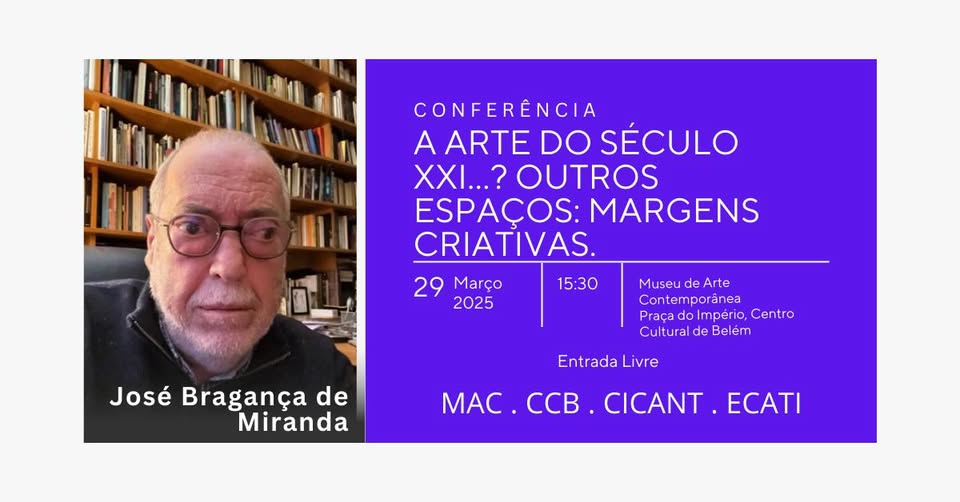
Uma alegoria da Arte Contemporânea - Conferência por José Bragança de Miranda
An allegory of contemporary art - Conference by José Bragança de Miranda
Event by: Rui Filipe Antunes, Jonas Runa, Jose Gomes Pinto
Location: Museum of Contemporary Art – MAC/CCB, Praça do Império, Lisboa
About event
José Bragança de Miranda Conference
March 29
15: 30h in the MAC/CCB auditorium
An allegory of contemporary art
paradoxically a diffuse crisis crosses the idea of contemporary art, while works of art multiply and disseminate. In a moment of turning into 1970, Adorno states that "it became manifest that everything concerning art is no longer evident, both in itself and in its relationship with the whole, and even its right to existence." The various aesthetics they sought to think of it were failing successively, above all for the refusal of the artists of any aesthetic judgment, but also because the institutional center of the arts - the museum - was losing strength, as if a kind of general evasion had occurred. Current attempts to use policy as a criterion is more a problem than a solution, since without the strength of an-arché art is reduced to the mere auxiliary of war ideologies. Under these circumstances the only criterion that seems to remain is the “work of art”, each in its uniqueness producing a transient aesthetic, inventing concepts, determining their meetings and disagreements in the real. In this sense, each work, being unique, spontaneously creates an allegory of art. All do it necessarily, but for mysterious reasons not all do the same way, nor do they have the same power. This is what will be sought to show.
Bio
José A. Bragança de Miranda is a doctorate in Communication Sciences from the New Unversity of Lisbon, with aggregation in 'Theory of Culture' in the same university. He is currently a professor at Lusophone University, where he performs the functions of Rector. It has been taught in the areas of culture theory, contemporary arts and media theory. Author of numerous essays in the most diverse areas of contemporary culture, their publications stand out only the analytical books of current, politics and modernity, features. Essays on contemporary culture, culture theory, synthesis, Albuquerque Mendes or the ardor of art, endless fall, shipping. A philosophical experimentation in blogs, body and image and Jorge Molder, constellations: essays on culture and technique in contemporary (Documenta, 2023).
----
Conference inserted in the annual conference cycle spaces other Mac/CCB. Cicant. Ecati
This cycle is a partnership between the Cultural Center and Belém and the School of Communication, Architecture, Arts and Information Technologies (Ecati) and the Center for Investigated Communication, Culture and New Technologies (Cicant) of Lusófona-University Center of Lisbon.
The purpose of this partnership is to link academic and scientific production with the community, providing the possibility of knowledge transmission while proving as a space of plural dialogue. The action that each institution carries out the possibility of thematic synergies, ranging from the visual arts, cinema, cell arts and sound arts, communication and culture, architecture and new digital devices.
These annual conferences will take place at the Belém Cultural Center once a month, Saturday, 15:30 in the MAC/CCB auditorium and with a program that extends between March and December.
The art of the 21st century…? Other spaces: creative margins.
In 1926, the historian and theorist of art, Carl Einstein, publishes in Berlin in the famous propyläen-Verlag, The art of the twentieth century. Very early, many thought. Right in the first paragraphs of the work, Einstein touches a problem that seems to be repeated now, that of the "skepticism of this time".
The creative doing of man also consists of creating a dimension that does not belong to the regime of natural, cognition, knowledge, but of the imagination and the new ways of redesigning objects, albeit in the first dimensions may still be linked; Art, because it acts from the real, and over it, is a construction company and configuring of the real, since it organizes it, reorganizing its objects around laws that do not exist in nature, but only in the creative drive of man; Because only art has the power to "turn things into signs never seen" (Carl Einstein). This characterization is understood because for Einstein it was always, and especially, to move away from his time, to create distances to think, to want to go beyond the historical time, seeking the temporal simultaneity of the ways of seeing that history had previously produced, 'duty', says in the art of the twentieth century, 'transforming human activity and perception'. For Einstein everything was thrown into the forms of disorder of visuality and the organization of images, anticipating much of the fractures that in the same century came to produce and still subsist today. It is this form of reorganization of the vision that collects within itself the concept of hallucinatory, an element that belongs to it as an instrument that allows you to recreate new ways of seeing, not a means or instrument that gives you forms, that projects ideas or sensations, but that causes modifications of the look and, in doing so, produces new ways of seeing, of recreating one's own reality. Therefore, for this, art is always, also, of the order of the politician. The use of the concept of hallucinatory refers, in Einstein, to complex psychic processes that connect subjective conditions and objective conditions, psychic processes and perceptual phenomena, social phenomena, as well. When hallucinatory is produced, they occur for this processes of reactions between the psyche and the biological phenomenon, producing these reactions the transvisual, a concept that goes beyond the simple definition of art as something watertight, completely defined. Among these possibilities, we want to think, a century later, the situation of art in the 21st century and for that, not only Carl Einstein challenges us, also comes to game the well -known statement, sometimes repeated in the last centuria, by Samuel Beckett in a very related title to what we propose: "It is the end that is the worst, then the end, the end is the end that is the worst" (l'enommable, 1958).
March 29
15: 30h in the MAC/CCB auditorium
An allegory of contemporary art
paradoxically a diffuse crisis crosses the idea of contemporary art, while works of art multiply and disseminate. In a moment of turning into 1970, Adorno states that "it became manifest that everything concerning art is no longer evident, both in itself and in its relationship with the whole, and even its right to existence." The various aesthetics they sought to think of it were failing successively, above all for the refusal of the artists of any aesthetic judgment, but also because the institutional center of the arts - the museum - was losing strength, as if a kind of general evasion had occurred. Current attempts to use policy as a criterion is more a problem than a solution, since without the strength of an-arché art is reduced to the mere auxiliary of war ideologies. Under these circumstances the only criterion that seems to remain is the “work of art”, each in its uniqueness producing a transient aesthetic, inventing concepts, determining their meetings and disagreements in the real. In this sense, each work, being unique, spontaneously creates an allegory of art. All do it necessarily, but for mysterious reasons not all do the same way, nor do they have the same power. This is what will be sought to show.
Bio
José A. Bragança de Miranda is a doctorate in Communication Sciences from the New Unversity of Lisbon, with aggregation in 'Theory of Culture' in the same university. He is currently a professor at Lusophone University, where he performs the functions of Rector. It has been taught in the areas of culture theory, contemporary arts and media theory. Author of numerous essays in the most diverse areas of contemporary culture, their publications stand out only the analytical books of current, politics and modernity, features. Essays on contemporary culture, culture theory, synthesis, Albuquerque Mendes or the ardor of art, endless fall, shipping. A philosophical experimentation in blogs, body and image and Jorge Molder, constellations: essays on culture and technique in contemporary (Documenta, 2023).
----
Conference inserted in the annual conference cycle spaces other Mac/CCB. Cicant. Ecati
This cycle is a partnership between the Cultural Center and Belém and the School of Communication, Architecture, Arts and Information Technologies (Ecati) and the Center for Investigated Communication, Culture and New Technologies (Cicant) of Lusófona-University Center of Lisbon.
The purpose of this partnership is to link academic and scientific production with the community, providing the possibility of knowledge transmission while proving as a space of plural dialogue. The action that each institution carries out the possibility of thematic synergies, ranging from the visual arts, cinema, cell arts and sound arts, communication and culture, architecture and new digital devices.
These annual conferences will take place at the Belém Cultural Center once a month, Saturday, 15:30 in the MAC/CCB auditorium and with a program that extends between March and December.
The art of the 21st century…? Other spaces: creative margins.
In 1926, the historian and theorist of art, Carl Einstein, publishes in Berlin in the famous propyläen-Verlag, The art of the twentieth century. Very early, many thought. Right in the first paragraphs of the work, Einstein touches a problem that seems to be repeated now, that of the "skepticism of this time".
The creative doing of man also consists of creating a dimension that does not belong to the regime of natural, cognition, knowledge, but of the imagination and the new ways of redesigning objects, albeit in the first dimensions may still be linked; Art, because it acts from the real, and over it, is a construction company and configuring of the real, since it organizes it, reorganizing its objects around laws that do not exist in nature, but only in the creative drive of man; Because only art has the power to "turn things into signs never seen" (Carl Einstein). This characterization is understood because for Einstein it was always, and especially, to move away from his time, to create distances to think, to want to go beyond the historical time, seeking the temporal simultaneity of the ways of seeing that history had previously produced, 'duty', says in the art of the twentieth century, 'transforming human activity and perception'. For Einstein everything was thrown into the forms of disorder of visuality and the organization of images, anticipating much of the fractures that in the same century came to produce and still subsist today. It is this form of reorganization of the vision that collects within itself the concept of hallucinatory, an element that belongs to it as an instrument that allows you to recreate new ways of seeing, not a means or instrument that gives you forms, that projects ideas or sensations, but that causes modifications of the look and, in doing so, produces new ways of seeing, of recreating one's own reality. Therefore, for this, art is always, also, of the order of the politician. The use of the concept of hallucinatory refers, in Einstein, to complex psychic processes that connect subjective conditions and objective conditions, psychic processes and perceptual phenomena, social phenomena, as well. When hallucinatory is produced, they occur for this processes of reactions between the psyche and the biological phenomenon, producing these reactions the transvisual, a concept that goes beyond the simple definition of art as something watertight, completely defined. Among these possibilities, we want to think, a century later, the situation of art in the 21st century and for that, not only Carl Einstein challenges us, also comes to game the well -known statement, sometimes repeated in the last centuria, by Samuel Beckett in a very related title to what we propose: "It is the end that is the worst, then the end, the end is the end that is the worst" (l'enommable, 1958).