This event has been ended!
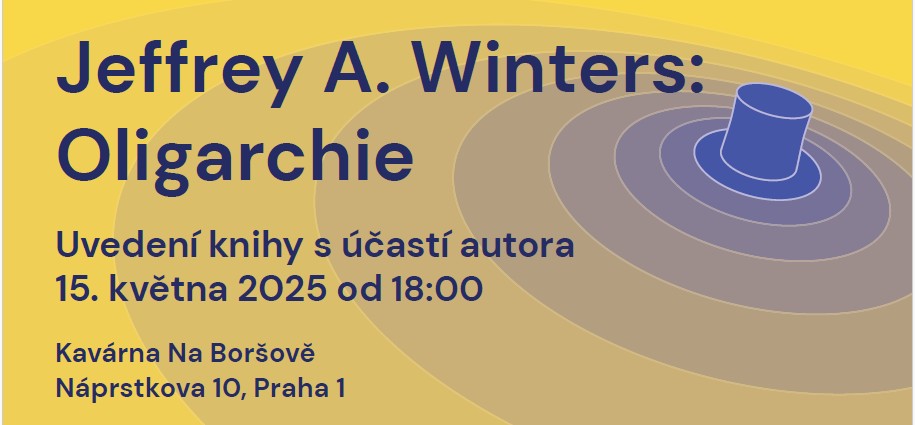
Uvedení knihy s účastí autora | Jeffrey A. Winters: Oligarchie
The book with the author's participation Jeffrey A. Winters: oligarchy
Event by: Filosofický ústav Akademie věd České republiky
Location: Na Boršově, Náprstkova 10, Praha 1
Talks & discussions
About event
We cordially invite you to the presentation of Jeffrey A. Winters: oligarchy
Czech translation of the book:
• Jeffrey A. Winters (Northwestern University) International)
The event will be simultaneously interpreted into Czech
Winters' book oligarchy analyzes the functioning of oligarchic structures in life of society across political regimes, civilization circuits and historical periods. Oligarchs have long been defined by the wealth that gives them power, but also exposes them to specific threats. Their efforts to defend wealth differ depending on the threats they face, which also includes the degree of coercion involved in, and depending on whether they act independently or collectively in the defense of their property claims. We can then distinguish four types of oligarchy: warring, ruling, sultanist and civic. The book presents specific cases of oligarchs from ancient Athens and Rome, from the US, Indonesia, Philippines, Singapore, Venice or Siena. His research, publications and teaching focus on comparative and political economics. In addition to the oligarchy, the important topics of his work include relations between the state and capital, the mobility of capital and the structural power of investors, the world bank, human rights, authoritarianism and democratic transitions in post -colonial countries. He conducted extensive research in the region of Southeast Asia. Let us mention at least: Power in Motion: Capital Mobility and the Indonesian State (Cornell, 1996) and Reinventing The World Bank (Cornell, 2002), which he released with Jonathan Pincus.
Czech translation of the book:
• Jeffrey A. Winters (Northwestern University) International)
The event will be simultaneously interpreted into Czech
Winters' book oligarchy analyzes the functioning of oligarchic structures in life of society across political regimes, civilization circuits and historical periods. Oligarchs have long been defined by the wealth that gives them power, but also exposes them to specific threats. Their efforts to defend wealth differ depending on the threats they face, which also includes the degree of coercion involved in, and depending on whether they act independently or collectively in the defense of their property claims. We can then distinguish four types of oligarchy: warring, ruling, sultanist and civic. The book presents specific cases of oligarchs from ancient Athens and Rome, from the US, Indonesia, Philippines, Singapore, Venice or Siena. His research, publications and teaching focus on comparative and political economics. In addition to the oligarchy, the important topics of his work include relations between the state and capital, the mobility of capital and the structural power of investors, the world bank, human rights, authoritarianism and democratic transitions in post -colonial countries. He conducted extensive research in the region of Southeast Asia. Let us mention at least: Power in Motion: Capital Mobility and the Indonesian State (Cornell, 1996) and Reinventing The World Bank (Cornell, 2002), which he released with Jonathan Pincus.