This event has been ended!
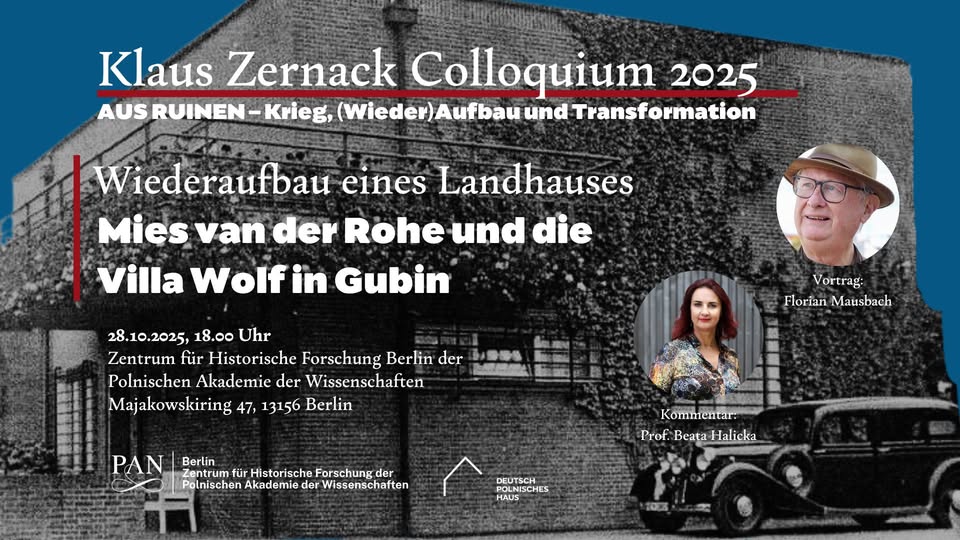
Wiederaufbau eines Landhauses. Mies van der Rohe und die Villa Wolf in Gubin
Reconstruction of a country house. Mies van der Rohe and the Villa Wolf in Gubin
Event by: Deutsch-Polnisches Haus, Zentrum für Historische Forschung Berlin
Location: Polnische Akademie der Wissenschaften, Majakowskiring 47, Berlin - Bezirk Pankow
About event
Klaus Zernack Colloquium 2025:
From ruins - war, (re)construction and transformation
Reconstruction of a country house
Mies van der Rohe and the Villa Wolf in Gubin
PL ↓
Date: October 28, 2025, 6 p.m.
Place: Center for Historical Research Berlin
of the Polish Academy of Sciences,
Majakowskiring 47, 13156 Berlin
On the last Tuesday in October we would like to focus on a special reconstruction project as part of the Klaus Zernack Colloquium. Villa Wolf is a single-family house that was built east of the Neisse in the then German town of Guben in 1925 and 1927 and was not rebuilt after a fire in 1945. Both the architect of the house, the family that commissioned the house, and the German-Polish reconstruction efforts that began over ten years ago fit well into this year's motto "From Ruins - War, (Re)construction and Transformation" of the event series, which is organized by the Center for Historical Research Berlin together with the German-Polish House.
Ludwig Mies van der Rohe (actually Maria Ludwig Michael Mies, 1886 –1969) was a German-American architect who is considered one of the best-known and most important representatives of modernism. Villa Wolf is considered his “first decidedly modern building”. Which groundbreaking architectural innovations were used in Guben and were continued and further developed by Mies van der Rohe in the construction of the Villa Stimmehat in Brno (1929-1930) and the German Pavilion in Barcelona (1928-1929)?
The wedding of Erich Wolf and Elisabeth Wilke in 1922 united two large entrepreneurial families from the Guben textile industry, which had already shaped the appearance of the provincial town architecturally. What does Erich Wolf's decision to have his family house built by Mies van der Rohe tell us? What continuities and breaks can be seen in the Wolf family, who lived in the villa for almost 20 years?
The German-Polish “Support Association for the Reconstruction of Villa Wolf” was founded on June 13, 2017. After the reconstruction of the lost building plans began in 2014, extensive archaeological excavations followed in 2021, which uncovered large parts of the cellar, individual staircase approaches and remains of the masonry. In 2023, DOM Publishers published an elaborate volume entitled: "Mies van der Rohe. Villa Wolf in Gubin. History and Reconstruction (ed. by Dietrich Neumann)", which documents the complex context, the excavations and the reconstruction idea. According to the latest plans, a German-Polish cultural and meeting center is to be built in the rebuilt milestone of modern architecture. The questions arise about the realistic completion of the ambitious project and its embedding in the German-Polish border region.
We are very pleased to have Florian Mausbach, one of the co-founders of the initiative, for the lecture and for the commentary with Prof. Dr. Beata Halicka was able to gain an important expert on the German-Polish border region. The event will be moderated by Jakub K. Sawicki (CBH PAN).
This year's series of events as part of the Klaus Zernack Colloquium of the Center for Historical Research Berlin of the Polish Academy of Sciences is taking place in cooperation with the German-Polish House.
Presenter:
Florian Mausbach (born 1944). Architect and urban planner. From 1995 to 2009 he headed the Federal Office for Building and Regional Planning (BBR), responsible for civil federal buildings in Berlin, Bonn and abroad, as well as the scientific institute for urban development and regional planning. After studying architecture and urban planning in Braunschweig and Berlin, Mausbach initially worked in Düsseldorf before helping to shape urban development in the city administration of Frankfurt am Main from 1979 to 1990 and in Bielefeld and the unified Berlin in the 1990s. He was the initiator of a call launched in 2017 to build a monument to the Polish victims of the German occupation, an important sub-goal of which was achieved this year with the inauguration of a temporary monument. He has also been involved for years in an association that aims to rebuild the Villa Wolf in Gubin, a work by Ludwig Mies van der Rohe, as part of German-Polish cooperation. On October 17, 2025, Florian Mausbach will be awarded the Knight's Cross of the Order of Merit of the Republic of Poland.
Beata Halicka is Professor of the History of East Central Europe at the Adam Mickiewicz University in Poznan. From 2006 to 2013 she worked at the European University Viadrina in Frankfurt (Oder) and held visiting professorships at the universities of Calgary (Canada) and El Paso and Phoenix (USA). Her research focuses on forced migration, nationalism, German-Polish relations, the Polish diaspora, border regions, and remembrance culture and politics. For her book “Poland's Wild West - Forced Migration and the Cultural Appropriation of the Oder Region 1945-1948” she received the Identitas Prize for the best historical book in Poland in 2016. In her current project she deals with the fates of Polish women who emigrated to the USA in the context of the Second World War.
Jakub K. Sawicki is a translator, historian and project coordinator. He deals with German and Polish history of the last centuries. He wrote, among other things: his master's thesis on the Warsaw Palace of Culture and Science in the Polish public and his doctoral thesis is dedicated to the food cultures in the Federal Republic of Germany, the GDR and the People's Republic of Poland around 1970. Since September 2023 he has been coordinating the scientific projects at the PAN's Center for Historical Research Berlin.
PL
Klaus Zernack Colloquium 2025:
Wyrosłe z ruin – wojna, (od)budowa i transformacja
Odbudowa rezydencji:
Mies van der Rohe i Willa Wolfa w Gubinie
Data: 28 października 2025, 18:00
Miejsce: Centrum Badań Historycznych PAN,
Majakowskiring 47, 13156 Berlin
W ostatni wtorek października w ramach seminarium Klaus Zernack Colloquium chcielibyśmy zająć się szczególnym projektem odbudowy. Willa Wolfa to dom jednorodzinny, który powstał w latach 1925–1927 na wschód od Nysy, w ówczesnym niemieckim Guben, i pożarze w 1945 roku nie został odbudowany. Zarówno architect domu, rodzina, która zleciła jego budowę, jak in niemiecko-polskie wysiłki na rzecz odbudowy, które rozpoczęły się ponad dziesięć lat temu, dobrze wpisują się w tegoroczne motto “Wyrosłe z ruin – wojna, (od)budowa i transformacja” cyklu wydarzeń organizowanych przez Centrum Badań Historycznych w Berlinie we współpracy z Domem Polsko-Niemieckim.
Ludwig Mies van der Rohe (właściwie Maria Ludwig Michael Mies, 1886–1969) by niemiecko-amerykańskim architectem, zaliczanym do najbardziej znanych and znaczących przedstawicieli modernizmu. Willa Wolfa is one of the “pierwszą zdecydowanie modernistyczną budowlę”. Powstaje pytanie, jakie przełomowe innowacje architektoniczne, które zastosowano w Gubinie, były kontynuowane and rozwijane przez Miesa van der Rohe podczas budowy Willa Stimmehatów w Brnie (1929–1930) oraz niemieckiego pawilonu wystawowego in Barcelona (1928–1929)? wpłynęły na Architectureę tego prowincjonalnego miasta. What did you say to Eric Wolfa or to the budowy of the home of Miesowi van der Rohe? What's going on in Wolfów? zostało powołane 13 czerwca 2017 roku. Po rozpoczęciu w 2014 r. rekonstrukcji utraconych planów budowlanych, w 2021 roku przeprowadzono szeroko zakrojone wykopaliska archeologiczne, które ujawniły duże fragmenty piwnicy, pojedyncze stopnie schodów i pozostałości murów. W 2023 r. wydawnictwo DOM Publishers opublikowało bogato ilustrowany tom zatytułowany: "Mies van der Rohe. Willa Wolfa w Gubinie. Historia i odbudowa" (por red. Dietricha Neumanna), który schriftuje wielowarstwowy kontekst, wykopaliska i ideę odbudowy. Zgodnie z ostatnimi planami w odbudowanym symbolu nowoczesnej architektury ma powstać polsko-niemieckie centrum kultury i spotkań. Rodzi to pytania or realistyczną realizację tego ambitnego projectu in this osadzenie in niemiecko-polskim regionie przygranicznym współtwórców inicjatywy odbudowy, do wygłoszenia wykładu, and także Prof. Beatę Halicką, znaną znawczynię polsko-niemieckiego regionu przygranicznego, do wygłoszenia komentarza. Moderatorem wydarzenia będzie Jakub K. Sawicki (CBH PAN).
Florian Mausbach (born 1944) – architect and urbanista. W latach 1995-2009 kierował Federal Office for Building and Regional Planning (BBR), odpowiedzialny za cywilne budynki federalne w Berlinie, Bonn in za granicą, jest to także instytut naukowy zajmujący się urbanistyką and zagospodarowaniem przestrzennym. Po studiach zwodzie w latach 1979-1990 kształtować we władzach miasta rozwój urbanistyczny Frankfurtu nad Menem, a w latach 90 years in Bielefeld and Berlin. Był inicjatorem rozpoczętej w 2017 r. apelu na rzecz budowy pomnika poświęconego polskim ofiarom niemieckiej okupacji, co w tym roku pozwoliło osiągnąć ważny cel pośredni, jakim było odsłonięcie tymczasowego pomnika. Ponadto od lat angażuje się w ziałalność stowarzyszenia, które w ramach współpracy polsko-niemieckiej dąży do odbudowy Willi Wolfa w Gubinie, dzieła Ludwiga Miesa van der Rohe. 17 października 2025 r. Florian Mausbach zostanie odznaczony Krzyżem Kawalerskim Orderu Zasługi Rzeczypospolitej Polskiej.
Beata Halicka is the professor's historii European Środkowo-Wschodniej na Uniwersytecie in. Adama Mickiewicza w Poznaniu. W latach 2006–2013 pracowała at Uniwersytecie Europejskim Viadrina we Frankfurcie nad Odrą oraz była professorką wizytującą at university w Calgary (Canada) oraz El Paso i Phoenix (USA). Jej badania koncentrują się na przymusowych migracjach, nacjonalizmie, stosunkach polsko-niemieckich, polskiej diasporze, regionalach przygranicznych oraz kulturze i polityce pamięci. Za swoją książkę Polski Dziki Zachód. Przymusowe migracje and kulturowe oswajanie Nadodrza 1945-1948 otrzymała w 2016 roku Nagrodę Identitas dla najlepszej książki historycznej w Polsce. The two main projects are in Polish territory, the second part of the project is based on the Stanów Zjednoczonych naukowych. Zajmuje się historią Niemiec i Polski ostatnich stuleci. Napisał m.in. Pracę magisterską na temat warszawskiego Pałacu Kultury i Nauki w Polskiej opinii publicznej, a w swojej pracy doktorskiej zajmuje się kulturą jedzenia w RFN, NRD i PRL około 1970 roku. Od września 2023 roku koordynuje projekty naukowe w Centrum Badań Historycznych PAN w Berlinie.
From ruins - war, (re)construction and transformation
Reconstruction of a country house
Mies van der Rohe and the Villa Wolf in Gubin
PL ↓
Date: October 28, 2025, 6 p.m.
Place: Center for Historical Research Berlin
of the Polish Academy of Sciences,
Majakowskiring 47, 13156 Berlin
On the last Tuesday in October we would like to focus on a special reconstruction project as part of the Klaus Zernack Colloquium. Villa Wolf is a single-family house that was built east of the Neisse in the then German town of Guben in 1925 and 1927 and was not rebuilt after a fire in 1945. Both the architect of the house, the family that commissioned the house, and the German-Polish reconstruction efforts that began over ten years ago fit well into this year's motto "From Ruins - War, (Re)construction and Transformation" of the event series, which is organized by the Center for Historical Research Berlin together with the German-Polish House.
Ludwig Mies van der Rohe (actually Maria Ludwig Michael Mies, 1886 –1969) was a German-American architect who is considered one of the best-known and most important representatives of modernism. Villa Wolf is considered his “first decidedly modern building”. Which groundbreaking architectural innovations were used in Guben and were continued and further developed by Mies van der Rohe in the construction of the Villa Stimmehat in Brno (1929-1930) and the German Pavilion in Barcelona (1928-1929)?
The wedding of Erich Wolf and Elisabeth Wilke in 1922 united two large entrepreneurial families from the Guben textile industry, which had already shaped the appearance of the provincial town architecturally. What does Erich Wolf's decision to have his family house built by Mies van der Rohe tell us? What continuities and breaks can be seen in the Wolf family, who lived in the villa for almost 20 years?
The German-Polish “Support Association for the Reconstruction of Villa Wolf” was founded on June 13, 2017. After the reconstruction of the lost building plans began in 2014, extensive archaeological excavations followed in 2021, which uncovered large parts of the cellar, individual staircase approaches and remains of the masonry. In 2023, DOM Publishers published an elaborate volume entitled: "Mies van der Rohe. Villa Wolf in Gubin. History and Reconstruction (ed. by Dietrich Neumann)", which documents the complex context, the excavations and the reconstruction idea. According to the latest plans, a German-Polish cultural and meeting center is to be built in the rebuilt milestone of modern architecture. The questions arise about the realistic completion of the ambitious project and its embedding in the German-Polish border region.
We are very pleased to have Florian Mausbach, one of the co-founders of the initiative, for the lecture and for the commentary with Prof. Dr. Beata Halicka was able to gain an important expert on the German-Polish border region. The event will be moderated by Jakub K. Sawicki (CBH PAN).
This year's series of events as part of the Klaus Zernack Colloquium of the Center for Historical Research Berlin of the Polish Academy of Sciences is taking place in cooperation with the German-Polish House.
Presenter:
Florian Mausbach (born 1944). Architect and urban planner. From 1995 to 2009 he headed the Federal Office for Building and Regional Planning (BBR), responsible for civil federal buildings in Berlin, Bonn and abroad, as well as the scientific institute for urban development and regional planning. After studying architecture and urban planning in Braunschweig and Berlin, Mausbach initially worked in Düsseldorf before helping to shape urban development in the city administration of Frankfurt am Main from 1979 to 1990 and in Bielefeld and the unified Berlin in the 1990s. He was the initiator of a call launched in 2017 to build a monument to the Polish victims of the German occupation, an important sub-goal of which was achieved this year with the inauguration of a temporary monument. He has also been involved for years in an association that aims to rebuild the Villa Wolf in Gubin, a work by Ludwig Mies van der Rohe, as part of German-Polish cooperation. On October 17, 2025, Florian Mausbach will be awarded the Knight's Cross of the Order of Merit of the Republic of Poland.
Beata Halicka is Professor of the History of East Central Europe at the Adam Mickiewicz University in Poznan. From 2006 to 2013 she worked at the European University Viadrina in Frankfurt (Oder) and held visiting professorships at the universities of Calgary (Canada) and El Paso and Phoenix (USA). Her research focuses on forced migration, nationalism, German-Polish relations, the Polish diaspora, border regions, and remembrance culture and politics. For her book “Poland's Wild West - Forced Migration and the Cultural Appropriation of the Oder Region 1945-1948” she received the Identitas Prize for the best historical book in Poland in 2016. In her current project she deals with the fates of Polish women who emigrated to the USA in the context of the Second World War.
Jakub K. Sawicki is a translator, historian and project coordinator. He deals with German and Polish history of the last centuries. He wrote, among other things: his master's thesis on the Warsaw Palace of Culture and Science in the Polish public and his doctoral thesis is dedicated to the food cultures in the Federal Republic of Germany, the GDR and the People's Republic of Poland around 1970. Since September 2023 he has been coordinating the scientific projects at the PAN's Center for Historical Research Berlin.
PL
Klaus Zernack Colloquium 2025:
Wyrosłe z ruin – wojna, (od)budowa i transformacja
Odbudowa rezydencji:
Mies van der Rohe i Willa Wolfa w Gubinie
Data: 28 października 2025, 18:00
Miejsce: Centrum Badań Historycznych PAN,
Majakowskiring 47, 13156 Berlin
W ostatni wtorek października w ramach seminarium Klaus Zernack Colloquium chcielibyśmy zająć się szczególnym projektem odbudowy. Willa Wolfa to dom jednorodzinny, który powstał w latach 1925–1927 na wschód od Nysy, w ówczesnym niemieckim Guben, i pożarze w 1945 roku nie został odbudowany. Zarówno architect domu, rodzina, która zleciła jego budowę, jak in niemiecko-polskie wysiłki na rzecz odbudowy, które rozpoczęły się ponad dziesięć lat temu, dobrze wpisują się w tegoroczne motto “Wyrosłe z ruin – wojna, (od)budowa i transformacja” cyklu wydarzeń organizowanych przez Centrum Badań Historycznych w Berlinie we współpracy z Domem Polsko-Niemieckim.
Ludwig Mies van der Rohe (właściwie Maria Ludwig Michael Mies, 1886–1969) by niemiecko-amerykańskim architectem, zaliczanym do najbardziej znanych and znaczących przedstawicieli modernizmu. Willa Wolfa is one of the “pierwszą zdecydowanie modernistyczną budowlę”. Powstaje pytanie, jakie przełomowe innowacje architektoniczne, które zastosowano w Gubinie, były kontynuowane and rozwijane przez Miesa van der Rohe podczas budowy Willa Stimmehatów w Brnie (1929–1930) oraz niemieckiego pawilonu wystawowego in Barcelona (1928–1929)? wpłynęły na Architectureę tego prowincjonalnego miasta. What did you say to Eric Wolfa or to the budowy of the home of Miesowi van der Rohe? What's going on in Wolfów? zostało powołane 13 czerwca 2017 roku. Po rozpoczęciu w 2014 r. rekonstrukcji utraconych planów budowlanych, w 2021 roku przeprowadzono szeroko zakrojone wykopaliska archeologiczne, które ujawniły duże fragmenty piwnicy, pojedyncze stopnie schodów i pozostałości murów. W 2023 r. wydawnictwo DOM Publishers opublikowało bogato ilustrowany tom zatytułowany: "Mies van der Rohe. Willa Wolfa w Gubinie. Historia i odbudowa" (por red. Dietricha Neumanna), który schriftuje wielowarstwowy kontekst, wykopaliska i ideę odbudowy. Zgodnie z ostatnimi planami w odbudowanym symbolu nowoczesnej architektury ma powstać polsko-niemieckie centrum kultury i spotkań. Rodzi to pytania or realistyczną realizację tego ambitnego projectu in this osadzenie in niemiecko-polskim regionie przygranicznym współtwórców inicjatywy odbudowy, do wygłoszenia wykładu, and także Prof. Beatę Halicką, znaną znawczynię polsko-niemieckiego regionu przygranicznego, do wygłoszenia komentarza. Moderatorem wydarzenia będzie Jakub K. Sawicki (CBH PAN).
Florian Mausbach (born 1944) – architect and urbanista. W latach 1995-2009 kierował Federal Office for Building and Regional Planning (BBR), odpowiedzialny za cywilne budynki federalne w Berlinie, Bonn in za granicą, jest to także instytut naukowy zajmujący się urbanistyką and zagospodarowaniem przestrzennym. Po studiach zwodzie w latach 1979-1990 kształtować we władzach miasta rozwój urbanistyczny Frankfurtu nad Menem, a w latach 90 years in Bielefeld and Berlin. Był inicjatorem rozpoczętej w 2017 r. apelu na rzecz budowy pomnika poświęconego polskim ofiarom niemieckiej okupacji, co w tym roku pozwoliło osiągnąć ważny cel pośredni, jakim było odsłonięcie tymczasowego pomnika. Ponadto od lat angażuje się w ziałalność stowarzyszenia, które w ramach współpracy polsko-niemieckiej dąży do odbudowy Willi Wolfa w Gubinie, dzieła Ludwiga Miesa van der Rohe. 17 października 2025 r. Florian Mausbach zostanie odznaczony Krzyżem Kawalerskim Orderu Zasługi Rzeczypospolitej Polskiej.
Beata Halicka is the professor's historii European Środkowo-Wschodniej na Uniwersytecie in. Adama Mickiewicza w Poznaniu. W latach 2006–2013 pracowała at Uniwersytecie Europejskim Viadrina we Frankfurcie nad Odrą oraz była professorką wizytującą at university w Calgary (Canada) oraz El Paso i Phoenix (USA). Jej badania koncentrują się na przymusowych migracjach, nacjonalizmie, stosunkach polsko-niemieckich, polskiej diasporze, regionalach przygranicznych oraz kulturze i polityce pamięci. Za swoją książkę Polski Dziki Zachód. Przymusowe migracje and kulturowe oswajanie Nadodrza 1945-1948 otrzymała w 2016 roku Nagrodę Identitas dla najlepszej książki historycznej w Polsce. The two main projects are in Polish territory, the second part of the project is based on the Stanów Zjednoczonych naukowych. Zajmuje się historią Niemiec i Polski ostatnich stuleci. Napisał m.in. Pracę magisterską na temat warszawskiego Pałacu Kultury i Nauki w Polskiej opinii publicznej, a w swojej pracy doktorskiej zajmuje się kulturą jedzenia w RFN, NRD i PRL około 1970 roku. Od września 2023 roku koordynuje projekty naukowe w Centrum Badań Historycznych PAN w Berlinie.