This event has been ended!
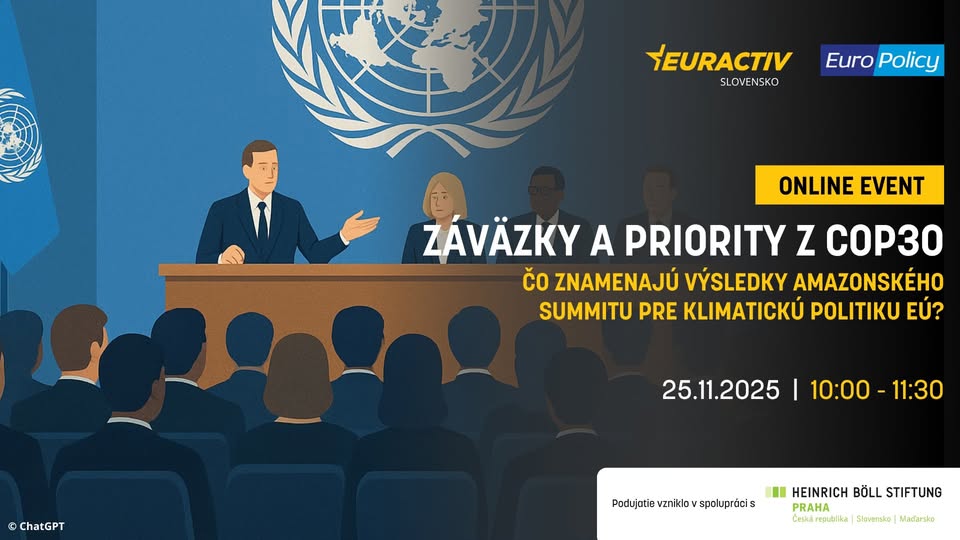
Záväzky a priority z COP30 - čo znamenajú výsledky amazonského summitu pre klimatickú politiku EÚ?
Commitments and priorities from COP30 - what do the results of the Amazon summit mean for EU climate policy?
Event by: EURACTIV.sk, Heinrich-Böll-Stiftung Prague
Online event
Discussions and lectures
About event
The UN climate change conference COP30 in Belém, Brazil returns after three decades to the country where the global climate process began. This year's summit represents a key milestone on the way to 2030 – the deadline by which countries must meet their climate commitments under the Paris Agreement. COP30 is therefore mainly focused on the measures needed to limit global warming to 1.5 °C, on presenting new national action plans (so-called "nationally determined contributions" - NDCs) and on evaluating progress in meeting the financial commitments made at COP29. from October 20 to 23). The EU is expected to adopt the new NDC - a climate goal until 2040 as well as the EU's climate commitment until 2035 - before the conference. The topics of decarbonization and fair transformation in energy and industry, the mobilization of funds for developing countries and the operation of the loss and damage fund, carbon credits or solutions for carbon capture will also be important for the EU.
In the discussion that will take place after the conference, we will look at how the EU is managing to maintain its position as a climate leader, what commitments and priorities it has pursued, and what the outcomes and ambitions of COP30 mean for climate policy, industry and finance for decarbonisation. We will also address the following questions:
- How did COP30 shift the global debate on climate finance and nature protection?
- Is the EU ambitious enough, is it managing to fulfill its climate plans and commitments in the face of growing pressure for concessions in the name of maintaining competitiveness?
- What effects can the conclusions of COP30 have on individual sectors - energy, agriculture, transport or defense?
PANELISTS
- Michal Kiča, vice-chairman of the Democrats, former state secretary of the Ministry of the Environment of the Slovak Republic
- Tamara Stohlová, NRSR MP for Progressive Slovakia
- Kateřina Chajdiaková, Director, Slovak Climate Initiative
- Žaneta Jansa Gregorová, Program Manager - Energy and Climate, Heinrich Böll Stiftung
The discussion will be moderated Lucia Lauková, editor of the EURACTIV Slovakia portal.
The event is organized by the civil association EuroPolicy in cooperation with the EURACTIV Slovakia portal and the Prague office of the Heinrich-Böll-Stiftung.
In the discussion that will take place after the conference, we will look at how the EU is managing to maintain its position as a climate leader, what commitments and priorities it has pursued, and what the outcomes and ambitions of COP30 mean for climate policy, industry and finance for decarbonisation. We will also address the following questions:
- How did COP30 shift the global debate on climate finance and nature protection?
- Is the EU ambitious enough, is it managing to fulfill its climate plans and commitments in the face of growing pressure for concessions in the name of maintaining competitiveness?
- What effects can the conclusions of COP30 have on individual sectors - energy, agriculture, transport or defense?
PANELISTS
- Michal Kiča, vice-chairman of the Democrats, former state secretary of the Ministry of the Environment of the Slovak Republic
- Tamara Stohlová, NRSR MP for Progressive Slovakia
- Kateřina Chajdiaková, Director, Slovak Climate Initiative
- Žaneta Jansa Gregorová, Program Manager - Energy and Climate, Heinrich Böll Stiftung
The discussion will be moderated Lucia Lauková, editor of the EURACTIV Slovakia portal.
The event is organized by the civil association EuroPolicy in cooperation with the EURACTIV Slovakia portal and the Prague office of the Heinrich-Böll-Stiftung.