This event has been ended!
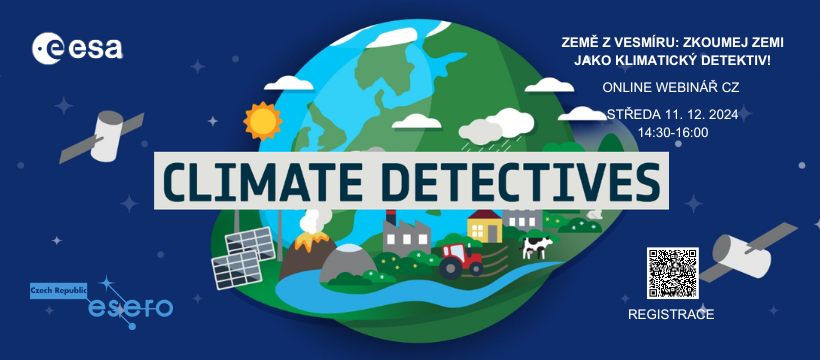
ZEMĚ Z VESMÍRU: ZKOUMEJTE ZEMI JAKO KLIMATICKÝ DETEKTIV!
EARTH FROM SPACE: EXPLORE THE EARTH AS A CLIMATE DETECTIVE!
Event by: ESERO Česká republika
Online event
Discussions and lectures
About event
An online webinar where you'll learn how data from Earth-orbiting satellites provides valuable information that can make a difference in climate action – from mapping Earth's forests to tracking the melting of glaciers. And you will learn how to get them and use them in teaching. In addition to the presentation of the Copernicus program, you will also learn about the CLIMATE DETECTIVES competition project, through which ESA engages students in solving climate problems using a combination of different methods with remote sensing of the Earth in the main role.
ONLINE WEBINAR PROGRAM
M.Sc. Veronika Florianová
(Observatory and Planetarium Brno)
Introduction – overview of topics that the webinar participants will discover.
Mgr. Jan Veselý
(Prague Planetarium)
Copernicus Program
The European Copernicus program provides an abundant amount of data from remote sensing of the Earth, which are used by scientists, ecologists and politicians to protect our planet. You will learn how the Sentinel satellites monitor key climate processes.
Mgr. Veronika Florianová
(Observatory and planetarium Brno)
Copernicus Browser
Explanation of the principles of remote sensing of the Earth and how satellite images from the Copernicus program are used to analyze climate change.
Mgr . Jan Veselý
(Prague Planetarium)
Climate detective story (alternatively The hottest or coldest summer?)
In July 2023, a satellite from the Sentinel family of the European Copernicus project measured a record global ocean surface temperature. 0.6°C higher than the long-term average. Is it a lot or a little? We will show how even 2nd grade elementary school and high school students can understand the problem and describe it using satellite data. The heat released from the oceans is released into the atmosphere, where it is converted into kinetic and potential energy. The implications are illustrated by data from terrestrial weather stations and media reports. We will look for processes that release comparable energy. And we will have to go into space for that.
Mgr. Veronika Florianová
(Observatory and Planetarium Brno)
CLIMATE DETECTIVES
Practical advice on how to involve students in the Climate Detectives project - from choosing a research question to data processing to analysis of results and presentation. Inspiration and tips for successful project management.
IMPORTANT INFORMATION
When? 11.12. 2024 14:30-16:00
Where? online
Language? CZ
Registration and questions? by email to [email protected]
ONLINE WEBINAR PROGRAM
M.Sc. Veronika Florianová
(Observatory and Planetarium Brno)
Introduction – overview of topics that the webinar participants will discover.
Mgr. Jan Veselý
(Prague Planetarium)
Copernicus Program
The European Copernicus program provides an abundant amount of data from remote sensing of the Earth, which are used by scientists, ecologists and politicians to protect our planet. You will learn how the Sentinel satellites monitor key climate processes.
Mgr. Veronika Florianová
(Observatory and planetarium Brno)
Copernicus Browser
Explanation of the principles of remote sensing of the Earth and how satellite images from the Copernicus program are used to analyze climate change.
Mgr . Jan Veselý
(Prague Planetarium)
Climate detective story (alternatively The hottest or coldest summer?)
In July 2023, a satellite from the Sentinel family of the European Copernicus project measured a record global ocean surface temperature. 0.6°C higher than the long-term average. Is it a lot or a little? We will show how even 2nd grade elementary school and high school students can understand the problem and describe it using satellite data. The heat released from the oceans is released into the atmosphere, where it is converted into kinetic and potential energy. The implications are illustrated by data from terrestrial weather stations and media reports. We will look for processes that release comparable energy. And we will have to go into space for that.
Mgr. Veronika Florianová
(Observatory and Planetarium Brno)
CLIMATE DETECTIVES
Practical advice on how to involve students in the Climate Detectives project - from choosing a research question to data processing to analysis of results and presentation. Inspiration and tips for successful project management.
IMPORTANT INFORMATION
When? 11.12. 2024 14:30-16:00
Where? online
Language? CZ
Registration and questions? by email to [email protected]