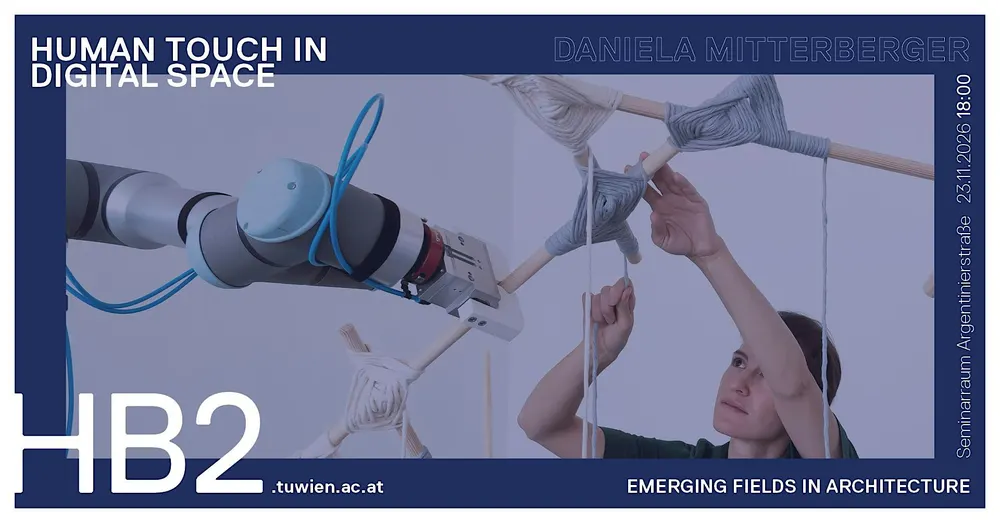
Human Touch in Digital Space | Daniela Mitterberger (ETH-Zurich)
Evento di: Emerging Fields in Architecture, TU Wien
Posizione: Vienna University of Technology, Vienna - Wieden
Informazioni sull'evento
Lecture by Daniela Mitterberger (ETH - Zurich)
HUMAN TOUCH IN DIGITAL SPACE
In the frame of the Module Emerging Fields in Architecture (++), HB2, TU Wien
+
The dominant story of AI and automation today is one of replacing human judgment, labor, and craft. This talk argues that in architecture and construction, the real potential of these technologies lies not in replacing people who design and build, but in extending what they can perceive, decide, and make.
Designing and building architecture depends on many forms of situated decision-making, intuition, and craft that are difficult to formalize. Humans are particularly good at coping with uncertainty, responding to changing materials, environments, and situations. Yet many digital fabrication workflows still exclude these human decisions and actions, treating people mainly as operators or gradually removing them in the pursuit of greater automation.
Research on Human Augmentation in Architecture takes another approach. Rather than asking how much of construction can be completely automated, it asks how humans and machines can work better together, and how digital information can become directly accessible and actionable on site. Through spatial computing, machine vision, interactive robotic systems, and interfaces that augment craft, this work explores how people can perceive otherwise invisible information, interact with digital models while building, negotiate actions with machines, and respond to changing material conditions.
Projects including Augmented Bricklaying, Interactive Robotic Plastering, and COMPAS XR demonstrate this approach in construction, while exploratory works such as Sylva, Magic Queen, and Degrees of Life investigate its broader architectural and cultural potential.
Moving between architecture, science, and art, the lecture asks what happens when machines are not understood as a replacement for human capability, but as partners that extend it. It proposes an augmented architecture in which humans and machines continuously reshape how we design, make, and inhabit the built environment.
++
Das Modul Emerging Fields in Architecture vermittelt aktuelles Wissen aus neuen Forschungsfeldern in architektur- und ingenieurswissenschaftlichen Disziplinen, mit dem Ziel aktuelle und zukünftige Entwurfsherausforderungen im breiteren gesellschaftlichen Kontext fachübergreifend und grundlegend zu bearbeiten. Die Vorlesungen vermitteln Kenntnisse über unterschiedliche und fachübergreifende Zugänge zur Entwurfsfindung, aktuelle Entwicklungen und Resultate der Material- und Bauweisenforschung, über das Planen und Bauen unter/in extremen Bedingungen sowie über Strukturen die sich aufgrund von wechselnden Parametern verändern bzw. entwickeln.
In diesem Zusammenhang werden Strategien zur Entwurfsfindung (von der ersten Idee bis zur Umsetzung) im interdisziplinären Diskurs hinterfragt, und der Frage nachgegangen wie sich der Weg von der Idee zur Realisierung gestalten kann und inwieweit es möglich ist systematisch kreativ zu sein.
Daniela Mitterberger is a Professor at ETH Zurich, leading the Architecture and Human Augmentation Group. Her research focuses on digital fabrication, extended reality, and human-machine collaboration. Mitterberger serves on the Board of Directors of the COMPAS Association, supporting its open-source frameworks for interdisciplinary collaboration in the AEC industry. She leads the development of COMPAS XR, the framework that integrates extended reality and robotics. Prior to joining ETH Zurich, Mitterberger was an assistant professor at Princeton University and co-lead of the Immersive Design Lab at ETH Zurich. She received her doctoral degree in Architecture from ETH Zurich in 2023, with a focus on adaptive digital fabrication and human-machine collaboration.
Parallel to her academic career, Daniela Mitterberger also explores the boundaries between science and art with her multidisciplinary architecture office MAEID [Büro für Architektur und Transmediale Kunst], which she co-founded in 2015. MAEID’s work has been awarded numerous international prizes and exhibited in renowned galleries, institutions, and events, including the Milan Triennale 2025, Venice Biennale 2021, Princess of Asturias Awards 2021, Seoul Biennale 2020, Ars Electronica Linz, MAK Vienna, Melbourne Triennial, Academy of Fine Arts Vienna, and HdA Graz.